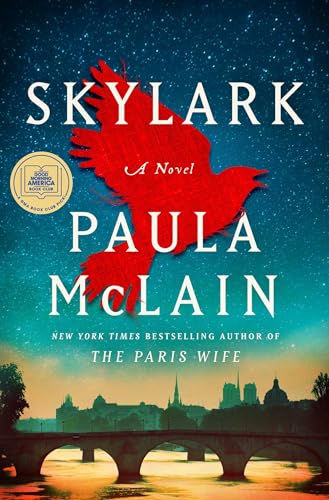
Skylark
In her newest novel, Paula McLain takes us once more to Paris, this time the troubled Paris of the 1660s and the 1940s. In the 17th-century city, artistic innovation is stifled by the guilds, whose corrupt masters control both their industry and the lives of its artisans. For the clandestine female dyer who seeks a wider horizon, a madhouse awaits to starve and bleed any ambitious “hysteric” into submission. In occupied Paris, Jews are being rounded up and deported to camps. When his neighbors are abducted, a Polish psychiatrist helps four teenagers escape through a network of tunnels whose limestone walls were carved out by quarrymen three centuries earlier. There, the children discover imprints that signal the endurance of the human spirit in the face of unthinkable violence and loss. These tiny carvings join one story of daring escape to another, inspiring claims on the future against all odds.
McLain does not force these two stories to align. The guild tyrants are not reborn as Nazis; the asylum is not the Holocaust. Rather, the natural and constructed contours of Paris—rivers, streets, hollows beneath and structures above—become containers for tales of both systemic cruelty and life-sustaining love and resistance.
At first, I missed the simpler structures of The Paris Wife or Love and Ruin, where Hemingway’s slow malevolence breathes tension into the smallest of actions. In Skylark, McLain’s canvas is as busy as Bruegel’s. Her palette bursts with color. But as I adjusted to the pace, I became alternately enthralled by each plot, longing to return to one even as I plunged into the other. And true to form, McLain’s characters come powerfully alive, tugging the reader into the long past of a city that has borne witness to both extraordinary suffering and profound resilience.