Launch: Kate Lord Brown’s The Silver Thread
INTERVIEWED BY CAROLYN NEWTON
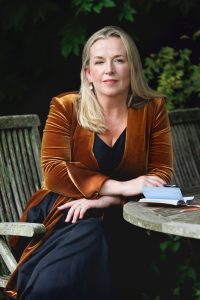
Kate Lord Brown was a finalist in ITV’s The People’s Author contest, and her novel The Perfume Garden, which has been published in nine languages, was shortlisted for the Romantic Novel of the Year. Her books have been top ten bestsellers in the UK, Canada, and several European countries. Kate has also written editorial, reviews and regular columns for Traveller, Conde Nast, Good Housekeeping, the Daily Telegraph, Sunday Express and others. She wrote the first book club column in the Middle East, introducing a host of writers to the region through the pages of Ahlan! After many years living overseas, she has returned to the wild and beautiful south-west of England, where she grew up.
How would you describe this book and its themes?
The Silver Thread is a story of three cities, two women, and one hundred years – an epic tale of enduring love and the moments which tie people together forever.
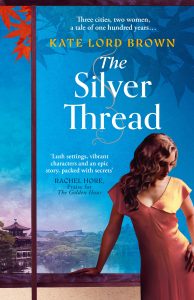 What drew you to Bel’s and Mira’s stories and inspired you to write this book?
This is the most ambitious book I’ve written yet – I wanted to try and conjure a lifetime, and the evolution of a ‘new woman’ at the turn of the twentieth century. We meet teenage Bel on the day Liberty opened in London in 1875 – she is bright, creative, broke, and determined to work there. Liberty was revolutionary – I’ve always been fascinated by the east/west conversation in art and design of this period. I studied art history at the Courtauld Institute, and wrote my thesis on fashion.
I love Liberty – it always feels like the mothership on trips ‘home’ to London (no wonder as it is largely constructed from ships’ timbers!). I also worked at another famous department store while I was a student, in the designer rooms, so there’s a lot of personal experience in there. My ‘day job’ career as an art consultant also inspired Mira’s 1980s strand of the story, where she is brought in to assess an apartment in Paris which belonged to famous designer Isobel Bright. She has to find out what happened to Bel and why has it been closed since the 1920s.
What was something that you learned in your research that surprised you?
The research was glorious – I have a whole bookshelf full! I was lucky enough to spend time going through the Liberty archive in Westminster, and was fascinated to find out that the store opened with only three employees, one of whom was a young Japanese boy. Nothing is known about him, and his name is recorded incorrectly with several variations in different documents. I’m always looking for a key, a plausible way in for a fictional character in a factual setting, and this was it. This boy lost to history became Hiro.
In both The Golden Hour and The Silver Thread, you take your readers on a sumptuous dual timeline journey. What is the allure to you as a writer to craft a tale that moves a reader across decades and continents?
Thank you – I’ve always been fascinated by the ripple effects of history. In novels you tend to meet people at crucial moments in their lives, and with a dual timeline you get to see the aftershocks – the secrets and lies told to cover up the events, or the lasting effects of that moment in time.
What is an element in this story that has a strong personal connection to you or your family?
We’re an expat family, and the three cities – London, Paris, Tokyo – have played big parts in our lives. We lived in London for many years, and I was often in Paris prowling around the auction houses buying and selling art, just like Mira and Ned. I first visited Japan thirty years ago as a student, and my husband lived there so we both love the culture. It’s a fascinating place, and it was wonderful introducing our children to it a couple of years ago.
What insights are you hoping that readers will take away from reading your book?
I hope it will sweep readers away with a story which weaves across time and oceans. It’s a story about love and sacrifice – as I say in the dedication to my family, there’s a Japanese saying: ichi-go, ichi-e which reminds us to treasure every fleeting moment with the people and places we love. It’s a good reminder in a crazy world.
How does warp and weft of fabric serve as a metaphor in the book?
As Hiro says: ‘Silk is alive – it has light in it’. The book is really a celebration of this – everything that is human, natural, creative, beautiful, alive. In some countries in Asia there’s the concept of the ‘red thread’ tying people together. Hiro ‘imagined it more as a silver thread … memories strung like jewels along it, tying us to the people and places we love’. I like the idea of these glittering silver threads crisscrossing the world, warp and weft, as you say.
Evoto
If an author event for you and The Silver Thread featured book-themed appetizers, what dishes would best pair well with your novel?
Perrier-Jouët Belle Époque champagne for dear Bel, and sushi for Mira – Ned introduces her to it as it was still something of a novelty in the 1980s.
What is the best writing advice you have to share?
Write from the heart, but – as someone once advised me – zip up your rhino suit when you need to. Writers have to put it all on the line, to write with emotion, to really feel the story so that your readers will be moved too. But publishing is a tough business, and a lot of it is completely beyond your control. In the course of a long career, reach for your rhino suit, once in a while, to keep your writer’s heart safe.
What is the last great book you read?
The English Patient by Michael Ondaatje

HNS Sponsored Author Interviews are paid for by authors or their publishers. Interviews are commissioned by HNS.