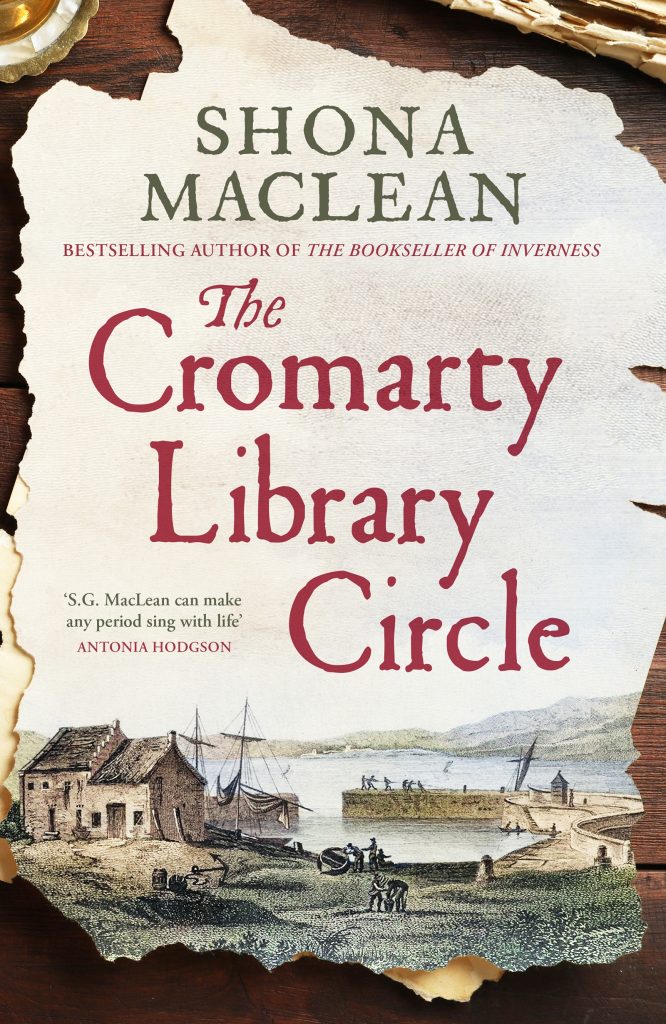
A Lucky Find: Shona MacLean Talks to Lucinda Byatt about Her Standalone Novel, The Cromarty Library Circle
WRITTEN BY LUCINDA BYATT
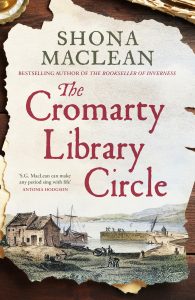 Most historical fiction authors head for the archives after they’ve decided on the topic of a novel. However, in a reverse process, it was a lucky archival find during research for a work of non-fiction that was the spark for Shona MacLean’s latest novel, The Cromarty Library Circle (Quercus, 2026), set in 1831-32.
Cromarty is a small town on the Black Isle, in northeast Scotland. Many can be excused for not having heard of it, unless you’ve come across its most famous native, Hugh Miller (1802-56). Owing to its location, Cromarty was also a bustling port for the American colonies, shipping goods, people and ideas in both directions. So what was this document?
MacLean says, “I found the document in the Highland Archive Centre in Inverness, where I had gone into look at the records of highland burghs (towns) with a view to starting on a non-fiction project. The Cromarty document more or less jumped out at me, because my eye is always drawn to anything about books or libraries. The document listed the 36 relatively prominent citizens of the town – from titled landed proprietors and high-ranking military personnel down to the schoolmaster and women who appear to have been widows or spinster sisters. The books they had chosen for their library were also listed, as was the order in which they were to be passed between people. It was this last that really sparked the idea. That along with the fact that there were women as well as men in the membership just sparked a vision of all sorts of potential social tensions and dramas between people living around one small town that I just could not shake. For the novel, I cut the number of members down to a more manageable twelve, and invented fictional characters to represent the types of people I thought, or found to have been, actual members.”
MacLean’s earlier novels (see HNR 90, 2019) are first and foremost great stories, grounded in research. Leaping forward from the 17th to the 19th century, she continues to write about a combination of historical figures, often slightly reimagined, and purely fictional characters. In this instance, she says that she avoided including Hugh Miller, “that stonemason, voracious reader, poet, geological pioneer, naturalist and journalist who became a national newspaper editor before committing suicide in his 50s”, because “for him to have been more than a peripheral character would have skewed the book away from the fictional ones I wanted to create.”
I asked MacLean about the challenges and drawbacks of basing characters on historical figures. “Other than the restrictive nature of writing lives that are already known, the biggest boundary for me is the idea of misrepresenting someone to the detriment of their reputation, just for the sake of a story.” MacLean told me about some of the serendipitous finds that led her to reimagine historical figures.
“The idea for my town clockmaker, James Craig, who according to my story had gone to France in the early days of the French Revolution, came from a Hugh Miller newspaper item about a native of Cromarty who had refused, out of radical political principle, to toast the health of the king.”
Similarly, “The character of Dr Fraser, minister of Resolis, was the result of another stroke of luck. At an early stage of my research, I discovered there was a memoir, Memorabilia Domestica, written by the minister of Resolis of the time, Donald Sage. I found Sage such a huge, compelling figure who expressed himself very resolutely on his contemporaries, that he came to life very vividly in my mind.”
The redoubtable ‘Miss Juniper’ is based on the real Black Isle schoolmistress, Elizabeth Bond. Her Memoirs of a Village Governess, MacLean writes, “had caused a sensation by peeling back the layers of social convention and revealing the flaws and misbehaviours of her neighbours in Fortrose.”
A similar lucky find was the diary of Anne Fraser. As MacLean writes, “it was a real joy when I went back into the archive to read the diary of a young woman of the period – simply to get insight into the interior and exterior lives of women of that period – and discovered the young woman (Anne Fraser) had spent a significant amount of time in Cromarty and been a pupil and companion of the elderly governess (Elizabeth Bond) on whom I based my character, Miss Juniper.”
The historical background is woven into a plot buzzing with social commentary. David Alston (who is mentioned in the Author’s Note) has highlighted the links between this remote Scottish township and the Caribbean sugar plantations which were “hidden in plain sight” until only recently. Exports of salt herring to the Caribbean were a precious source of revenue, while other industries included weaving hemp into bags used in the West India trade, known as Inverness cotton bagging. Mixed-race children were certainly present in Cromarty and across Scotland, as shown by Hester, one of the book’s most evocative characters. The debate over the compensation paid to slave owners, and the question of who benefits from 1832 Great Reform Act are hot topics within the community. Russia has brutally suppressed a rebellion in Poland, and lastly, a major cholera epidemic is encroaching on Cromarty which not only will affect commerce but also individual lives. Many of these themes echo our own worries and concerns, so I asked MacLean how present-day events impact her writing.
“I often realise when I am writing a novel that the research has shown me repeating patterns in history, which can come out in the book as themes which reflect the time of the book’s setting and our own time, too. This is always a realisation, rather than an intention. I write entirely from the perspective of trying to reflect my characters’ experiences and world view and to do it as entertainingly as possible. I think if I tried to write with some sort of ‘lesson’ for the reader in mind, I would be lost. If seeing the reflecting patterns helps the reader reflect on their own times, that is a bonus, I suppose, but not one I’d ever go looking for.”
The Cromarty Library Circle examines personal relations within a small community built on a rigid social hierarchy with a fragile equilibrium. This intriguing plot, involving an ensemble of characters, is amply researched, yet the scholarship is deftly kept out of sight, foregrounding a portrait of global connections and interdependent lives.
About the contributor: Lucinda Byatt is HNR Features Editor and honorary lecturer at Edinburgh University.
Published in Historical Novels Review | Issue 116 (May 2026)