The Young Will Remember: Eve J. Chung’s Sophomore Novel
WRITTEN BY EDWARD JAMES
 When you look out of the window of an aeroplane, do you wonder about the people living below? Do they pause to wonder about the strangers flitting overhead? These brief glances are all we’ll ever share … unless something goes wrong and our lives collide.
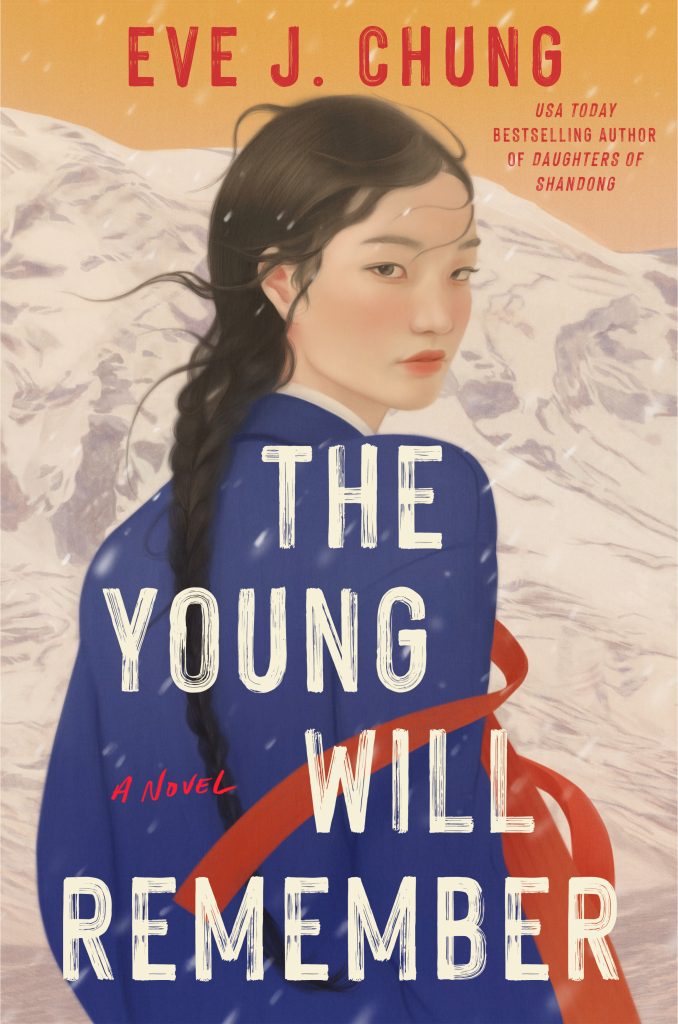
This is how Eve J. Chung’s new novel, The Young Will Remember (Berkley, 2026), begins. An American transport plane is forced down in North Korea in 1950, during the Korean War. Pilot and passengers are shot by a military patrol, but Ellie Chang, a Chinese American war correspondent, is spared by the intervention of a civilian claiming she is her missing daughter. She takes Ellie home to join the Christian pastor and his wife and son with whom she lives. For several months Ellie shares their trials and tragedies until she escapes back to her old life.
This is a novel, a powerful thriller, but based on real events, real people and detailed research. Chung is a human rights lawyer who explores the role of women in war as well as deeper themes about identity and allegiance.
Every war is a compromise. The famous military theorist von Clausewitz, though often accused of advocating ‘total war’, actually said it never happens. Every war is a ‘limited war’, limited by formal conventions and tacit understandings. The major constraint has always been to limit war’s impact on the female population. Female reproductive capacity is limited, male capacity much less so. If human groups are to survive, they should leave warfare to the more expendable males.
What about women who want to go to war? Should we deny equal opportunity? Ellie worries about this. She is attracted to violence, which is why she is a war correspondent, ever-trying to get closer to the fighting, at the same time excusing herself that it is in the cause of peace. ‘The more we know about war the better we could be about preventing it. Though I tried to explain this to my family, my visits often left me worried that something was wrong with me.’
I am divided on this. We should protect women, but we British were happy for them to ‘man’ our anti-aircraft guns during the Blitz, justifying this by classifying AA guns as defensive weapons. Chung is more concerned about violence against women, particularly rape. Much of the book concerns the search for a Korean girl conscripted by the Japanese in WW2 as a ‘comfort woman’ (Korea was under Japanese colonial rule until 1945). Tens of thousands of young women were pressed into service, mostly Koreans but also from elsewhere in Southeast Asia, to provide sexual services to Japanese troops. Many died of disease, mistreatment, and malnutrition, and it was not until the 1990s that the Japanese government acknowledged their existence and made grudging reparation. The campaign for more fulsome atonement continues.
Ironically, comfort women were introduced in 1937 to avert mass civilian rapes such as followed the Japanese invasion of China in the 1930s. Whether they reduced civilian rapes is unknown. As Ellie observes, ‘every woman knows that in every war, on every side, men rape women, cruelly, viciously and with impunity. American soldiers and American leadership were no exception… This was a type of story no domestic paper would print or cared to print.’
Chung’s other main target is the mass bombing of civilian targets. I thought I knew all about this. I spent much of my childhood in air raid shelters, escaped from the burning debris of my grandmother’s house in 1944 and was evacuated to live with less than welcoming strangers. Yet I was lucky. Bombed-out households in London had at least makeshift food, shelter and medical care and we were evacuated by train. Unlike Ellie, I did not stumble along roads lined with the corpses of other refugees.
Chung describes the total destruction of Pyongyang by the USAF, leaving the survivors to fend for themselves in the rubble or trudge over mountains in search of somewhere with a functioning infrastructure. She estimates this added 50% to the death toll, but often the aftermath was more deadly than the bombs. Most victims were women, children and the elderly, active males having been conscripted for the war.
Today’s guided missiles are more discriminating. The missile that nearly did away with me could not reliably hit a target smaller than London. Yet the ‘collateral damage’ we daily see on television is still distressingly familiar.
Chung does not just tell horror stories. The family which shelters Ellie are loyal North Koreans who see Americans as aggressors, but as they struggle to survive, all our sympathies are with them. As each succumbs, Ellie weeps for them and so do we. Most people do not want war, so why kill each other when it is easier to love each other?
Chung explains that the title of her book is ‘a play off the saying “the old will die and the young will forget”’. I researched this saying and found it is generally attributed to David Ben-Gurion, Israel’s first Prime Minister, although the only source is his biographer. It is taken to mean that once the Palestinian refugees displaced by the 1948 war have all died, their children will forget ancestral grievances, and they will fade into history.
By replacing ‘forget’ by ‘remember’ Chung is saying that if we keep alive the memories of past horrors, the next generation will not repeat them. Yet Ben-Gurion’s (alleged) prediction proved false. Palestinians have remembered, and war repeats incessantly. No war has been memorialised more than WW1, in words and in stone, but then there was WW2.
Nevertheless I am cautiously optimistic. We have successfully outlawed poison gas and biological weapons and hopefully anti-personnel mines. More importantly we have held back from nuclear war. I will die in peace (which I once doubted). I hope the same for my great grandchildren.
About the contributor: Edward James was a HNR Reviews Editor for 13 years. He is author of The Frozen Dream and Freedom’s Pilgrim and had a career in social policy and as an adviser on social security.
Published in Historical Novels Review | Issue 116 (May 2026)