Launch: Jon Byrne’s Soldiers of Christ
INTERVIEWED BY ELLEN IRWIN
Jon Byrne, originally from London, now lives with his German family by a lake in Bavaria with stunning views of the Alps. As well as writing, he works as a translator for a local IT company and occasionally as a lumberjack. He has studied the medieval world for over twenty years, building up a comprehensive personal library and a particular interest in the often-overlooked Northern Crusades.
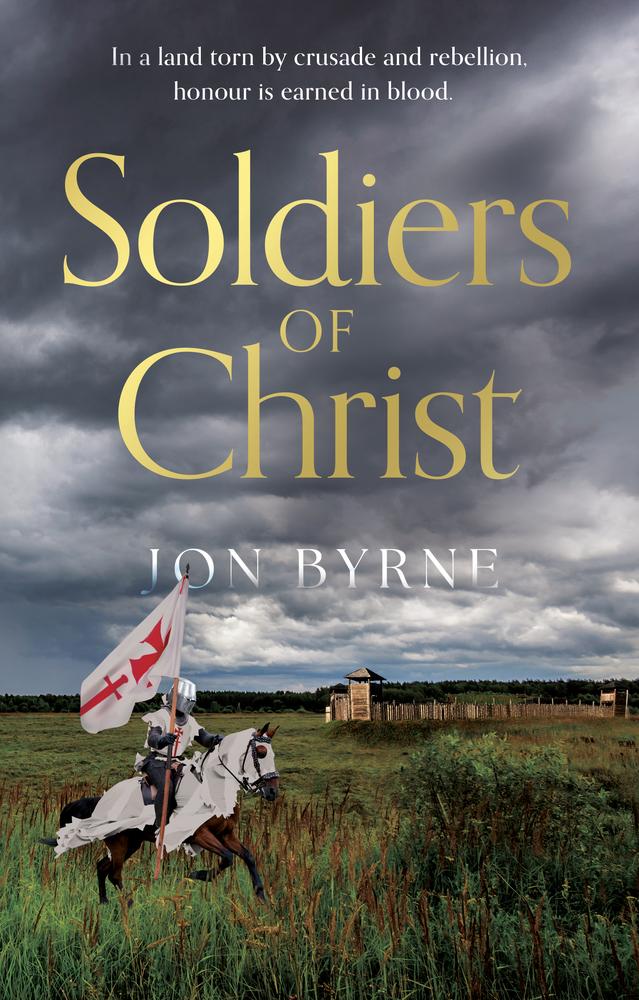
 How would you summarize Soldiers of Christ—the second book in The Northern Crusader Chronicles?
Soldiers of Christ continues the story of Richard Fitz Simon, a knight from England who, after losing his inheritance, joins the Order of Swordbrothers, tasked with bringing the pagans of the eastern Baltic to God. The book’s frame is set in 1242 and shows an older Richard, now a captive of Prince Alexander Nevsky of Novgorod after the Battle on the Ice, looking back on his life, while writing a chronicle for Prince Alexander and his Irish scribe, Fergus.
The main narrative begins in 1205, after young Richard’s first proper battle. After earning fame for killing the Lithuanian champion, Richard briefly gains a measure of honor and recognition in the German Order, but his position remains precarious. His superior, Brother Rudolf, is furious that Richard disobeyed his orders, and certain fellow sergeant-brothers resent him and question his legitimacy. And he finds himself in trouble with Bishop Albert, the head of the mission, for past events that happened in Lübeck in Sword Brethren.
Tensions rise, and when Richard is sent as part of a detachment to help build a new castle on the frontiers of Christendom, things escalate and finally explode into brutal violence and bloodshed.
What inspired you to write a story about the lesser known “Northern Crusades,” told through the eyes of an English knight?
I first became interested in these little-known crusades after reading The Northern Crusades by Eric Christiansen and learning about the Livonian Brothers of the Sword (Schwertbrüderorden). They were a minor German religious Order and were an unsavory bunch, which was the thing that had initially grabbed my interest. Many of the Swordbrothers were not very pious or saintly – they were unorthodox and argued constantly with Bishop Albert, whose mission they were nominally there to support. Over time, there was no crime they were not accused of.
It was this contradiction that I found interesting, and having Richard as an English knight just added to making things more difficult for him.
What internal journeys must Richard navigate as he attempts to reconcile faith, duty, and identity in a brutal world? How do you relate to him? How do you think readers might relate to him?
Richard is a fundamentally good person, if a little headstrong and arrogant. Of noble birth, he has always dreamed of becoming a knight and defending the weak. However, religion basically bores him. And despite being a Christian (almost everyone in his world was), he has severe doubts about his own lack of faith – something that he continually questions in his head. This is compounded by the brutal warfare in the eastern Baltic. Conversion at sword point is something Richard finds hard to reconcile. And, of course, there are further ‘women’ issues that complicate his life only further.
Altogether, I like Richard as a character and can only hope that readers do likewise.
Were there specific people, themes, or conflicts that gripped hold of you in your extensive research of the Baltic region during the medieval period that you felt strongly should be in your novel?
Quite a lot of characters in the book actually lived in history (Bishop Albert, Theodoric, Wenno, Berthold, Wickbert, etc.). Very little is known about these people, and I enjoy trying to bring them to life. Bishop Albert increasingly clashed with the Swordbrothers over tithes and the division of captured pagan lands – and in some ways his ‘baby’ (the Order) grew into a monster he couldn’t control. Both Albert and the Order appealed to the pope several times in their dispute. I found the scheming and politicking between the different factions fascinating.
I imagine that being a German-English translator and having travelled to the settings relevant to your book has influenced your telling of the story. How so?
The Order of Swordbrothers were German; therefore, there is far more information about them in German than in English. This definitely makes speaking German an advantage. And there is nothing like going to the places depicted to help bring them alive. It also makes it easier to get information that cannot be obtained over the internet or on Google Maps. For example, I was unaware of the original wooden hillfort of the Wends at Wenden (Cēsis) on Nut Hill that predated the much more famous stone castle – it lies just beneath the main hill in a park, and there is nothing remaining, with little information about what existed beforehand. Without learning this on site, the story would have been very different. And, of course, travelling on holiday to different countries with my family and a clear goal in mind is always nice.
Do you have plans for a third installment in this series?
I am finishing the third book in the series, but the story will not end there. I can imagine there being several more books in the series – there is a lot more of this little-known history left to explore, and Richard’s story is far from over.
Can you share a bit about your journey towards being a historical fiction author?
I was inspired to start writing when I lived in India approximately twenty-five years ago. I was staying in a hotel room in Jaisalmer that was built into the city fortifications and had (blunt) swords on the wall. The setting was very inspiring. I hadn’t really written anything since school, but once I started, I couldn’t stop, loving every moment as the words flowed, finally retiring to bed at 3am. This became my first fantasy novel, and I finally finished writing and editing one year later. I sent it to a few agents, and apart from some interest, it was never picked up. I then wrote two further fantasy novels, the last being a monster of over 200,000 words, none of which I ever attempted to publish. It was then I decided I would rather write historical fiction set in the medieval age.
 What advice or encouragement would you give to aspiring authors in our genre?
Perseverance. The world of publishing has changed massively in recent years, and there are many more ways to get your work out there than in the past (if that is your wish). There is no stigma about self-publishing books anymore. If you believe in your work enough, it will find an audience. And learn how to market because with millions of books out there, it’s hard to get noticed.
What is the last great book you read?
Bernard Cornwell’s The Burning Land

HNS Sponsored Author Interviews are paid for by authors or their publishers. Interviews are commissioned by HNS.