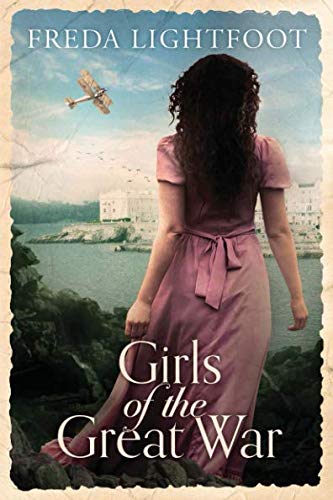
Girls of the Great War
At the end of this book I was reminded of Thelma Ritter’s classic line in All About Eve: “What a story! Everything but the bloodhounds snappin’ at her rear end.” This book has it all. The prologue introduces teen Martha, giving birth to an illegitimate child in 1894. When we next meet her in 1916, she’s Queenie, a singer whose fame is waning due to her love of alcohol. Her eldest daughter, Cecily, is pressed to take her mother’s place on the stage, but Queenie resents the competition. Her younger daughter, Merryn, is more dutiful. When Cecily’s secret fiancé is killed in the war, she’s filled with a desire to help the troops, so she puts together an entertainment troupe consisting of herself, Merryn, smooth-talking Johnny, a drummer, and unfortunately Queenie. The four of them entertain the Tommies with songs and scenes, while Merryn succumbs to Johnny’s dubious charms, Queenie looks for alcohol, and Cecily is pressed into transporting escaped soldiers to safety as a condition of their employment. That sounds like something the British army would ask of a singer, doesn’t it?
Armistice brings more drama, not less, as Merryn and Johnny must wed as she’s pregnant, and surprise, he’s not that great a guy. Queenie grows ever more demanding, and Cecily can only find work as a singer on a cruise ship. There’s an outrageous denouement at the end, which I won’t spoil. Cecily is very fond of exposition, so she explains to her sister and lover why the amazing news they’d just learned accounted for her mother’s behavior throughout the book.
Told from Cecily’s and Merryn’s perspectives, the book reflects the lack of options for women at this time. Given opportunities during wartime, women are relegated to the sidelines when the war is over. Historically accurate, yes, but the details in this particular story make me roll my eyes as much as Thelma Ritter’s Birdie did.