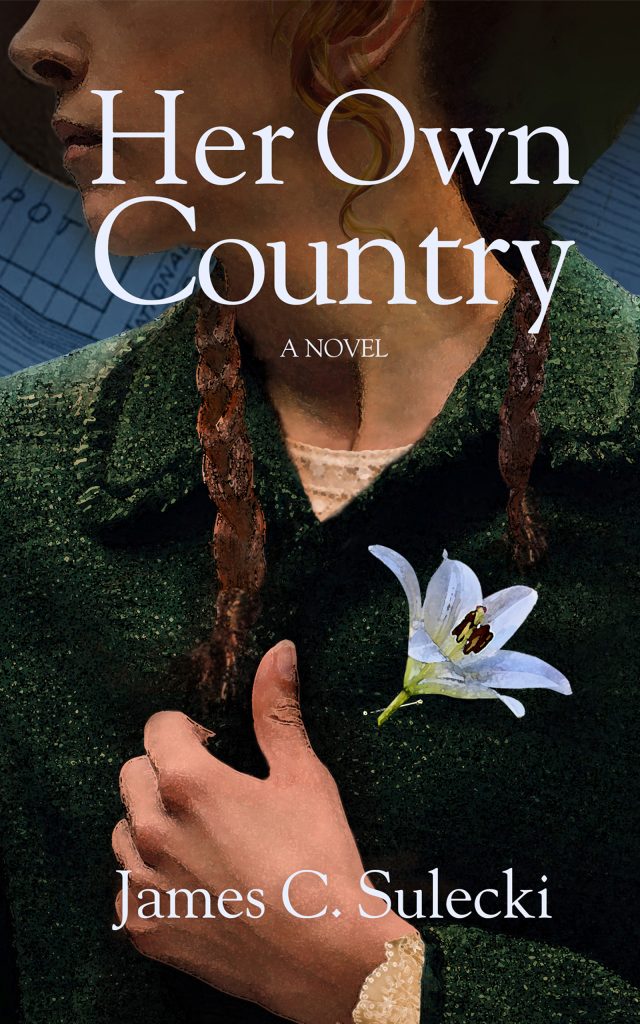
Launch: James C. Sulecki’s Her Own Country
INTERVIEW BY LESLIE S. LOWE
James C. Sulecki(opens in new tab) is a lifelong journalist and former chief content officer of a business media company. An avid researcher of local lore, he is the author of an award-winning nonfiction book on sports history, The Cleveland Rams. His deep connection to the city shapes his fiction; he resides in a Cleveland neighborhood just steps from Irishtown Bend, Ohio City, and Whiskey Island, where his debut novel, Her Own Country, is set.
 How would you describe this book and its themes?
In Her Own Country(opens in new tab), a young Irish immigrant woman finds 1919 America wanting, and after a series of unforeseen events and misfortunes in Cleveland that only deepen her reservations, she does the unthinkable and returns to Ireland. The story has themes of coming-of-age, identity, self-determination, nationalism, the ravages of corruption and runaway capitalism, and the idea of home.
What inspired and attracted you to writing historical fiction?
First and foremost, it’s my enduring love of history both actual and fictional, especially from the first half of the twentieth century, which was so tumultuous and saw change at such a high velocity that it still shapes our modern times. Historical fiction feels like a natural progression from my first book, The Cleveland Rams (McFarland, 2016), a nonfiction history book about the National Football League’s early years of the 1920s, 30s and 40s.
What are you working on now, and is it related to this in any way?
I’m in the early-planning stage for a possible sequel to Her Own Country. This will follow the main character, Moira Conway, to Ireland and the Irish War of Independence. Ireland at the dawn of the 1920s was ripe with juicy, world-turning events that rival those in book one.
Also—big left turn—I have a finished first draft of a novel about a defunct rock band in 1970s Los Angeles that I’m gradually pushing to completion.
What difficulties did you have in writing this one, especially since it was on a more personal level since it relates to your great-grandmother?
No undue difficulty. Her Own Country was a labor of love, and the first draft took me about nine months to write. However, writing from a female protagonist’s point-of-view, which comprises about two-thirds of this book, is obviously challenging for a cisgender male writer like me. I hope I’ve accurately captured Moira’s mind and voice. As you mention, the energy, independence, and defiance of my Irish great-grandmother, whom I was fortunate to know through age thirteen, was a spiritual inspiration.
Is there a key historical event you found in researching that inspired you to write this story to portray a key message relevant now?
Yes. It was discovering that the Thompson machine gun, or Tommy gun, was secretly developed by Warner & Swasey Co.—otherwise an above-board manufacturer of industrial machinery and telescopes in Cleveland—and that it was later used by the Irish Republican Army against the British military in the Irish War of Independence. Automatic weapons obviously are still with us today, as is, unfortunately, prevalent gun violence, especially here in the U.S. It’s understandable that Moira, the story’s protagonist, is distraught over a possibility she may have been complicit in unleashing the machine gun onto general society.
What kind of research did you do for this story? Did you get to do any interesting interviews?
I read a few books and did plenty of online research—especially of Cleveland locations, history, and the city’s Irish immigrant community of that time, and also the early years of the Irish War of Independence and the role of Irish-Americans in support thereof. I live a short bike ride from the Irishtown Bend and Ohio City neighborhoods along the Cuyahoga River where most of the book takes place, so I often go there for inspiration. My wife and I also spent a week in Ireland, with visits to GPO Museum Dublin and EPIC: The Irish Emigration Museum were especially helpful in bringing the 1910s and 20s to life.
How do you feel readers will connect with Moira and John? Who do you connect with more and who was the most difficult to write?
The mishaps, setbacks, and unwelcome surprises that Moira and her older brother John encounter—the everyday human struggles—are universal experiences. Both characters have a lot of energy and hope for the future, but with their ongoing need for survival in a mostly hostile land, they have to keep pushing forward. I think readers can identify with this.
I connect most with Moira—she’s skeptical, discerning, questioning; and much like my great-grandmother, she’s feisty and independent. John, by contrast, is a nascent picture of “greed is good” capitalism, of an uncaring libertarian.
Every author has his own publishing journey. Tell me about yours.
I’ve formed own my publishing imprint, 40 Seasons Press, in direct response to the state of the “big five” publishers today. I think I understand the realities of business about as well as the next person. I spent decades as a business journalist and also for a time as a publishing director, but the authors and stories the “trad publishers” are seeking today seem to come from an ever-tightening circle. For indie authors like me, the speed and reach and cost-efficiencies of self-publishing today are a godsend.
 What advice would you give to other aspiring historical writers?
Write about historical events and topics that resonate today. I’m a firm believer that history repeats. In Her Own Country, Cleveland in 1919 is beset by worker unrest, union busting, predatory capitalism, and fairly widespread ad-hominem damning of “others” as un-American socialists and “commies.” Sounds a little like today.
What is the last great book you read? Why?
It’s got to be the 2016 novel The Sellout by Paul Beatty, the first American to win the Booker Prize. I also just enjoyed his book Slumberland from 2008, but The Sellout is a bit better at distilling Beatty’s unique brand of biting satire and picturesque word choices. Though this may not necessarily show in my own work, I’m a fool for observational satire about American society and the type of high-brow/low-brow writing you see in Beatty’s work and also that of his (and my) inspiration, Kurt Vonnegut.
 HNS Sponsored Author Interviews are paid for by authors or their publishers. Interviews are commissioned by HNS.