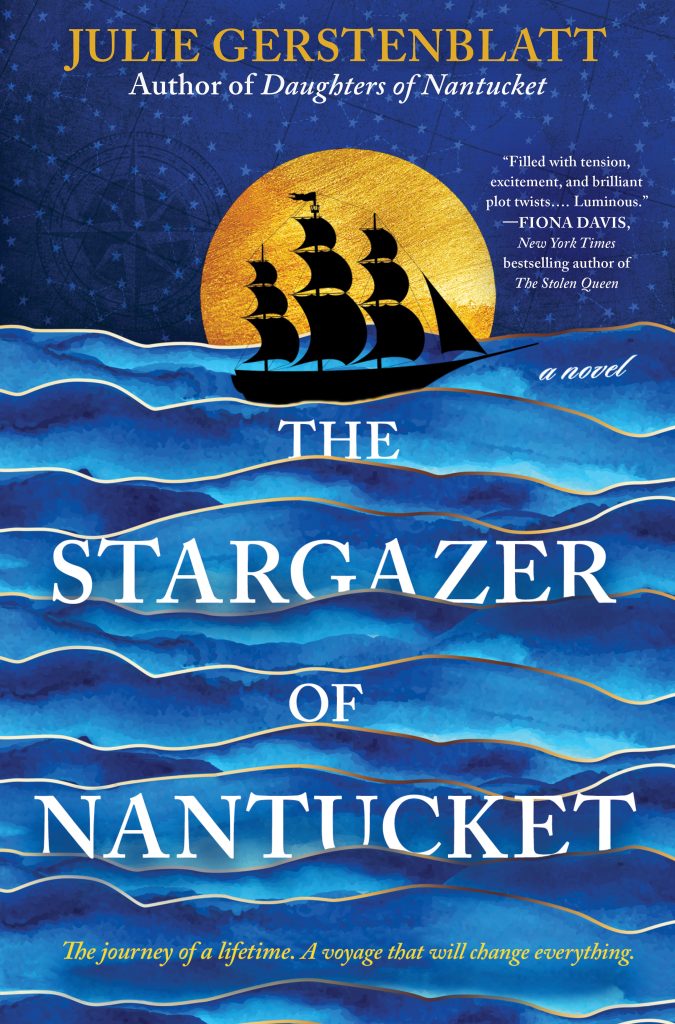
Global Reach, Sensory Detail: The Stargazer of Nantucket
WRITTEN BY JANICE DERR
 Reimagining the overlooked stories of Nantucket’s maritime history
Julie Gerstenblatt obviously has a deep love for Nantucket. Her website includes a video tour of historic sites that feature in her novels, family photos taken on the beach and at local shops and restaurants, and even a recipe for a Nantucket Seabreeze, a cocktail that she says “perfectly pairs” with her novel, Daughters of Nantucket.
Given the prominent role of place in her novels, I asked Julie what draws her to the seaside city, especially in the mid-19th century. She explained that visiting Nantucket today feels like stepping into the past. “The downtown has been preserved, retaining much of its original charm from the 19th century, with its cobblestoned Main Street and brick sidewalks and dirt and shell paths off the wharves. Because of this old-world charm, Nantucket practically implores visitors, especially ones like me with vivid imaginations, to travel back in time.” As for the time period, “Nantucket in the 18th and 19th centuries was the whaling capital of the world, bringing much wealth to the island’s inhabitants, and just as much loss. Moby-Dick may have put Nantucket on the map, but there are many other stories of heroism and tragedy emanating from this magnificent island that have been overlooked in fiction, particularly surrounding women’s lives. I aim to highlight stories of courage, struggle, and adventure from the past, so that maybe, the next time readers step off the ferry, they can see Nantucket through a new (old?) lens.”
Julie’s first novel, Daughters of Nantucket (MIRA, 2023), centers on three independent, entrepreneurial women living in a whaling community while many of the island’s men are away on ships for long periods. Her second novel, The Stargazer of Nantucket (Park Row, 2026), is set aboard a merchant ship sailing from Nantucket to China in 1851. While the story moves from land to sea, the characters retain the characteristics and spirit so specific to the island’s residents. I asked Julie why she chose to set her latest book on a ship. She responded, “I visited many historic homes and museums, and, in every single one, items imported from China were on display. I wondered about the global shopping sprees that led to every stately home in New England proudly displaying a blue porcelain urn by the fireplace and a silk rug underfoot. Who traveled on those merchant ships and made the decisions about what to purchase, and what was their life like?”
Julie sees her two novels as “bookends that together create a full Nantucket historical fiction experience.” She goes on, “Daughters takes place within one square mile of town. The setting is supposed to feel tightly contained, leading to the spread of gossip and, later, fire. The Stargazer is the complete inverse, highlighting the global reach of intrepid Nantucketers and representative of America at large in the 19th century.”
Stargazer is a standalone, but fans of Julie’s first novel will recognize some returning characters. She did this as a special nod to her readers. “I left a few strands open at the end of Daughters, and book clubs love to ask me about one plot point in particular regarding Eliza Macy. Since Stargazer is set five years after The Great Fire, I thought it would be fun to play with that. I was able to do a sort of wink-and-nod to readers, providing a possible explanation for what happened after the end of the novel. If you know, you know. And if you don’t, it doesn’t alter your reading experience of Stargazer at all.”
She continues, “Without any spoilers, I will say that there is another character from my first novel who reappears in a much bigger way in Stargazer… I loved taking a young character I invented in one book and letting them mature, creating a whole new storyline for them in another novel. It was tremendous fun to link Daughters and Stargazer in this way.”
Most of the characters in Julie’s books are adults, but I couldn’t help but wonder if her ability to create such believable child characters comes from the career she held before becoming a novelist, as a middle school English teacher. She responds, “I like to include as many diverse voices as I can in my fiction, including not only characters from different classes and ethnicities, but age groups as well. There’s something very truthful about a child’s vision of the world, before they are corrupted by adulthood and toughened up by life… Both Joseph Allen in Daughters and Chin in Stargazer hold up mirrors to the adults around them, acting like a foil – and providing levity in very intense, life-and-death moments.”
Along with strong characterization, Stargazer stands out for its vivid detail. The book’s descriptions of the ship’s layout, the weather, the food, and the smells (good and bad) help the reader feel like they are really there. When I asked about her research and how she was able to capture such strong sensory imagery, she said she read “at least twenty books,” including Sea Wife by Amity Gaige, The Wide, Wide Sea by Hampton Sides, The Wager by David Grann, and books about the Flying Cloud, the famous Donald McKay clipper that inspired her fictional ship in Stargazer. She also credits meditation for helping with her writing process. “I practice meditation and yoga, and writing to me is a form of meditation. I take what I’ve learned, and then I let the real world disappear around me, imagining myself there, on deck of a ship in 1851, in slow motion. What do I hear? What do I see? How does it smell?”
In her next book, Julie plans on returning to Nantucket, though in a different era. Scheduled for release in the spring of 2028, her upcoming work is what she calls “recently historical,” taking place in 1989 and 2024. “The story revolves around best friends from college, one who betrays the other, and the boy who gets between them. I lived on Nantucket in the summer of 1989 and have always wanted to write about that time – and I think readers are going to enjoy seeing a more contemporary version of my favorite island setting.”
About the contributor: Janice Derr is a librarian and has been a reviewer for Historical Novels Review since 2012.
Published in Historical Novels Review | Issue 117 (August 2026)