Fishbones, Fairy Tales and Family Secrets: Fishbone Cinderella by Elizabeth Lim
 BY HELEN PIPER
There are fairy godmothers, glass slippers and handsome princes—and then there are magical fishbones.
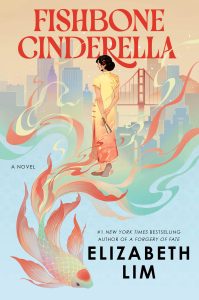
Elizabeth Lim’s Fishbone Cinderella (Del Rey, 2026), her first adult historical novel, takes its inspiration from Ye Xian, the ancient Chinese version of Cinderella. But anyone expecting the familiar rags-to-riches fairy tale is in for a surprise. Lim’s Cinderella inhabits a world of war, hunger, arranged marriages, immigration and family secrets. Happily ever after is by no means guaranteed.
That was part of the attraction for Lim.
“Unlike the Disney-influenced Western version of Cinderella, the Chinese version Ye Xian doesn’t necessarily have a happily ever after,” she says. There are several versions of the tale, and some are decidedly unsentimental. In one, Cinderella’s husband sells her golden slippers to finance his army; in another, she becomes one concubine among his many wives.
Lim was fascinated by these darker endings and “the sense of realism that they offered.”
That collision between fairy tale and reality runs throughout Fishbone Cinderella. Lim’s women may possess magical gifts, but those gifts cannot protect them from the forces of history. And behind the magic is a story about mothers and daughters: what mothers endure, what they choose not to tell and what their daughters inherit anyway.
The novel begins in Guangdong in 1940. Yut Ying is a young girl when she narrowly escapes Japanese soldiers after discovering an extraordinary ability: she can make herself invisible. Her mother has a gift of her own—dreams that foretell the future—and gives her daughter a gold bracelet with links shaped like fishbones, warning her of a curse hanging over the women in their family.
Due to the strife on the Chinese mainland, Yut Ying is sent to Hong Kong to live with her father and his second wife. Eventually, her life takes her across the Pacific to the United States. The story moves between Yut Ying—later Helen—and her daughter Marigold, growing up in the very different world of the 1960s San Francisco Bay Area.
For Lim, the novel is also personal. Fishbone Cinderella is loosely inspired by her grandmother’s life, and it is a story she had wanted to write for years.
“It’s been my golden rule as an author to write what I want to read,” she says, “and it so happens that historical fiction and fantasy have always been my favorite genres.”
Writing the novel meant immersing herself in China in the 1930s, wartime Hong Kong and the Bay Area of the 1960s, while also drawing on anecdotes from her family history. The research produced some unexpected discoveries.

author photo by Adrian Ow
For instance, in wartime Hong Kong, soy milk saved many lives. Lim discovered the story of Dr. K. S. Lo, founder of Vitasoy, whose soy milk provided an inexpensive and nutritious source of food during the Japanese occupation. The family of Tommy Yeung, the boy Yut Ying meets in the novel, is loosely inspired by Vitasoy’s founders.
Another surprising discovery was the fate of Yoshiko Yamaguchi, a Japanese singer who passed as Chinese. Yamaguchi was so convincing that she was almost executed for treason and collaboration with the Japanese after the war. It was only when her Japanese identity became known that she escaped this fate. Her story fascinated Lim and helped inspire the inclusion of collaborators in the novel.
These historical details give Fishbone Cinderella its texture, although history never remains safely in the past. The Sino-Japanese War follows Yut Ying/Helen and her husband long after the fighting has ended. Its consequences cross the Pacific and infiltrate family dynamics through secrets and arguments between parents and daughters.
One of the most striking moments comes when Helen tells her wilful teenage daughter Marigold, “You are Chinese, not American.”
It initially appears to encapsulate the conflict between an immigrant mother and an American-born child, but Lim sees something more complicated at work.
“The core conflict between Marigold and Yut Ying/Helen is a consequence of Helen’s unwillingness to share the tragedies from her past, and how they’ve shaped her into the woman she’s become,” she explains.
Yut Ying/Helen has buried much of that past while trying to construct a future in a new country. But silence does not necessarily prevent the next generation from inheriting its consequences. Marigold is left trying to understand a mother whose fears, rules and expectations have origins she knows nothing about.
There is a wonderful irony here. Marigold’s magical gift is that she can see the past.
Her mother can make herself invisible.
Lim describes the gulf that can exist between immigrants and their children as “a sea of misunderstanding.” She was interested in mothers living “interesting” lives so that their children might have the privilege of experiencing peace.
“I always intended Fishbone Cinderella to be a story about mothers and daughters,” she says, “about the disappointments and secrets and burdens that mothers carry.”
For me, this is at the heart of the novel. A mother wants to spare her daughter the suffering she endured and so does not speak of it. Yet by withholding the story, she can also deprive her daughter of the means to understand her.
The complicated inheritance between women extends beyond Yut Ying/Helen and Marigold. Yut Ying/Helen’s stepmother, Sai Ma, occupies the position traditionally reserved for Cinderella’s wicked stepmother. Lim, however, gives us something less comfortable than a straightforward villain. Sai Ma’s disappointments in life, Lim says, become “a sharp bitterness” that shapes the way she treats both her daughter and stepdaughter.
The fairy-tale character is still there, but so is the woman underneath.
Yut Ying/Helen grows up at a time when many marriages are arranged and relatively few women have the privilege of marrying for love. Her daughter Marigold comes of age in 1960s San Francisco and Berkeley, surrounded by radically different ideas about love, freedom and individual choice.
Marigold may inherit the past, but she does not necessarily have to repeat it.
Which brings us back to Cinderella.
In Ye Xian, Cinderella’s magical helper is not a fairy godmother but a fish. When the stepmother kills and eats it, the fishbones retain their magic. Lim rearranges elements of the folktale for her historical setting, transforming the fishbones into the bracelet that connects Yut Ying and Marigold and runs through the mystery at the centre of the novel.
The title, Lim says, is meant to feel “like a puzzle whose last piece comes together at the very end.”
Fishbones also seem a fitting image for what remains between generations: fragments of stories, half-understood memories, family expectations whose origins may have been forgotten. Someone has to piece them together.
Lim had something her characters do not always have—the stories themselves. Having listened to her grandmother throughout her life, she says she came to the novel with “a good sense of what it was like for an actual person to be living through the times and events depicted in the book.” She supplemented those stories with research and conversations with family friends, but tried to let the private lives of her characters remain at the centre of the history.
And that may explain why, for all its magic, Fishbone Cinderella feels grounded in something very recognizable.
Women disappear. Dreams foretell the future. A daughter sees into the past. Yet perhaps the most difficult task in the novel requires no supernatural powers at all: seeing your mother as someone who had an entire life before she became your mother.
The daughter must discover the history that shaped her mother. The mother has to accept that her daughter does not have to relive it.
Somewhere between Guangdong, wartime Hong Kong and 1960s California, Cinderella changes too. The prince is no longer the whole answer, and escape does not necessarily mean happily ever after.
Sometimes the magic is simply in finally telling the story.
Although Fishbone Cinderella may leave you with one rather less profound legacy as well: an unexpected craving for soy milk, ngau lam and egg tarts.
About the contributor: Helen Piper is an actress and a poet. She is currently working on her first novel. Previously she worked as a lawyer.