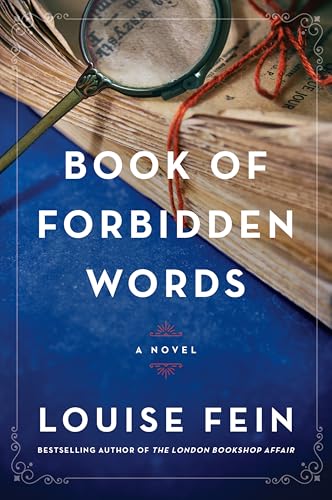
Book of Forbidden Words
The titular forbidden words conjure censorship, book-banning, and women suppressed by the patriarchy’s stranglehold. Fein’s three courageous women challenge this inequity in an impressive, insightful novel. In 1952 New York, highly educated housewife, Milly, dreams of ancient texts, while the Red Scare political narrative bans novelists Joyce and Steinbeck and demonises the “other”. Milly appears to prize her ordinary family life but, as a once-lauded Bletchley cryptanalyst, feels deeply unfulfilled. Twice-widowed Charlotte owns a printing empire in 1552 Paris, amidst severe punishment for heresy. She is always within the Inquisitor Fidei’s peripheral vision, but her stellar reputation keeps him at bay, for now. In 1524, Thomas More adopts a young ward, Lysbette, as Henry VIII’s Great Matter dominates the religious stage. She’s coerced into a nunnery where, safe from men’s treachery, she’s free to write her own narrative, as the Tudors continue to rock the nation. Lysbette’s many tragedies strengthen her resolve to seek out Charlotte in 1552.
Fein’s engaging commentary gives us pause to consider how the female has been reduced and shamed over generations, and how the power resides within all of us, both men and women, to create a fairer world when we are ready to embrace one. The author has created relatable, likeable fictional characters, giving a valid appreciation of the Tudor, Renaissance, and Cold War eras. She draws attention to the various problems which hold women back from century to century, whilst sharing the many similarities. One story often overshadows the other when we skip from era to era, but here every episode of the three strands fascinates, and the transition between the timeframes is barely noticeable. History’s relentless, often malfunctioning repetition through the centuries is wisely considered, but there’s no missing the poignant commentary on contemporary life. A hopeful, thought-provoking gem which speaks to a better future for us all.