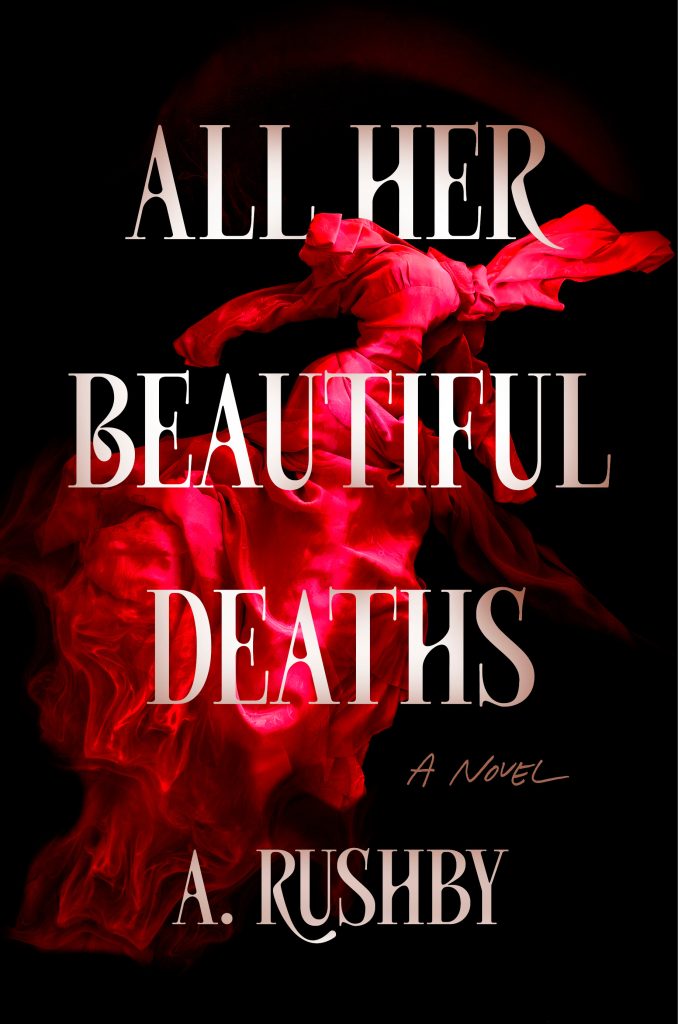
Peak Decaying Grandeur: A. Rushby’s All Her Beautiful Deaths
 BY BETHANY LATHAM
A. Rushby had always been interested in the various accoutrements of Victorian mourning, “the elaborate glass carriages and black Belgian horses with plumes atop their heads … the jet and hairwork jewelry and, of course, the memorial photography.” But it was a particular work that started her on the journey which would eventually become her second novel, All Her Beautiful Deaths (Berkley US / Verve UK, September 2026). “It wasn’t until I read a book on the photography of Julia Margaret Cameron, a photographer whose portraiture was original and emotive and often blurred, that I came up with a character who had a mission – she wanted to capture emotion in death portraiture,” Rushby says.
Rushby’s dual-timeline novel explores this idea by alternating between the present and the Victorian period to delve into the world of death, emotion, and art. In the current day, young artist Hadley Allard has endured a string of tragedies. Her mother is lost to dementia, and her closest friend has also just died, leaving her an album of Victorian memorial photographs, young women captured in unique ways after death. One of the most powerful images – a dead girl cradling a dead swan – is missing, stolen by Hadley’s ex-boyfriend to use as fodder for his latest tasteless art installation.
As Hadley seeks to find out more about the mysterious Victorian photographer who so intrigues her, she learns that the handsome and fabulously wealthy scion of the Culpepper family is desperate to acquire the album. As manager of the Culpepper Trust, he can open all doors in the London art world for Hadley, but at what cost to her, and with what motive?
Meanwhile, in 1865, Minnie Price takes a position as a maid in the strange household of the Culpeppers. Culpepper House abuts Highgate Cemetery, and the family has been recently decimated: father, mother, and one child all lost to scarlet fever, leaving only Edmund Culpepper and his sister, Edith. Edith, mostly deaf and mute from her brush with the fever, is eccentric, choosing photography over frippery, and when Minnie is tasked with serving as her companion, despite misgivings, she becomes embroiled in the family’s affairs. Young women come to Culpepper House, and it’s never long before Edith is photographing their corpses.
Rushby has called Highgate Cemetery “the most glorious space there ever was,” and she elaborates on the appeal it holds for her as a setting: “I’ve always been fascinated by Victorian cemeteries ever since I was a small child, and I now live a few minutes’ walk from one in Australia (this is no accident!). This interest definitely stemmed from my mother (also an historical author) being involved in this cemetery’s historical society. People often think Victorian cemeteries are spooky, or macabre, which I don’t agree with at all. They’re such wonderful spaces – usually constructed on the outskirts of a city at the time, as the years tick on they become enveloped as the city grows and then turn into oases of calm. They’re usually very peaceful, green spaces within a bustling metropolis. Highgate is particularly special, however, because it boasts such incredible architecture, like the Egyptian Avenue and the Circle of Lebanon. To see such features dripping with ivy and foxes running about and so on – it’s peak decaying grandeur. But not only is it gothic and wonderful, these features are then juxtaposed with some equally stunning modern architecture – new glass and steel houses jutting out into the cemetery itself. I love everything about the place.”
When questioned about the art world and the substantial role it plays in the novel’s plotting, Rushby explains, “As an author of historical fiction, I can get quite caught up in recreating a different time and place and populating it with people who become very real to me. I often leave a book feeling a little bit sad that I can’t enter that fictional world – that I must leave my characters behind to reside in a time and place that I cannot. The closest I’ve ever come to entering such a world is when I’ve visited immersive museum installations, such as the incredible Dennis Severs’ House in Spitalfields in London. Or the sadly no longer Vauxhall Pleasure Gardens exhibit at the old site of the Museum of London. I think it’s also why I’m drawn to large scale installation art, which might not have anything to do with history, but is also a way of entering another sort of reality. Chiharu Shiota had some beautiful elements of historical dress in “The Soul Trembles”, which is definitely what drew me to her work, and I stumbled across Oliver Beer’s “Oma’s Kitchen Floor” quite by accident and thought it was incredibly moving.”

author photo by Bloom Branding Photography
As with her earlier novel, Slashed Beauties (Berkley US, 2025 / Verve UK, April 2026), Rushby alternates her historical storyline with a contemporary one. When asked which timeline she prefers to write, she notes that it’s a difficult question. “Writing the historical storyline is laborious and painful and teeth-gnashingly time consuming because you’re slowed down all the time digging up historical detail, but it also means you get to spend lots of glorious time chasing down those details and falling down rabbit holes, which is the best part about being an historical author,” she says. “The modern storyline all feels a lot more familiar and the writing tends to come together much faster, but it’s difficult in that I believe it’s harder to hold the attention of the reader (who is usually more invested in the historical storyline as they’re generally interested in historical fiction overall).”
To dig up that historical detail, Rushby used sources such as Rites of Passage – Death and Mourning in Victorian Britain by Judith Flanders, which she says was “particularly useful for an overview.” Rushby notes, “Jannie Uhre Kongsgaard’s Photographing Death: Representations of Death in Memorial and Art Photography in Victorian Britain felt as if it was written just for me as it combined the two things I most wanted to write about (memorial and art photography), and I was very lucky to be able to connect with Jannie herself.”
Memorial photography is a particularly emotive form of art, since during the Victorian period it was often one of the few images the living would have of loved ones lost. In a world where people regularly take thousands of pictures of everything from the food on their plates to their own faces ad nauseum, a single image being all that remains of a person lived with and loved is a foreign concept. In elaborating on why she wished to write about memorial photography and all that comes with it, Rushby says, “I think photography from the period where people are unsmiling and stiff-looking often gives us a false impression of the Victorians – that they were a staid or unfeeling bunch, simply because of the long exposure times required. But of course they weren’t. They were just like us and felt grief in a similar way too, though, sadly, they most likely experienced much more of it.”
About the contributor: Bethany Latham is a professor, librarian, and Managing Editor of Historical Novels Review.