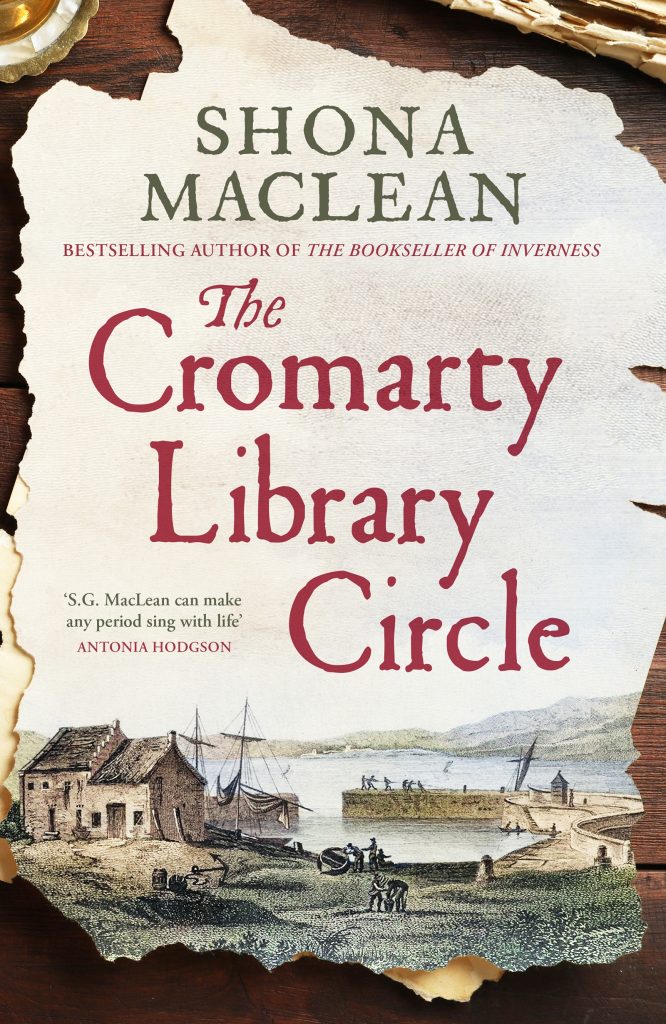
Most historical fiction authors head for the archives after they’ve decided on the topic of a novel. However, in a reverse process, it was a lucky archival find during research for a work of non-fiction that was the spark for Shona MacLean’s latest novel, The Cromarty Library Circle (Quercus, 2026), set in 1831-32.
Cromarty is a small town on the Black Isle, in northeast Scotland. Many can be excused for not having heard of it, unless you’ve come across its most famous native, Hugh Miller (1802-56). Owing to its location, Cromarty was also a bustling port for the American colonies, shipping goods, people and ideas in both directions. So what was this document?
MacLean says, “I found the document in the Highland Archive Centre in Inverness, where I had gone into look at the records of highland burghs (towns) with a view to starting on a non-fiction project. The Cromarty document more or less jumped out at me, because my eye is always drawn to anything about books or libraries. The document listed the 36 relatively prominent citizens of the town – from titled landed proprietors and high-ranking military personnel down to the schoolmaster and women who appear to have been widows or spinster sisters. The books they had chosen for their library were also listed, as was the order in which they were to be passed between people. It was this last that really sparked the idea. That along with the fact that there were women as well as men in the membership just sparked a vision of all sorts of potential social tensions and dramas between people living around one small town that I just could not shake. For the novel, I cut the number of members down to a more manageable twelve, and invented fictional characters to represent the types of people I thought, or found to have been, actual members.”
MacLean’s earlier novels (see HNR 90, 2019) are first and foremost great stories, grounded in research. Leaping forward from the 17th to the 19th century, she continues to write about a combination of historical figures, often slightly reimagined, and purely fictional characters. In this instance, she says that she avoided including Hugh Miller, “that stonemason, voracious reader, poet, geological pioneer, naturalist and journalist who became a national newspaper editor before committing suicide in his 50s”, because “for him to have been more than a peripheral character would have skewed the book away from the fictional ones I wanted to create.”
I asked MacLean about the challenges and drawbacks of basing characters on historical figures. “Other than the restrictive nature of writing lives that are already known, the biggest boundary for me is the idea of misrepresenting someone to the detriment of their reputation, just for the sake of a story.” MacLean told me about some of the serendipitous finds that led her to reimagine historical figures.
“The idea for my town clockmaker, James Craig, who according to my story had gone to France in the early days of the French Revolution, came from a Hugh Miller newspaper item about a native of Cromarty who had refused, out of radical political principle, to toast the health of the king.”
Similarly, “The character of Dr Fraser, minister of Resolis, was the result of another stroke of luck. At an early stage of my research, I discovered there was a memoir, Memorabilia Domestica, written by the minister of Resolis of the time, Donald Sage. I found Sage such a huge, compelling figure who expressed himself very resolutely on his contemporaries, that he came to life very vividly in my mind.”
The redoubtable ‘Miss Juniper’ is based on the real Black Isle schoolmistress, Elizabeth Bond. Her Memoirs of a Village Governess, MacLean writes, “had caused a sensation by peeling back the layers of social convention and revealing the flaws and misbehaviours of her neighbours in Fortrose.”
A similar lucky find was the diary of Anne Fraser. As MacLean writes, “it was a real joy when I went back into the archive to read the diary of a young woman of the period – simply to get insight into the interior and exterior lives of women of that period – and discovered the young woman (Anne Fraser) had spent a significant amount of time in Cromarty and been a pupil and companion of the elderly governess (Elizabeth Bond) on whom I based my character, Miss Juniper.”
The historical background is woven into a plot buzzing with social commentary. David Alston (who is mentioned in the Author’s Note) has highlighted the links between this remote Scottish township and the Caribbean sugar plantations which were “hidden in plain sight” until only recently. Exports of salt herring to the Caribbean were a precious source of revenue, while other industries included weaving hemp into bags used in the West India trade, known as Inverness cotton bagging. Mixed-race children were certainly present in Cromarty and across Scotland, as shown by Hester, one of the book’s most evocative characters. The debate over the compensation paid to slave owners, and the question of who benefits from 1832 Great Reform Act are hot topics within the community. Russia has brutally suppressed a rebellion in Poland, and lastly, a major cholera epidemic is encroaching on Cromarty which not only will affect commerce but also individual lives. Many of these themes echo our own worries and concerns, so I asked MacLean how present-day events impact her writing.
“I often realise when I am writing a novel that the research has shown me repeating patterns in history, which can come out in the book as themes which reflect the time of the book’s setting and our own time, too. This is always a realisation, rather than an intention. I write entirely from the perspective of trying to reflect my characters’ experiences and world view and to do it as entertainingly as possible. I think if I tried to write with some sort of ‘lesson’ for the reader in mind, I would be lost. If seeing the reflecting patterns helps the reader reflect on their own times, that is a bonus, I suppose, but not one I’d ever go looking for.”
The Cromarty Library Circle examines personal relations within a small community built on a rigid social hierarchy with a fragile equilibrium. This intriguing plot, involving an ensemble of characters, is amply researched, yet the scholarship is deftly kept out of sight, foregrounding a portrait of global connections and interdependent lives.
About the contributor: Lucinda Byatt is HNR Features Editor and honorary lecturer at Edinburgh University.
Published in Historical Novels Review | Issue 116 (May 2026)
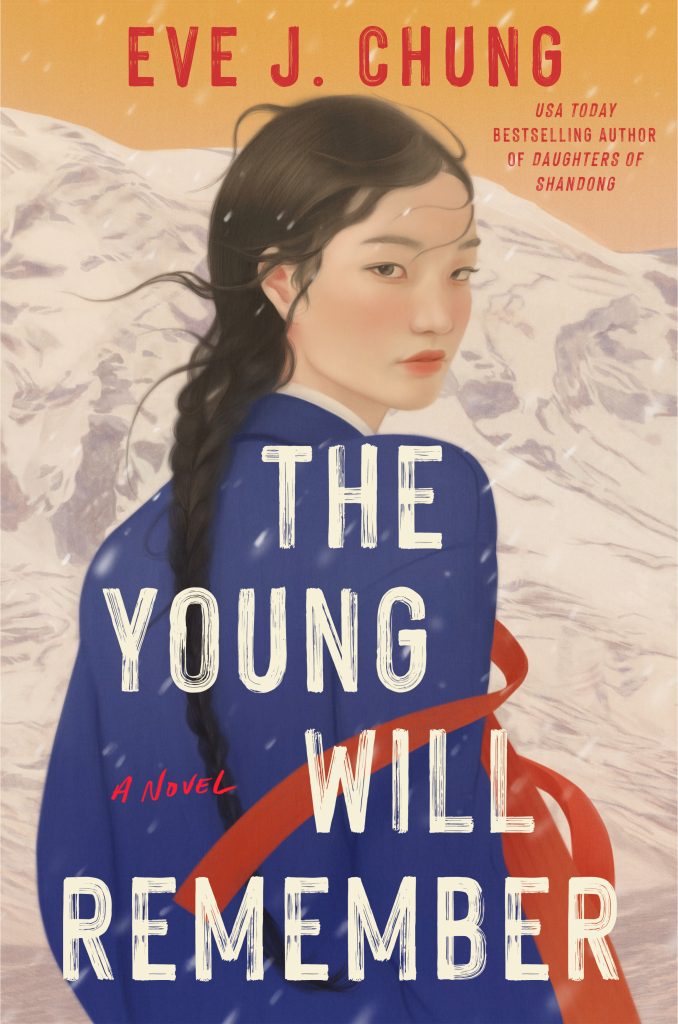
When you look out of the window of an aeroplane, do you wonder about the people living below? Do they pause to wonder about the strangers flitting overhead? These brief glances are all we’ll ever share … unless something goes wrong and our lives collide.
This is how Eve J. Chung’s new novel, The Young Will Remember (Berkley, 2026), begins. An American transport plane is forced down in North Korea in 1950, during the Korean War. Pilot and passengers are shot by a military patrol, but Ellie Chang, a Chinese American war correspondent, is spared by the intervention of a civilian claiming she is her missing daughter. She takes Ellie home to join the Christian pastor and his wife and son with whom she lives. For several months Ellie shares their trials and tragedies until she escapes back to her old life.
This is a novel, a powerful thriller, but based on real events, real people and detailed research. Chung is a human rights lawyer who explores the role of women in war as well as deeper themes about identity and allegiance.
Every war is a compromise. The famous military theorist von Clausewitz, though often accused of advocating ‘total war’, actually said it never happens. Every war is a ‘limited war’, limited by formal conventions and tacit understandings. The major constraint has always been to limit war’s impact on the female population. Female reproductive capacity is limited, male capacity much less so. If human groups are to survive, they should leave warfare to the more expendable males.
What about women who want to go to war? Should we deny equal opportunity? Ellie worries about this. She is attracted to violence, which is why she is a war correspondent, ever-trying to get closer to the fighting, at the same time excusing herself that it is in the cause of peace. ‘The more we know about war the better we could be about preventing it. Though I tried to explain this to my family, my visits often left me worried that something was wrong with me.’
I am divided on this. We should protect women, but we British were happy for them to ‘man’ our anti-aircraft guns during the Blitz, justifying this by classifying AA guns as defensive weapons. Chung is more concerned about violence against women, particularly rape. Much of the book concerns the search for a Korean girl conscripted by the Japanese in WW2 as a ‘comfort woman’ (Korea was under Japanese colonial rule until 1945). Tens of thousands of young women were pressed into service, mostly Koreans but also from elsewhere in Southeast Asia, to provide sexual services to Japanese troops. Many died of disease, mistreatment, and malnutrition, and it was not until the 1990s that the Japanese government acknowledged their existence and made grudging reparation. The campaign for more fulsome atonement continues.
Ironically, comfort women were introduced in 1937 to avert mass civilian rapes such as followed the Japanese invasion of China in the 1930s. Whether they reduced civilian rapes is unknown. As Ellie observes, ‘every woman knows that in every war, on every side, men rape women, cruelly, viciously and with impunity. American soldiers and American leadership were no exception… This was a type of story no domestic paper would print or cared to print.’
Chung’s other main target is the mass bombing of civilian targets. I thought I knew all about this. I spent much of my childhood in air raid shelters, escaped from the burning debris of my grandmother’s house in 1944 and was evacuated to live with less than welcoming strangers. Yet I was lucky. Bombed-out households in London had at least makeshift food, shelter and medical care and we were evacuated by train. Unlike Ellie, I did not stumble along roads lined with the corpses of other refugees.
Chung describes the total destruction of Pyongyang by the USAF, leaving the survivors to fend for themselves in the rubble or trudge over mountains in search of somewhere with a functioning infrastructure. She estimates this added 50% to the death toll, but often the aftermath was more deadly than the bombs. Most victims were women, children and the elderly, active males having been conscripted for the war.
Today’s guided missiles are more discriminating. The missile that nearly did away with me could not reliably hit a target smaller than London. Yet the ‘collateral damage’ we daily see on television is still distressingly familiar.
Chung does not just tell horror stories. The family which shelters Ellie are loyal North Koreans who see Americans as aggressors, but as they struggle to survive, all our sympathies are with them. As each succumbs, Ellie weeps for them and so do we. Most people do not want war, so why kill each other when it is easier to love each other?
Chung explains that the title of her book is ‘a play off the saying “the old will die and the young will forget”’. I researched this saying and found it is generally attributed to David Ben-Gurion, Israel’s first Prime Minister, although the only source is his biographer. It is taken to mean that once the Palestinian refugees displaced by the 1948 war have all died, their children will forget ancestral grievances, and they will fade into history.
By replacing ‘forget’ by ‘remember’ Chung is saying that if we keep alive the memories of past horrors, the next generation will not repeat them. Yet Ben-Gurion’s (alleged) prediction proved false. Palestinians have remembered, and war repeats incessantly. No war has been memorialised more than WW1, in words and in stone, but then there was WW2.
Nevertheless I am cautiously optimistic. We have successfully outlawed poison gas and biological weapons and hopefully anti-personnel mines. More importantly we have held back from nuclear war. I will die in peace (which I once doubted). I hope the same for my great grandchildren.
About the contributor: Edward James was a HNR Reviews Editor for 13 years. He is author of The Frozen Dream and Freedom’s Pilgrim and had a career in social policy and as an adviser on social security.
Published in Historical Novels Review | Issue 116 (May 2026)
I am assuming that readers of this article have seen Barry Lyndon and know its plot. On release in 1975, it was a commercial failure in the USA but better received in the rest of the world; its popularity and critical reputation have climbed immensely since then. Hundreds of internet pages have been written about it, and two books.1, 2
The origins of Barry Lyndon lie in Stanley Kubrick’s planned film of the life of Napoleon. However, by the early ´70s, the director, always conscious of commercial realities despite his unremitting focus on making the films he wanted to make, was prevailed upon to shelve the project. A series of biographical epics were failing epically at the box office – not just Waterloo, in which Rod Steiger played Napoleon, but also Cromwell and Nicholas and Alexandra.3 But Warner Brothers did back Kubrick to make a less expensive historical film which would use some of the research for the Napoleon project. He selected as his raw material Barry Lyndon, by William Makepeace Thackeray, a little-known novel first published in 1844.4 Thackeray’s inspiration was the history of the Irish soldier Andrew Robinson Stoney (1747-1810), who gained great wealth by marriage to Mary Eleanor Bowes, widow of the Earl of Strathmore. Stoney tricked Bowes into marrying him via a conspiracy involving a faked duel. On marriage he incorporated his wife’s name into his own. He starved and beat his wife for years in the attempt to acquire her fortune, but was ultimately unsuccessful and died in prison.
The resemblances between this historical biography and the novel/film are obvious – Redmond Barry changes his name to Barry Lyndon on marriage to the widowed Honoria, Lady Lyndon, and flies very high in wealthy society, but then loses everything. The book’s writing style has a knowing dryness wherein we can easily spot how the author makes fun of the vanity of his leading man, through whose egotistical eyes the story is told. Thackeray was married to an Irish woman and was obviously fascinated by the melancholic fluctuations, as he saw it, of the Irish psyche. Much of the book concerns itself with class-conscious humour, which has dated. The name of Barry’s nemesis, his stepson Lord Bullingdon, may have been inspired by the Bullingdon Club, a clique of wealthy Oxford University students.
In adapting the book, Kubrick removed some characters and enlarged others and – as any Hollywood adaptor of a Victorian novel would do – improved the organization of the story, whilst also adding far more emotional heft. The climactic duel between Barry and his stepson was purely Kubrick’s conception and greatly improves on the original, in which Bullingdon only manages to give his stepfather a thrashing.
Another story about a selfish protagonist who negotiates war and poverty, marries for money, but then sees the marriage collapse after the death of a child in a riding accident, is Margaret Mitchell’s Gone with the Wind. The film of the book was, in visual terms alone, outstandingly successful. These visuals are not enough for many people, Kubrick himself among them. As he commented (quoted by Strelow): ‘It’s a really terrible movie.’ Thirty-five years on, did the director approach Barry Lyndon in a competitive spirit? A fascinating speculation.
Warner Bros. insisted that a bankable leading man played the main character. The rather blandly handsome Ryan O’Neal may not have been Kubrick’s first choice, but he turns in a fine performance, conveying more grief and self-doubt than is ever suggested by the bumptious voice of Thackeray’s narration. The script was originally closer to the book, with narration in the first person, and with scenes in Dublin which were never filmed. These changes were made during production. No shooting script was used: everything was organized in the director’s own head.
Kubrick originally planned to film in a converted aircraft hangar in Radlett, near his Hertfordshire home. However, the powerful film industry unions expressed their displeasure at any production outside of a purpose-built film studio. Because the idea of building his own studio was solely intended to maintain control of his unit, Kubrick then made a rapid U-turn and decided to film entirely in the Republic of Ireland. This could readily be justified in terms of the number of period settings available. Other historical films had recently used Irish locations: Lock up Your Daughters (1969) in which Kildare Town stands in for 18th-century London, Sinful Davy (1969) and Ryan’s Daughter (1970).
Aided by expert production designer Ken Adam, a roster of locations was chosen. Initially based in Waterford, from summer 1973 the cast and crew, about 160 people, roved around the countryside, castles and demesnes. Many Irish actors and technicians were employed: some 250 men from the Irish army were recruited as soldier extras, kitted out in costumes sent over from Radlett. At this time the Irish Troubles were at their height, affecting both North and South. In January 1974, a day’s filming in Dublin’s Phoenix Park had to be cancelled due to IRA bomb threats in the city. In February 1974 all production in Ireland was abruptly closed down. It has been widely reported that this was due to a bomb threat, but the truth remains murky. Maria Pramaggiore comments that it may have been a hoax threat made by an extra who had been fired. Following a hurried move, filming continued on English locations for the scenes corresponding to the second part of the story.
This free-wheeling method of production does reveal itself in little mistakes. There is an obvious costume continuity error in the scenes where Barry has temporarily promoted himself from private to lieutenant. When referring to the death of Lady Lyndon’s first husband, the novel states that it happened ‘in the Kingdom of Ireland’, but the film changes that to ‘the Kingdom of Belgium’, Kubrick being unaware that this country did not exist in the 18th century. One character, Lord Wendover, is introduced with the first name of ‘Gustavus Adolphus’ but was later addressed as ‘Neville’. Towards the end, mention is made of the Irish-sounding ‘Doolan’s Farm’, but whilst in the book this part of the narrative happens in Ireland, in the film we see recognizable English locations.
Still, the experience of watching the film is one I always find immensely compelling. We begin with a duel scene filmed in crepuscular light against a mountainous background5; as soon as we start to wonder who is fighting who, the narrator (Michael Hordern) explains that we are witnessing the death of Redmond Barry’s father. The first actor seen in close up is Marie Kean as the widowed Mrs Barry, as she walks through the garden of her Irish cottage on the arm of a would-be suitor, who never appears again. But the first dialogue is the word ‘Killarney’ spoken by Gay Hamilton as Nora Quin at the end of a card game she and Redmond have been playing in a shell-lined room beyond whose window rain is falling. The game leads to flirtation, but then flirtation inevitably leads to disappointment, as Nora is stolen away from Redmond by the comically abrasive English officer, Captain Quinn (Leonard Rossiter).
Although the film has a reputation for slowness, it does cover a period of some 30 years as Barry moves from minor Irish gentry to soldiering to gambling and then to great wealth as the husband of a countess: time jumps are handled with some economy. The narration, dryly written in the third person but closely adapted from Thackeray, streamlines the transitions between scenes. Every shot is beautifully set up. Often the zoom lens works dynamically, as a scene starts on a detail and then widens out to show an artfully arranged composition. For many interior shots, the backgrounds are soft, and indeed at times only the eyes of the actors remain in focus. This short depth of field was a consequence of the wide camera aperture that Kubrick required, due to his insistence that only (or mainly) candles should be used for lighting – an approach to authenticity which, like the frequent zooming, counterintuitively draws attention to very fact that we are watching a film.
As people are static and glorious music plays, whilst the mellifluous narration moves the story along, the effect is rather like being in an art gallery that tells a story. It is far from a silent film, however. Much dialogue is adapted from Thackeray, but there are also newly written scenes. Some of these are excellent: late in the film there is a dialogue between Mrs Barry and the chaplain Reverend Runt (Murray Melvin) which is a superb example of how two people’s long-tried civility can dissolve, when circumstances change.
Despite the 18th-century setting, the film’s tone resembles, ultimately, that of late Victorian melodrama, where morality triumphs and women are idealized. In Barry Lyndon only Barry’s mother is a vivid character – the other women are types. The German girl Lischen is used by Thackeray in a farcical mistaken identity scene which is probably the funniest part of the book, livelier than the film’s ponderous little romance between her (Diana Koerner) and Barry. Kubrick’s camera idolizes the beauty of Marisa Berenson, playing Honoria. Although she does good work with her eyes, her vocal variety is limited. Hence the script gives her little to say, and much of that dialogue is stiff. For example, she always calls her first son ‘Lord Bullingdon’ even within the family. Honoria is also a flat character in the book, where her marriage to Redmond takes place only 70 pages from the end. Whilst the film is better structured, she remains a distant ideal, quite different from the vibrant women in films based on 18th– century originals, such as Tom Jones (1963). The death of Barry’s son Brian is glossed over by Thackeray (he finds himself here with an incident at odds with his authorial tone), but in the film there is a poignant, arguably mawkish, deathbed scene and funeral, punishing the protagonist even more severely than Scarlett O’Hara was punished by the death of Bonnie Blue. Strelow calls this, with justification, ‘the most openly emotional sequence in any Kubrick film’. An 18th-century viewer might recognize the look of Barry Lyndon – Hogarth, Gainsborough and others – but be perplexed by its earnest moral tone. Considering how out of key this tone is with the 1970s, it is amazing that this film was funded by a Hollywood studio. Beauty overcomes a lot. This beauty, the notion that the past was more picturesque, as well as more eventful, is what draws a lot of us to creating historical fiction. When writing, I often find myself inserting little homages to Barry Lyndon.
Let the final word rest with Kubrick himself. In a magazine interview published in 1972, he laid down a challenge (which applies to us novelists too): ‘I don’t think anyone has ever successfully solved the problem of dealing in an interesting way with the historical information that has to be conveyed, and at the same time getting a sense of reality about the daily life of the characters.’ (quoted by Strelow). Having identified this problem, Kubrick then made a film which – despite the few shortcomings I mention above – overcomes it in magnificent style.
References:
Pramaggiore, Maria, Making Time in Stanley Kubrick’s Barry Lyndon, London, Bloomsbury, 2015.
Strelow, John, The Big Movie: A Guide to Stanley Kubrick’s Barry Lyndon, independently published, 2023.
Two of these three are quite interesting, but rampant inaccuracy deprives Cromwell of any merit.
Thackeray, W.M., Sanders, Andrew (Introduction), Barry Lyndon, Oxford: Oxford University Press, 1984.
John Strelow proves that the composition of this shot was modelled closely on one in Hell’s Angels (1930).
About the contributor: Ben Bergonzi is an HNS reviewer and a member of the organizing committee for the HNS conference to be held in Ireland this August. His first novel, A Cruel Corpse, published last year, is a crime story with an eighteenth-century military setting. Its sequel, with a theatrical setting, will be published this year.
Published in Historical Novels Review | Issue 116 (May 2026)
Judy Batalion, author of the historical novel The Last Woman of Warsaw (Dutton, 2026), gained prominence for her previous book, an award-winning bestseller. As she relates: “The Light of Days was a nonfiction narrative history about young Jewish women who risked their lives to resist against the Nazis, acting as couriers, intelligence agents and community leaders who upheld morale and led uprisings.” Their incredible stories made Batalion wonder about the world that created such confident, bright-lipstick-wearing women. What she learned about 1930s Poland challenged many of her expectations.
Batalion points out: “People generally think of pre-war Polish Jewry as a religious and traditional community; Warsaw, Poland’s capital, evokes images of black-and-white destruction. In 1938, however, Warsaw hosted theatres, cabaret, nightclubs with revolving dancefloors, and fashion shows – it was ‘the Paris of the North.’ One-third of the population was Jewish, and shared in a golden age of poetry, film, comedy, and literature.”
Many of these artists were women. Batalion explains: “Polish women gained the vote in 1918. Education was mandatory for girls through 8th grade. Women worked as poets, novelists, journalists, traders, lawyers and dentists. Women’s magazines featured articles about gender dynamics and birth control. Young women, some of the first not to be match-made and pursuing love relationships, were learning to make their way in the modern world, fuelled by neat haircuts, fitted blazers, and shorter skirts. (One could see the whole shoe! a satirist wrote at the time.)”
As much as this was a creative and gender-progressive moment, Batalion is keen to highlight that “it was also a time of growing nationalism, authoritarianism and antisemitism. I became fascinated by this tension.”
In early 2021, when she “began to put pen to paper,” she says, “we were in the throes of the pandemic. Travel was difficult, and many archives and libraries were shut. So, instead of sleuthing for a ‘true story,’ I decided to create one based on the historical research I’d conducted over 15 years.”
Writing fiction, she believed, would allow her to not only “paint this colorful world but to delve into the characters’ feelings and desires.” And she “began to imagine female characters who were aware of the political conditions around them, but were primarily experimenting with being modern girls, grappling with friendships and romance, with the meaning of art and identity. They had no idea what was coming.”
When Moorea Corrigan thinks about the inspiration for Thistlemarsh (Berkley/Del Rey, 2026), she imagines “many different roots all feeding the same plant: The largest roots are my lifelong love of period dramas and the fantasy genre.”
Corrigan grew up “coveting American Girl Dolls,” she says. “I would watch reruns of Anne of Green Gables and Heidi. However, my real love for historical stories bloomed when I saw the 2005 adaptation of Pride and Prejudice. Jane Austen and her novels immediately consumed my life. From there, I joined the Jane Austen Society of North America, watched Masterpiece Theatre with my grandmother on Sunday nights, and read other classic novels with gusto.”
She also “grew up on fantasy novels,” she continues, “particularly the works of Diana Wynne Jones, Gail Carson Levine, and Robin McKinley. Fairy tale retellings of all kinds lined my bookshelves, which branched off into fantasy films, with favorites including Labyrinth (1986), The Last Unicorn (1982), La Belle et le Bête (1946), and the Disney fairy tale classics influencing my imagination. To my delight, I discovered historical fantasy novels like Naomi Novik’s Temeraire series and Susanna Clarke’s Jonathan Strange and Mr. Norrell, which let me indulge both of my greatest literary passions.”
The other roots nourishing Corrigan’s story are “younger, but no less important,” she shares. “Although I eventually returned to Colorado, I went abroad for school, completing my undergraduate degree at the University of Edinburgh. My time in the UK perfectly coincided with the centenary of World War I, which stoked my interest in the period. This, paired with a module in my British History course focusing on the decline of the British manor house and a Fairy Tale course, created the perfect breeding ground for the ideas that would eventually merge into Thistlemarsh.”
Corrigan returned to her childhood home, she says, “to write my master’s dissertation in 2019 and was there longer than planned due to the pandemic. Living in the house I grew up in for long periods of time finally brought all the ideas for Thistlemarsh together, twisting them into a story about restoring a house through a reluctant deal with a fairy.”
Jiyoung Han wrote Honey in the Wound (Simon & Schuster, 2026) in 2023 after reading that there were only nine surviving comfort women left in Korea. “‘Comfort women’ is the euphemism for the hundreds of thousands of girls and women forced into sexual slavery by the Japanese military in the 1930s and 1940s. That figure nine, in particular, gripped me with its unignorable call to act. Nine is something I can count on my fingers. Nine women in their nineties, facing the possibility of death without even a sincere apology from the Japanese government.”
Honey in the Wound is Han’s “bid to amplify the voices of these women, pulling from folklore and magical realism to show how one Korean family confronts the long shadow of Japanese colonialism throughout the 20th century,” she says. “Each generation of women here has special gifts: a tiger shapeshifter, a voice that can compel the truth from anyone, the infusion of emotions into cooking, the ability to see into others’ dreams. These powers were meant to represent the agency of these ordinary women, particularly in contexts where they didn’t have much of it. The women thus use their gifts in unexpected ways as they are thrust into war, love, and loss—-not just to fight and survive, but also to heal and bring comfort to their loved ones.”
Towards the end of the book, Han describes how “a ghost pleads for the living to remember and spare her from ‘a second death.’ The idea that each of us dies twice—first, when our bodies give out; second, when no one is left to remember us—is a central tenet of the novel. Many Koreans, myself included, still have living relatives that can tell us firsthand stories of suffering endured under Japanese Occupation.”
For Han, the march of “time is unrelenting. As of February 2026, there are only six Korean comfort women left. Soon, the last survivor of the Occupation will pass. We, their witnesses, will also eventually pass, and all the world will have of that era is what we’ve deemed worthy of recording.”
Han is leaving “Honey in the Wound as part of this record, with hopes that it helps these women to defy a second death.”
Laura Vogt’s In the Great Quiet (Lake Union Publishing, 2026) believes that “stories always begin around the fireplace, don’t they?”
For Vogt, in unexpected quiet moments, “there’s that first glint of something intriguing or puzzling. Over a decade ago, I chatted with my grandmother in her sitting room. Cozy on the couch, mug of tea in my palms, my grandmother telling old tales. She shared of her grandmother Minnie, who ventured alone into the Oklahoma frontier of 1893.”
Vogt immediately saw “Minnie: a vivid, crisp vision of a woman on horseback, red dust clouding, brown hair caught in the wind. Her determination. Her longings and fears … my body snapped to attention. The idea felt ordained. I recognized I glimpsed something important, something long-lost.”
As a historian, she is always “searching for untold stories, lost history, women forgotten in time. I’m passionate about rewriting the history of seemingly ordinary, unremarkable women. Those overlooked, their lives hidden along the fringes of the narrative. In the Great Quiet began with a question: Why on earth would an ‘ordinary’ woman of 1893 dash into such volatile terrain? Was she running? When she tightened her saddle bags onto her horse, was she weary or thirsty? Hopeful or haunted?”
For Vogt, “there’s a fine line between inspiration and compulsion. My characters grasp me by the throat. I’m struck by a visceral, almost tangible portrait of a woman and a moment in time—her posture, the tilt of her jaw, the wonder of her circumstances vibrating with possibility. I see them—but I’m missing so many pieces. I noticed Minnie as she was my ancestor, but the urgency to tell her story rooted more in my curiosity about her journey alongside this forgotten corner of history. Her situation felt arresting, compelling, and one that I believed would resonate with women today. Minnie came boldly to life. She was insistent and unyielding. She wasn’t a voice I could silence or look away from.”
One thing Vogt learned in writing this narrative of my heritage,” she says, “is that we must listen to our family’s stories. When we gather around fires, we must remain open to rediscovering what has been lost.”
Writing about The Last Woman of Warsaw, Judy Batalion underlines the fact that “we readers understand the cataclysmic context in a way the characters do not. They have no sense of the tremendous stakes of their tiniest actions, nor how their friendship will determine their fates.” This description could also appear to fit the characters created by the other debut novelists to inform and charm their readers.
About the contributor: Myfanwy Cook creates HF writing and language-related workshops for universities, charities and other organisations. She is currently highlighting the importance of miners and their families who migrated from Devon and the Tamar Valley during the 19th century.
Published in Historical Novels Review | Issue 116 (May 2026)
An attic discovery sent Sharon Spaulding on a years-long quest to hunt down the “trailblazing” women history forgot, overlooked, or ignored. In Women Make History: Fifty-Three Stories of Courage, Strength & Resilience (Feb. 2026), Spaulding relates the stories of accomplished women from colonial America through the 20th century. The origin of her quest lies in the late 1970s, when she married Carl Spaulding, great-grandson of women’s rights activist Mary Ware Dennett. Dennett’s accomplishments in the battle for birth control have come to light in recent years, but when Spaulding first heard her husband’s family members talk about this remarkable woman, she had no idea who Dennett was.
“When Mary died, all of her papers, her journals, her private diaries were stored in an attic in the family house,” Spaulding said. “Every time I visited, I would pull out a handful of letters from an old steamer trunk in the bat-infested attic and read her story.”
Over the course of those visits, Spaulding learned Dennett’s history. “As I learned about all her accomplishments, I was dumbfounded that nobody knew about her.”
Spaulding, who has written for Ms.Magazine, Smithsonian.com, and New Hampshire Magazine, eventually decided to write about Dennett. As she researched, she kept finding other women who should have been in our history books and weren’t. While she struggled to corral the vast amounts of information about Dennett’s life and times, Spaulding kept files on the other women she stumbled across.
Finally, she could no longer keep these women’s stories to herself. She published the first “Women Make History: Stories We Should Have Learned in School” newsletter in November 2020. “We started out pretty small. But the newsletter has an open rate of 74 percent. I would hear from readers from all around the country, commenting on the material and suggesting other women to include in the newsletter.”
Spaulding soon amassed a “treasure trove of history-making, life-changing, groundbreaking, courageous women—role models—whose stories deserved to be shared and passed down.” After a while she realized she had a book—a lively, irreverent, and generous compendium. In early 2025 she began turning the stories into a book. Choosing which ones to include proved to be a challenge. In fact, Spaulding said it was such a difficult task, she’s already planning a second volume: “As I continue to write the newsletter, I have all these new stories I want to include,” she said.
Spaulding has selected women who represent a variety of ethnicities, backgrounds, and fields as well as time periods. “The women I chose were predominantly American, starting in the colonial era, and each is concerned with a different issue,” she said. Two of the women are still alive.
Some of the women are well known, she explained, but most people don’t know the back story. For example, First Lady Edith Wilson served as de facto president when her husband was disabled. Less well known is that she was also a direct descendant of Pocahontas. Other women such as Mary Ellen Pleasant, an indentured servant who became a millionaire and helped to fund the Abolitionist cause, are more obscure.
“Sometimes the women are controversial and sometimes the information is questionable, but if you dig a little bit, you’ll usually find a gutsy, amazing woman,” Spaulding said. Studying these women gave Spaulding a better perspective on the challenges that women activists faced. “Not only did they have to win over other women, they also had to convince men in the halls of power to support them. They needed to shift cultural attitudes in order to bring about concrete actions and results,” she said.
When it came time to publish the book, she turned to an old friend and former colleague, Doug daSilva (dougdasilva.com), who had the artistic and technical know-how to get the book out to the public. “Doug designed the cover and did the layout for me. He did such a great job with the cover that a lot of the people who downloaded it on NetGalley said they did so just because of the cover.”
She had another partner in the creation of the book: her husband, Carl Spaulding, who drew illustrations of each featured woman. “When I first met Carl, he was supporting himself through school as a graphic artist. He went into digital advertising and hadn’t done any art in 40 years when this book gave him the opportunity to pick up a pen,” she said. “It’s been wonderful for him and me.”
Spaulding eschewed an academic style. She envisions the book as a resource for both older and younger women, including high school-aged readers, to learn about their foremothers. “Generally speaking, each entry is about a five-minute read,” she said. “For me, accessibility is key.” Historical fiction writers will also find the book a great resource. Spaulding noted that she met a number of women at the recent HNS conference who were interested in writing bio-fiction. “Any one of the women in the book would make for a great work of fiction.”
Now that Women Make History has launched, Spaulding intends to resume work on her own book about Mary Ware Dennett—the woman who started it all.
About the contributor: Trish MacEnulty’s next book The Woman with the Wicked Face: A Novel Inspired by the Life of Theda Bara will be released by Histria Press, Spring 2027. She is the author of The Delafield & Malloy Investigations series and Cinnamon Girl. She lives in Florida where she teaches a course in magazine writing at Florida A&M University. trishmacenulty.com
Published in Historical Novels Review | Issue 116 (May 2026)
We’ve enjoyed several historical fiction novels about Nero or featuring the infamous Roman emperor as a major character: Among them Manda C. Scott’s Rome tetralogy The Emperor’s Spy (Transworld, 2010), The Coming of the King (2011), The Eagle of the Twelfth (2012), and The Art of War (2013); and Margaret George’s The Confessions of Young Nero (Berkley, 2017) and The Splendour before the Dark (2018). Here my focus is on the more recent trilogy by S. P. Somtow, including Delicatus (Diplodocus Press, 2023), Imperatrix (2023), and Damnatio (2024); Simon Scarrow’s Tyrant of Rome (Headline, 2025); and Conn Iggulden’s trilogy including Nero (Penguin UK/Pegasus, 2024), Tyrant (2025), and Inferno (2026). New histories, too, have appeared.1
How do we capture a character from so ancient a time? Certainly, the aim of fiction is to bring the reader into the protagonist’s world. In historical fiction, we usually try to tally that portrayal with the historical record. But, it’s fiction, so we get to choose whether we believe the ‘sources’ or whether we want to invent stuff.
For example, dialogue. Are our characters portrayed as people just like us, speaking in modern vernacular? Simon Scarrow fits into this camp. His dialogue is thoroughly modern. Anachronistic, OK, but it lends a feeling of intimacy. It also allows for some cleverness. In Tyrant of Rome, one of his characters lets slip the F-word, then quips, ‘Pardon my Gallic’. Or, is an attempt made to take us inside the first-century mind? One way of doing this is to use the vocabulary of the time. I like this method, although many don’t. Does the Roman swearer say, ‘futuere’? Or, an author can use antiquated-sounding language. Make it sound like Tacitus, it sounds convincing.
Secondly, fact or myth, history or rumour? The first-century mind was dominated by gods, religious rituals, magic, superstition – and gossip. A juicy rumour is more fun than a boring historical fact, and the more incendiary the better. People wrote down the spicy gossip they heard in the bathhouses or whispered among their slaves, and we’ve accepted it as ‘history’. Modern historians point out that these wild rumours originated from adversaries of Nero.
In fiction, history can be twisted to suit. Conn Iggulden invents a naumachia (staged naval battle) starring the captive Caractacus.2 Did Claudius invade Britain with war elephants? Well, it’s more fun if he did. In Manda Scott’s words, ‘As long as I don’t put Otho before Galba… or stick stirrups on the saddles of my cavalry; if . . . I commit no gross anachronistic errors . . . then I can weave my narrative amongst the many pillars of accepted “fact”.’3 Margaret George says the key is ‘never to go against a known fact’.4 If you want to go further with ‘Nero, just for fun’, there’s the humorous alternate history A Song for Nero by Thomas Holt (Abacus, 2009). What if Nero didn’t die and lived to pursue his musical career?
Fun myths about Nero:
Saved by a snake
Was saved from assassins as a baby by a snake. Probably true. He wore a bracelet set with its skin.
A lunatic and a tyrant
Almost everyone portrays Nero as a tyrant, maybe a lunatic. Suetonius calls him ‘loathsome in every respect’.5 Scarrow describes him as ‘bull-headed’, and in Tyrant of Rome he portrays Rome as descending into anarchy under the volatile rule of an emperor who surrounded himself with sycophants, a danger of which, as an American, I am very familiar. Nero’s insistence on sycophancy goes to extremes. In Iggulden’s Inferno, Nero watches his audience eagerly, in case they register a flicker of inattention to his performances; Vespasian nods off and gets sent to Judaea. George’s Nero is just weak-willed and narcissistic, an artist who would have been a musician or charioteer had his nasty mother not finagled his way to the throne. Iggulden shows what thoroughly awful people they all were, men and women of the nobilitas – cuckolding senators, torturing slaves, murdering rivals and family members. But he admits that ‘there is no way of telling whether the nastier comments on Nero’s character have any basis in truth’. He did put an end to gladiatorial fights to the death. The lower classes weren’t much nicer. They adored the gore in the Circus and ripped enemies of the state to pieces with their bare hands on the Gemonian stairs.
Was addicted to chariot racing and poetry
Serious senators and Pisonian conspirators hated that he dressed in poet’s robes, curled his hair and played female roles on stage. Nero squandered the imperial treasury constructing a ten-horse chariot which barely fit into the hippodrome. George and Scott write breathtaking accounts of a chariot race from the charioteer’s point of view.
Fiddled while Rome burned
Tacitus repeated a rumour that Nero sang a song of the Fall of Troy upon hearing the news. Surprisingly, this one has a ring of accuracy. Nero tended to respond to momentous events by composing and singing a song.6 It would have been a cithara, though; violins weren’t invented until the 16th century. In Inferno, Nero stands in his newly built theatre, the roof burning above him, playing the cithara. His own song about Troy, in which Paris is the hero, apparently historically existed but is no longer extant.
Deliberately set the Fire
The rumour was already going around at the time that he or his agents deliberately set the fire to clear land for his Domus Aurea. This one, however, is fake news. By most accounts, Nero, despite his youth, dealt with the disaster as well as he might have done. According to Tacitus, he fought the fires with his own hands, immediately opened the imperial gardens for refugees and reduced the price of grain. Scarrow’s protagonists praise his leadership.
Threw Christians to the lions
A Neronian persecution is not attested to in the early Church writings, but since Tacitus wrote that Christians were set on fire to illuminate Caesar’s gardens, others thrown to dogs, and many were crucified,7 everybody then and now has accepted it as history. Scott has the arsonist as Saulos (St Paul), and Somtow has blaming the Christians as Pontius Pilatus’ idea. In Inferno, the fire is deliberately caused by the Christians, in order to fulfil their prophecy of the End Days, and the out-of-control tyrant Nero personally sets the scapegoats alight in the arena. We meet Paul and Peter, and to give us more footage of the Christians, Iggulden makes prefect Burrus a convert.
Committed incest with his mother
It was widely believed at the time that he had Agrippina killed, and Nero made jokes about it. The more salacious critics say he committed incest with her as well,8 which might as well have been true, he was so dominated by her. She insisted on having her own throne next to her son’s while he gave audience, which was considered shocking by misogynistic Romans. Agrippina’s last words were reportedly ‘Ventre feri (strike my womb)’, and the assassins complied.
Dressed his catamite as a woman and called him Empress
Sometimes, the most salacious of rumours are actually historical. It is precisely because opponents at the time – and Nero had plenty of those – used them as negative propaganda that the traditions were preserved in record. Although homosexuality was more accepted then than it has been in recent modern times, Nero’s and other emperors’ eromenoi were vilified. Somtow’s trilogy depicts Sporus’ horrific abuse by three emperors, Nero, Otho and Vitellius. The society of Rome’s upper class in general is often portrayed as debauched. In The Splendour Before the Dark, George has Petronius (author of Satyricon) leaving a letter outlining all Nero’s sexual exploits, including diagrams.
Dying words were ‘What an artist the world loses in me’
Yes, numerous sources quote his last words as ‘Qualis artifex pereo’.
Manda Scott writes with intimate cultural detail, taking elements from Christian legend, Jewish and Roman history and crafting them into new, ever-surprising plots. Her language is so beautiful, it’s believably antique. Simon Scarrow, Margaret George, Conn Iggulden, newer additions to the canon, offer us a cast of characters less exhaustive than writers like Colleen McCullough, whose Master of Rome series is set during an earlier period. This is less realistic – ancient Roman ruling class society comprised a large set of interconnected families, continually marrying, divorcing and poisoning each other – but it’s easier for the reader to contend with. Iggulden concentrates on intricate relationships between the characters. George’s characters are the more psychological, if a more fictionalised biography. But if we are not to chortle over the sensationalist gossip, is it fun enough? If it’s to read justifications for someone whom we know was guilty of at least some of the stuff he was accused of, is it factual enough?
The new spate of novels demonstrates the continuing appeal of Nero, whatever we may say about him. The question – were these stories really true? – remains just as interesting (and fun) 2000 years on.
References:
Thorsten Opper, Nero: The Man Behind the Myth (British Museum Press, 2021); Anthony Everitt & Roddy Ashworth, Nero: Matricide, Murder and Music in Ancient Rome (Random House, 2022); Jacob Abbot, The History of Nero (E-BOOKARAMA, 2019); John F Drinkwater, Nero: Emperor and Court (Cambridge Univ. Press, 2019).
Iggulden, Nero, p. 192. This historical spectacle in 52 CE featured a battle between Sicilian and Rhodian fleets.
Scott, Author’s Note in The Art of War.
George, Afterword in The Confessions.
Suetonius, Life of Nero, chapter 37.
Suetonius, Life of Nero, chapter 42.
Tacitus, Annals, Book 15, chapter 44.
Tacitus; Suetonius; Cassius Dio. Also George, The Confessions, p. 272.
About the contributor: Susie Helme is an editor and an award-winning novelist. The Lost Wisdom of the Magi (2020) won 2021 Killer Nashville Silver Falchion Award for Best Historical. The Genizah Codex and Dreaming of Jerusalem, both Finalists for the 2022 Claymore Award for Best Historical, are coming soon. https://www.susiehelme.co.uk
Published in Historical Novels Review | Issue 116 (May 2026)
Ian McGuire’s 18th-century foray into the Canadian wilderness
Many authors of historical fiction start with setting – a time, a particular place. Ian McGuire was more amorphous. In 2017, he jotted: “A fort in the west. Winter? A prophet arrives.” Years later, he says, “I reread those words and began to wonder what they could mean. What kind of fort? West of where? And why would a prophet appear? I didn’t know the answer to any of those questions, but I started to read more and think more, and my reading and thinking led me eventually to northern Canada and the Hudson’s Bay Company.” This would become his latest novel, White River Crossing (Crown US / Scribner UK, 2026).
In northern Canada, the Hudson’s Bay Company established a trading post in 1717, christened Prince of Wales’ Fort. McGuire learned that Englishman Samuel Hearne arrived there in the winter of 1770 and became the first European to reach Canada’s northern coast. Hearne wrote a book about his adventures, and after reading it, McGuire knew he had his novel: “The story would focus on a fictional expedition to the far north inspired by Hearne’s real journey,” he explains. Hearne is not the prophet; instead, it’s a shifty fur trader who arrives at the fort in 1766 to show its Chief Factor a stone … shot through with veins of gold. For a price, he’ll share where this gold can be found, and a secret party will be sent out to retrieve it. With the Company none the wiser, the Factor and his deputy, John Shaw, can keep the riches for themselves. Hearne (renamed Thomas), Shaw, and the Factor’s young nephew head into the wilderness with their Indigenous guides.
The relationships amongst different Native American groups play an integral part in the unspooling of the tale. McGuire expounds, “The eighteenth-century fur traders at Prince of Wales’ Fort had direct contact with three Indigenous groups: the Cree, whom they called the Southern Indians; the Dene, whom they called the Northern Indians; and the Inuit, whom they called the Esquimaux. The historical record, although patchy, makes it pretty clear that relationships between all three of these groups were antagonistic and often violent … From the perspective of the Hudson’s Bay Company, warfare tended to get in the way of trade, so they encouraged the different groups to make peace, although these efforts met with limited success until the nineteenth century. In White River Crossing the Europeans, guided by a Dene family, go north into Inuit territory … this brings the two groups closer together in a way which, in the end, proves to be disastrous.”
McGuire’s research included primary sources (e.g., Hudson’s Bay Company archives) and the work of archaeologists, anthropologists, and historians. He found Knud Rasmussen, the Greenlandic-Danish explorer and anthropologist, especially impactful – “in particular,” McGuire says, “his book on the intellectual culture of the group he called the ‘Caribou Eskimo’ produced as part of the Fifth Thule Expedition, 1921-1924. Although my novel is set about 160 years before Rasmussen was active, reading his work, which relies almost entirely on first-hand accounts given by the Indigenous people he meets and talks to, one gets the strong sense that the Inuit culture he’s describing has not changed significantly over that long period. I felt, on reading it, that I was getting a remarkably direct and relatively unfiltered description of a very different world, and that felt tremendously useful.”
This facilitated McGuire’s exploration of characters from disparate backgrounds and cultures. Were there any perspectives that were particularly difficult to capture? He elaborates, “Every character (one hopes) is complex in his or her own way and so figuring out how they think, speak, and behave is never entirely easy. Out of all the characters, we spend the most time with Tom Hearn, who is inspired by the real-life Samuel Hearne. He has the most extensive backstory by far, and he also has a slightly unusual character arc, so he was the character who occupied my mind more than any other. He’s morally complicated, too, so there were moments where it wasn’t immediately obvious to me how he would respond to certain situations, and I had to try out different options before deciding what was best. Hearn’s most obvious antagonist is John Shaw, the leader of the expedition, and the essential difference between them is that Hearn is full of doubts and uncertainty whereas Shaw is overwhelmingly self-assured and always believes he knows best. Having a character who knows exactly what he wants and rarely wavers from that course means their motivations are almost always clear, so it’s slightly harder to lose track of them. I certainly spent a lot less time agonizing over Shaw’s behavior than I did Hearn’s.”
Fans of McGuire’s The North Water (longlisted for the Man Booker) may find interesting parallels with his latest, not just in its cold, wild setting, but also in characterization. Like the protagonist of The North Water, Patrick Sumner, Hearne is a complex and self-reflective character, full of doubt and moral conflict. When asked if there were any callbacks, McGuire says, “White River Crossing is an adventure story, but it is also a story about the British Empire and more broadly about the kind of encounter between European colonists and Indigenous populations that occurred with calamitous consequences all around the world from the sixteenth century onwards. This interest in empire and the violence associated with it certainly connects White River Crossing to my previous two novels, The North Water and The Abstainer. These connections of theme and of style indeed feel so strong and consistent that it strikes me now in hindsight that, although it was never my intention while I was writing them, taken together the three books form a loose kind of trilogy … Their central concerns, the greed and arrogance that drives the imperialistic project and the violence that inevitably follows on from that are more or less the same. Psychological contrasts, certainty versus doubt, for example, definitely recur across all three novels.”
McGuire’s are historical, literary adventure thrillers that evince a compelling, propulsive style. When questioned about his skillful ability to generate and maintain that momentum, McGuire says, “That fast-paced style of writing seems to come quite naturally to me, so it’s not easy to step back from my own process and explain exactly how it’s done … since I’m quite wary of boring the reader, I tend to move briskly from one incident to the next. There’s not a huge amount of pondering or digression in between, which means the writing often feels lean and streamlined. As a reader, I actually enjoy novels which are quite slow and in which plot doesn’t feel central, but as a writer I tend to go in the opposite direction.”
While he doesn’t privilege historical fiction (“I wouldn’t ever want to suggest that historical fiction is superior to fiction set in the present day”), McGuire says the genre offers “something that’s distinctly different and valuable.” When done well, it provides clarifying perspective. “Historical fiction, if it aims to do more than just entertain,” McGuire explains, “is able to encourage the longer view and to remind us that the problems we face nowadays, though they seem brand new, may be rooted in tendencies that persist over hundreds or even thousands of years.”
About the contributor: Bethany Latham is HNR’s Managing Editor.
Published in Historical Novels Review | Issue 116 (May 2026)
For Americans, Abigail Adams is a household name. Historian Woody Holton, for example, declared that she “lives in the American memory as the most illustrious woman of the founding era.”1 Born in Massachusetts in November 1744, Abigail was the daughter of a parson. Aged twenty she married John Adams, a lawyer nine years her senior, who would in time become Vice President to George Washington and then the second President of the United States from 1797 to 1801. Their son, John Quincy Adams, became the sixth president in 1825: although Abigail did not live to see it, as she died of typhoid fever in 1818, aged 73. She’s known for being one of her husband’s closest advisors, and for holding radical ideas about women’s rights and women’s place in society. But these are just the basic headline facts. There is so much more to know. In 2026, the two hundred and fiftieth anniversary of the July 4th signing of the Declaration of Independence, what better way to intimately explore the story of one of the great figures of that period than in the expert hands of biographical novelists Stephanie Dray and Laura Kamoie? What was Abigail Adams’ character? What did she do, think, and say?
After a brief prologue, A Founding Mother (William Morrow, 2026) opens in 1765 with Abigail and John newly married. Abigail is heavily pregnant but determinedly independent. We meet her ‘waddling’ down the road to avoid being confined at home. The scene sets the tone and establishes Abigail’s singular character. “Her greatest strengths stood out to us immediately,” the authors explain. “She was noble of spirit. She had a strong moral compass. She had a strong mind, a strong personality, and a certain fearlessness. Of course, her weaknesses are a darker reflection of her strengths. She could be quite stubborn. She could be judgmental. And every so often a little bit reckless.”
Match such a character with the tumultuous years between 1765 and 1818, and you have a page-turning novel full of famous names, Abigail’s unique perspective, and a story that goes places many readers won’t expect.
“Readers may be surprised to learn that Abigail was often more radical than her husband,” say Dray and Kamoie. “Her opinions were less measured than his. She was often two steps ahead of getting to the place he might eventually land. I think readers may also be shocked to find that she was an entrepreneur and that John’s public career was enabled not just byher sacrifices on the farm, but also by her business acumen as an investor.”
The ways in which Abigail managed long periods of separation from her public servant husband, and creatively kept the family afloat financially, make for fascinating reading. Her experience surely reinforced her believe in women’s innate abilities, despite their lack of rights. In a famous 1776 letter, for example, Abigail wrote to her husband, urging him to “remember the ladies” when establishing the laws of their new nation. She wrote of men’s tendency toward tyranny over women and questioned whether women should be bound by laws made by bodies where they had no representation and no voice. For his response, you’ll have to read the book.
Of course, with such a well-known and beloved figure, the research must be impeccable.
Dray and Kamoie “started in the usual place. Biographies. Then primary sources—all the letters. So many letters! The National Archives has actually digitized them at Founders.archives.gov. What a gift to every American that these letters are so publicly accessible to every citizen. If that doesn’t make you want to kiss a historian, what will?
“At any rate, reading those letters, it was shocking to see how tart and funny Abigail really could be. And how direct she was, especially compared to the other women we’ve written about. Abigail was not one to suffer fools. And she had a Yankee no-nonsense way about her that was delightful. So one of the most fun things about the research this time is that we reached out to an expert Abigail Adams re-enactor, Carol Cohen, who gave us many juicy details about Abigail… including the part about her making bullets!”
It’s with full confidence then, that the reader can settle into A Founding Mother and enjoy a lively first-person account of her life. Her voice, in this telling, is one of its great strengths. Here for example, speaking of women’s role during the Revolution, she declares: “We, too, were patriots. Which, considering our situation, I considered heroic. After all, excluded from honors and offices, we would never be rewarded for it. Our property was still subject to the control of our husbands. Deprived of a voice in legislation, obliged to submit to laws imposed upon us without our consent, we ought to have been indifferent to the public welfare.”
She also has choice words at times for her husband and some of his famous colleagues. “What a little cock-sparrow general he made,” she observes of Alexander Hamilton, and of Thomas Jefferson she declares, “Oh, no one on earth knows Jefferson truly. He’s always been a riddle worthy of the sphinx.” I listed a few of the famous men we encounter in the novel, and asked Dray and Kamoie what they felt Abigail really thought of them:
“The truth is that Abigail Adams admired every single man on that list. But she didn’t always like them. And I think that includes her own husband. There were times she clearly wanted to throttle him. There were also times she was extremely frustrated by her own son. Now, of course, she truly did love Thomas Jefferson, and their falling out was incredibly painful to her. She loved his mind and his manners but came to suspect his morals and detest his politics. And as for Hamilton, of course, she thought he was a brilliant but dangerous devil. So there were times she was rooting for him, but ultimately, I don’t think she shed a tear when Aaron Burr shot him dead.”
As insightful as the novel is to the time and events of Abigail’s lifeline, where it really shines is in its exploration of the ways Abigail and John’s choices impacted their children and wider family. “This is a theme that runs through all the books that we’ve written together,” the authors confirm. “Certainly, the public service of our Founding Fathers demanded sacrifices and risks from them. But the sacrifices and risks were not theirs alone. They burdened their families tremendously; think of modern military spouses—a spouse may sign up to put his life on the line, but military families are asked to make sacrifices they never signed up for. Especially the children. That was the case for the Adams family as well. It was all well and good for John and Abigail to decide together that they were willing to be ruined in the cause of the new nation; but I doubt they understood, as young parents, what they would be asking of their children. The long absences. The pressures of having to live up to a famous parent. The danger of sea crossings during wartime. And much, much, more.”
The best historical fiction has the capacity to show us how people in the past felt and acted and leave us asking ourselves what we can learn from it. In A Founding Mother we see political divisions in the new nation form quickly, and so I asked the authors if there were lessons to be learned here.
“People often forget that the American Revolution was also a civil war,” they responded. “So there was never a time when Americans were all perfectly united in purpose and opinion. And some of those disagreements between Loyalists and Patriots were very bloody. Because of that, it probably shouldn’t be shocking that practically the moment the new nation is born, the people who survived the war are already divided into camps. And there is some bitter polarization.
“But what strikes us is that the polarization never reaches the level of violence that we see in revolutionary France at the same time, and the nature of the men and women who contributed to the American Revolution was such that they all wanted to see this enterprise succeed. This is why it seems almost quaint to read the letters between Jefferson and Hamilton when they were both in the cabinet. They absolutely hated each other. They were lashing out at each other in the press, and using surrogates to do it. They probably wished each other dead.
“And yet, the letters they exchanged were civil—on matters of government, even quite cooperative. I was a bit surprised by Hamilton asking Jefferson to remind him of something that had been decided in a cabinet meeting that he could not remember. They had mutually birthed this new nation—so they weren’t going to kill the baby, no matter how much they wanted to kill each other. Honestly, we could use a lot more of that civic spiritedness now.”
Never doubt, however, that this is Abigail Adams’ story. She’s a mother to a nation, but also to a large family, and it’s the depth of her character and experiences that will make this novel popular with readers and book clubs. Abigail’s consistent, determined, advocacy for women makes for a remarkable read from the first page to the last, and the authors aren’t shy about joining the dots between the past and present:
“We particularly want to emphasize what Abigail Adams means to women in 2026. This novel isn’t about a bunch of dusty lace and powdered wigs. It’s shockingly relevant to our world today. Abigail was struggling with many of the same political, economic, and family challenges that we struggle with now. And she speaks to us in a shockingly modern way. We’re all trying to find meaning and courage—fortunately, through historical fiction, we can borrow some of Abigail’s.”
References:
Woody Holton, Abigail Adams, A Life, Atria, 2009.
About the contributor: Reviews editor, reviewer ,and feature writer Kate is also the author of four historical novels, including The Scandalous Life of Nancy Randolph. Her Substack, Sis-Stories, features notable historical novels,where sister stories take center stage. www.kate-braithwaite.com
Published in Historical Novels Review | Issue 116 (May 2026)
The following Historical Novel Society members are celebrating the release of their new books – congrats to all! If you’re a current HNS member who’s written a historical novel or nonfiction work published (or to be published) in September 2025 or after, send the following details to us by April 7, 2026: author, title, publisher, release date, and a blurb of one sentence or less. Please shorten your blurbs down to one sentence, as space is limited. Details will appear in the May 2026 issue of HNR. Submissions may be edited.
Dave Schechter’s A Life of the Party (Fulton Books, Feb. 2025) evokes the adventures of a Jewish woman from a privileged, religious background who devoted more than four decades of life to the cause of working men and women as a member of the Communist Party.
Love Habit by TL Clark (Steamy Kettle Publishing, Mar. 1, 2025) is a medieval romance about novice monks who must try to balance love and liturgy.
The Better Angels by Robin Holloway (Holand Press, June 5, 2025) weaves the true story of Laura Towne, a Northern abolitionist whose faith, courage, and compassion enabled her to travel to the Sea Islands of South Carolina in 1862 to teach former slaves in the vortex of the Civil War.
In Unspoken (A Dust Novel), an HNS Editors’ Choice title written by Jann Alexander (Black Rose Writing, July 2025), set in a Texas town where nobody knows how to fix air you can’t breathe, one tenacious girl makes her stand — and faces what’s unspoken.
Set in Viking-era Ireland, James Murphy’s The Sword of Malachy-High Kings Book 1 (Independently published, July 7, 2025) tells the story of Brian Boru and Malachy Mor, two men who both rose to be High King of Ireland.
The Strange Story of Maria Hallett by Richard F. Zapf (World Castle Publishing, Aug. 3, 2025) is an imaginative retelling of the wreck of the pirate galley Whydah in 1717, which alternates between the 18th century and the present, and includes romance, a magic book, and a centuries-old unpaid debt.
An Author’s Research Notes on Medieval England by TL Clark (Steamy Kettle Publishing, Sept. 8, 2025) will walk you through all the fundamental things you need to know with an overview of the entire medieval period, from key events to the weather and even their toilet habits. Also, swearing.
In The Tide Waits for No Woman by Richard K. Perkins (Köehler Books, Sept. 16, 2025), it’s 1860, and a recently widowed young woman risks everything to join the Underground Railroad, but when she’s stranded in the Maine wilderness by successive blizzards, she must fight for survival—and for a freedom larger than her own.
Scott Badler’s Becoming JFK: John F. Kennedy’s Early Path to Leadership (Bancroft Press, Sept. 23, 2025) is an intimate portrait of Jack Kennedy’s formative years from 1935-1946, and his journey to find his voice, purpose, and resilience.
In Skip Carter’s Solitary Journey, Emperor Gallienus’ Sole Reign During the Chaos of Third Century Rome (Ingram Spark, Sept. 26, 2025), Emperor Gallienus, sole ruler after his father is captured by Persians, must defend the entire empire against invading tribes and internal revolts, deal with a restive Senate, and guard against tempting women willing to use any means available to advance their own interests.
Edward Parr’s Tamanrasset: Crossroads of the Nomad (Edwardian Press, Oct. 1, 2025), set in the uncharted Sahara at the dawn of the 20th century, the fates of four strangers haunted by loss become entwined by a journey across a desert on the brink of war.
In A. E. Macdonald’s The Macdonalds of Cedar Park (Skye Lewis Books, Oct. 14, 2025), on Saturday, the family went skiing and shopping, the next day, Pearl Harbor was attacked, on Monday, the country was at war, and the Macdonald family’s lives were changed forever.
Steve Vesce’s One Ordinary Man (Verlibri Media LLC, Oct. 15, 2025) is a historically accurate novel about the inspiring, surprising, and remarkable true story of Harry L. Hopkins—who grew from obscurity to play a leading and pivotal role in helping America overcome the Great Depression, defeat Fascism, and win World War II.
Moving among generations of a German-Jewish-American family, Red Anemones by Paula Dail (Historium Press, Oct. 17, 2025) is a poignant exploration of the intricate bonds, untold secrets, and unspoken legacies our ancestors bestow upon us.
After being ensnared by the French Secret Service into suppressing the army mutinies in the trenches in the First World War, patriot and staunch Catholic Antoine Martinet finds himself travelling to colonial Indochina to track down communists in the jungle and then returning to France to go undercover to prevent an extremist right wing group, the Cagoule, from overthrowing the Popular Front government in The Hooded Man, v.1 of the Dark Years Trilogy by Charles Searle (The Book Guild, Oct 28, 2025).
In The Life and Death of Abercrombie Lyle by Stephen Small (Palatine Publishing, Oct. 30, 2025), Great War veteran Abercrombie finds friendship in the turbulent Milan of 1919 with Brio, a charismatic journalist, and Carla, his beautiful wife; but when Brio takes a job with Mussolini, he throws Carla into Abercrombie’s arms and lights a twenty-year fuse of betrayal, deceit and revenge.
In Samantha Ward-Smith’s Ravenscourt (Mabel and Stanley Publishing, Oct. 31, 2025), set in 1880s Venice, a disgraced viscount meets a tragic widow with whom he finds solace and redemption—until they return to England where Ravenscourt, her late husband’s decaying manor, draws him into a labyrinth of desire, deception, and a madness that whispers from the walls.
Sarah Good’s crime was not witchcraft; it was poverty, in The Life & Times of Sarah Good, Accused Witch by Sandra Wagner-Wright (Wagner-Wright Enterprises, Nov. 14, 2025).
Cheryl Potts’ debut, The Castles of Ann Lynch (MJA Publications, Nov. 22, 2025), inspired by a true story, tells of the author’s great-grandmother coming to America from Ireland in 1860 as a fourteen-year-old orphan.
In The Diva’s Daughter by Heather Walrath (The Book Guild, Nov. 28, 2025), a young aspiring singer in 1930s Europe fights to achieve her operatic dreams while confronting personal loss, political pressure, and the secrets of her famous mother’s past.
Michelle Elliott’s Of Heaven and Hellfire (Self-published, Dec. 5, 2025), set in 1587 in England, features Beth Dudley, who serves as a quiet maid in the grand halls of Bodsworth Manor, where loyalty to Queen Elizabeth is law–and hiding a Catholic priest is treason.
Julian Hawthorne, son of famous novelist Nathaniel Hawthorne, joins Sherlock Holmes in a murder investigation involving a contemporary Count of Monte Cristo in Sherlock Holmes and the Adventure of the American Scalawag by Daniel D. Victor (MX Publishing, Dec. 8, 2025).
Brodie Curtis’s third historical novel Showboat Soubrette (Westy Vistas Publishing, Dec. 10, 2025) explores the romantic yet bigoted and sometimes lawless antebellum riverboat era when a river pirate viciously assaults star singer Stella Parrot, and she and her friends must run for their lives on the lower Mississippi River.
In the 1970s, singer Gunnar Erickson and guitarist Step Townsend leave small-town Nebraska for the burgeoning music scene of Los Angeles- only to struggle with the consequences of their fame when they make it big in Perfect Cadence by Tamar Anolic (Independently published, Dec. 15, 2025).
Catherine McCullagh’s latest alternate history novel, Murder and Masquerade (Big Sky Publishing, Dec. 30, 2025), takes place in London, 1946; an Irish policeman and ex-resistance leader joins forces with the man he hates obsessively, a former SS general, to thwart a fascist plot to overthrow the government and return Britain to a Nazi dictatorship.
The Double Standard Sporting House by Nancy Bernhard (She Writes Press, Jan. 20) is a timely and moving story about the women of an elite 19th-century New York City brothel fighting the corrupt Tammany Hall political machine.
The Last Gypsy Queen by Linda Paul (Black Rose Writing, Apr 16) follows a young Romani woman forced to read tarot cards at an amusement park, preventing her from becoming the doctor she longs to be while also facing prejudice and sabotage, demanding a choice between loyalty to her ancient heritage or pursuing her dreams.
In Fables & Lies by Elisabeth Storrs (The Book Guild, Apr. 28), set in 1940s Berlin, museum assistant Freyja Bremer marries SS scholar Kaspar Voigt to protect her father, unaware of his role in Himmler’s schemes; after falling for archaeologist, Darien Lessing, Freyja is drawn to aid a Jewish doctor, confronting moral corruption as she risks everything to safeguard truth, treasure and love amid chaos.
Lottie elopes with an actor when she is seventeen and a game of wits ensues, each vying for control in a world of comedy, illusions, and sleight of hand as they tour the length and breadth of Victorian Britain till tragedy strikes and the future is suddenly impossible to imagine, as told in Disappearing Acts by Helen Graham (Troubadour Publishing, May 28).
Miranda Miller’s seventh novel, The Fairy Visions of Richard Dadd, telling the story of the celebrated Victorian painter Richard Dadd, confined to Bedlam after committing patricide, who is haunted by vicious fairies, his dead father and the Egyptian god Osiris, will be reissued by Never Give Up Books in June 2026.
In 1944, Deirdre Rowan from neutral Éire is a receptionist at the Mayfair Ladies’ Club, and is soon hot on the trail of a handful of members and staff who are suspected of spying for the British Union of Fascists; the new and enigmatic manager, Maxwell Forster, with his slight foreign accent, does not escape her attention either, but in an unexpected way, as told in Molly Green’s Wartime Secrets at the Mayfair Club (Avon/HarperCollins, June 4).
In Kim Rendfeld’s Duchess of the New Dawn (independently published, June 16), Chiltrude, the daughter of Francia’s ruling family, defies her kinsmen and risks everything to seize her heart’s desire, protect her child, and preserve her new homeland’s cherished independence.
In Daughters of Naples by Diana Giovinazzo (Alcove Press, July 21), set in the 1940s in Naples, three sisters’ lives are forever changed by war; as one runs a dress shop, another is a midwife, and the youngest joins the Italian resistance, each must navigate the boundaries of love, loyalty, and survival in a city under siege.
The King’s Ghost (Fitzroy Books/Regal House, July 21), the third volume of A. L. Sirois’ YA trilogy set in ancient Egypt’s Third Dynasty, unfolds as follows: on the day of King Djoser’s coronation, a priest is found dead in the Temple of Ptah, and the young architect Imhotep is convinced that it’s no coincidence–but the death masks a secret that poses a direct threat to him and Djoser both.
“Why unweave the rainbow?” This was Emma Darwin’s response when asked whether she would have liked colour illustrations of the paintings referenced in her latest novel, The Bruegel Boy (Holland House, 2025). The story focuses on an imagined relationship between Pieter Bruegel the Elder and his model Gillis Vervloet (‘Gil’), an aspirant seminarian. “I’m very wary of drawing straight, obvious lines from the real-world materials that we appropriate to fiction.” So, this book is as much about what Darwin invents as it is about fleshing out what is known of Bruegel’s life and the turbulent history of his time. That history is fascinating, not least for the way it is reflected in Bruegel’s art. The backdrop was intellectual ferment, the struggle for independence from Habsburg control in the Low Countries, and the religious conflicts that came to a head in the great Beeldenstorm of 1566, a wave of iconoclasm only a few years before Bruegel’s death.
Darwin clearly relishes that she has been left with “plenty of room for my imagination to take charge”, and take charge she does in a way that is bold, challenging, intriguing and compelling. To get the most out of this book, the reader has to pay close attention to all the versions of Gil’s narrative that are preserved in his memory when, as an old man in his eighties, he arrives in the imaginary province of Altstadgott in the Saarland. Only by digging deep into these subtly different approaches to the truth can Gil achieve the understanding he needs to find the missing statue of St Michael which will enable him to enter the monastery there. We follow Gil’s efforts to find the statue in the present, interwoven with his formal account of his past to the abbot, and memories of his early life, particularly of his association with Bruegel which began when he was fifteen and Bruegel a well-established master painter in his thirties.
“We remember differently,” explains Darwin, “depending on why and what we’re remembering. Gil is only entirely honest in his thoughts, while just occasionally in the ‘Young Gil’ strand we’re reminded that this is all ‘Old Gil’s’ memories.” Interestingly, this was a change from the original concept which was to present “a single narrative in present tense, sliding back into various parts of the past, in past tense,” an approach which was found to be “a bit distancing for showing us the Young Gil story.” Thus, in the novel as it has evolved, the reader follows Gil’s early life in Antwerp, Brussels and beyond as if reliving it, and this treatment invests all threads of the story with immediacy. The occasions when discrepancies occur in the strands of Gil’s tale are illuminating for revealing how we all arrive at an accommodation in our minds for dealing with the past, particularly troubling episodes; the interpretation of recollections can shift as maturity and understanding are gained. This is also reflected in the way Darwin presents Bruegel’s art: as a prism through which a greater appreciation and insight into human nature can be achieved. “I wanted the story to be about how, through living with Bruegel and coming to see the world through Bruegel’s eyes, Gil comes to understand and deal with the world in a way which is psychologically more sustainable.”
In the world of the novel, contradictions abound, and Gil has to navigate a tortuous course around them. There is tension between the spiritual purity of Gil’s mentor in faith, the blind Father Paulus, and the iconoclasm that the Protestant doctrine of Sola Scriptorum (‘by scripture alone’) eventually leads to; conflict between Gil’s love and lust for women, and his longing for a chaste life devoted to the church; between his inclination to accept the designation of sin in the Bible without reservation, and loyalty to his homosexual brother Roeland; or between telling the truth, and his promise of secrecy to the Protestant Fra Thorne when he searches for the statue. “We are all profoundly, apparently, contradictory,” says Darwin. “Bruegel sets such contradictions up very emblematically sometimes – I’m thinking of paintings such as The Battle Between Carnival and Lent – but when you look there are also always people doing perfectly normal things: finding the middle way, if you like. Gil’s story is partly about finding the middle way, but to do that he first has to understand that cleaving to an absolute way may make you feel secure, but it will probably also destroy you.”
So, this is a novel with a message, but there is a numinous quality to it as well, an exploration of the transformation that painting can achieve, from flat line and colour to a vivid depiction of reality in the mind of the viewer (even of life itself invested with emotion and feeling), and the transcendence through faith and love to spiritual enlightenment. Whenever Gil is transported away from conflict, confusion or mundanity by contemplation of the divine, or beauty, or an appreciation of significance, time ceases to have any meaning for him. Time passed. Time stood still is a recurring motif. Darwin displays some of her most evocative writing around these episodes, as when Gil first arrives in Altstadgott in old age to find, not a bare Protestant church, but “incense coiling and billowing up into the spire, the gleam of gold and lapis lazuli and cinnabar, the altars dressed in silk and lace and cloth of silver… He found, in other words, the sights, sounds, scents of his oldest home, when he was youngest… Here in dimness that lay soft as silk-velvet between the columns, the points of candlelight flickered until the angels almost seemed to breathe.”There is a magical quality, too, in the way the narrative weaves around the execution of Bruegel’s paintings, so as to bring the scenes and their development vividly to life, as if we were there in Bruegel’s home and studio at the time when they were made. We see the tall, thin, red-headed Gil posing as the Archangel Michael for the Fall of the Rebel Angels, and Bruegel adjusting Gil’s position as he kneels in the role of a king for Adoration of the Magi in the Snow. We hear Bruegel instructing Gil to strive for “the moment of longing – of desire overwhelming even bodily pain. You have lived to see this and now you’re seeing it… but you don’t dare touch.” Then, when the Adoration is ready, and those close to Bruegel think it is perfect, we watch Bruegel adding snowflakes: “the snow seemed to fall so close that you might almost have reached out a hand to this Bethlehem and found a snowflake landing on your palm.” In this way, Darwin beautifully describes the moment of what is thought to be the first depiction of falling snow in a western painting.
The author has a fascinating explanation for Bruegel’s compassionate mind-set as she sees it exemplified in his art: he could have been a member of the secret Anabaptist ‘Family of Love’ founded by Hendrik Niclaes. “There were many Familists in the highly educated, liberal circles in which he moved in Antwerp,” she says, “including the geographer Abraham Ortelius, and the printer Christophe Plantin… I see a broadmindedness, a tolerance, an awareness of the difference between public face and private belief, in both Bruegel’s take on humanity and aspects of early Familism.” The possibility is an intriguing one that Darwin melds into the history by suggesting Bruegel too might have been a Nicodemite, in conforming outwardly to Catholicism while being a Familist. “It’s completely unprovable either way,” she says, “but proof isn’t what historical fiction is about.” The result is that Bruegel as portrayed in the novel is particularly empathetic to readers today.
What was Darwin’s approach to researching the mass of information needed to craft this story? “In a way, it started with reading Michael Baxendall’s Painting and Experience in Fifteenth-Century Italy when I was a teenager,” she answers. “It revolutionised Art History by situating the study of artistic creation in its social and economic context: the price of lapis lazuli matters as much as the presence of genius.” The author grew up partly in Brussels, but she did go back there, to Antwerp, and to Luxembourg to find a setting for the invented Altstadgott. “You need vivid and specific materials,” she says, “but you also need to ‘leave the research behind’, as Rose Tremain puts it: to let the ‘inert data’ compost down till it’s no different, has no greater privilege in your mind, than things you imagine or have always known.”
As for influences, Hilary Mantel’s Wolf Hall gets pride of place, then comes Antonia Forest’s two novels about Shakespeare’s theatre, The Player’s Boy (1970) and The Players and the Rebels (1971). “The Bruegel-Gil relationship stems from that sense of an older master/mentor who is deeply flawed but whose mentorship changes the orphaned protagonist’s life.”
This is a profound, thought-provoking and rewarding story with themes as relevant today as they were over four hundred and fifty years ago. “The novel is built on the tension between a powerful vocation or calling, and the other realities of self and society such as love, work and family,” says Darwin. “The tension is still there for us: just ask anyone in a cross-cultural marriage, or whose spouse’s dream job is on the other side of the world, or who’s trying to work out how to have children without destroying their career.”
The rainbow will continue to shimmer after the last page of The Bruegel Boy is turned.
About the contributor: Jenny Barden is a historical novelist who has at various times been a farmer, artist and city solicitor. She is published by Ebury Press and has just finished a psychological thriller set at the time of the Spanish Armada.
Published in Historical Novels Review | Issue 115 (February 2026)

 Most historical fiction authors head for the archives after they’ve decided on the topic of a novel. However, in a reverse process, it was a lucky archival find during research for a work of non-fiction that was the spark for Shona MacLean’s latest novel, The Cromarty Library Circle (Quercus, 2026), set in 1831-32.
 When you look out of the window of an aeroplane, do you wonder about the people living below? Do they pause to wonder about the strangers flitting overhead? These brief glances are all we’ll ever share … unless something goes wrong and our lives collide.
 Judy Batalion, author of the historical novel The Last Woman of Warsaw (Dutton, 2026), gained prominence for her previous book, an award-winning bestseller. As she relates: “The Light of Days was a nonfiction narrative history about young Jewish women who risked their lives to resist against the Nazis, acting as couriers, intelligence agents and community leaders who upheld morale and led uprisings.” Their incredible stories made Batalion wonder about the world that created such confident, bright-lipstick-wearing women. What she learned about 1930s Poland challenged many of her expectations.
 When Moorea Corrigan thinks about the inspiration for Thistlemarsh (Berkley/Del Rey, 2026), she imagines “many different roots all feeding the same plant: The largest roots are my lifelong love of period dramas and the fantasy genre.”
 Jiyoung Han wrote Honey in the Wound (Simon & Schuster, 2026) in 2023 after reading that there were only nine surviving comfort women left in Korea. “‘Comfort women’ is the euphemism for the hundreds of thousands of girls and women forced into sexual slavery by the Japanese military in the 1930s and 1940s. That figure nine, in particular, gripped me with its unignorable call to act. Nine is something I can count on my fingers. Nine women in their nineties, facing the possibility of death without even a sincere apology from the Japanese government.”
 Laura Vogt’s In the Great Quiet (Lake Union Publishing, 2026) believes that “stories always begin around the fireplace, don’t they?”
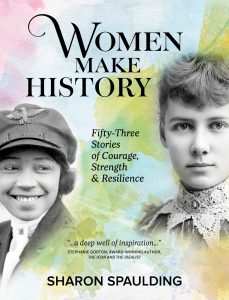 An attic discovery sent Sharon Spaulding on a years-long quest to hunt down the “trailblazing” women history forgot, overlooked, or ignored. In Women Make History: Fifty-Three Stories of Courage, Strength & Resilience (Feb. 2026), Spaulding relates the stories of accomplished women from colonial America through the 20th century. The origin of her quest lies in the late 1970s, when she married Carl Spaulding, great-grandson of women’s rights activist Mary Ware Dennett. Dennett’s accomplishments in the battle for birth control have come to light in recent years, but when Spaulding first heard her husband’s family members talk about this remarkable woman, she had no idea who Dennett was.
 We’ve enjoyed several historical fiction novels about Nero or featuring the infamous Roman emperor as a major character: Among them Manda C. Scott’s Rome tetralogy The Emperor’s Spy (Transworld, 2010), The Coming of the King (2011), The Eagle of the Twelfth (2012), and The Art of War (2013); and Margaret George’s The Confessions of Young Nero (Berkley, 2017) and The Splendour before the Dark (2018). Here my focus is on the more recent trilogy by S. P. Somtow, including Delicatus (Diplodocus Press, 2023), Imperatrix (2023), and Damnatio (2024); Simon Scarrow’s Tyrant of Rome (Headline, 2025); and Conn Iggulden’s trilogy including Nero (Penguin UK/Pegasus, 2024), Tyrant (2025), and Inferno (2026). New histories, too, have appeared.1
 Many authors of historical fiction start with setting – a time, a particular place. Ian McGuire was more amorphous. In 2017, he jotted: “A fort in the west. Winter? A prophet arrives.” Years later, he says, “I reread those words and began to wonder what they could mean. What kind of fort? West of where? And why would a prophet appear? I didn’t know the answer to any of those questions, but I started to read more and think more, and my reading and thinking led me eventually to northern Canada and the Hudson’s Bay Company.” This would become his latest novel, White River Crossing (Crown US / Scribner UK, 2026).
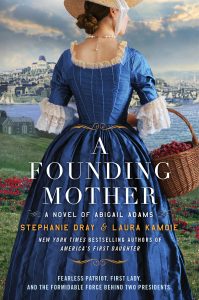 For Americans, Abigail Adams is a household name. Historian Woody Holton, for example, declared that she “lives in the American memory as the most illustrious woman of the founding era.”1 Born in Massachusetts in November 1744, Abigail was the daughter of a parson. Aged twenty she married John Adams, a lawyer nine years her senior, who would in time become Vice President to George Washington and then the second President of the United States from 1797 to 1801. Their son, John Quincy Adams, became the sixth president in 1825: although Abigail did not live to see it, as she died of typhoid fever in 1818, aged 73. She’s known for being one of her husband’s closest advisors, and for holding radical ideas about women’s rights and women’s place in society. But these are just the basic headline facts. There is so much more to know. In 2026, the two hundred and fiftieth anniversary of the July 4th signing of the Declaration of Independence, what better way to intimately explore the story of one of the great figures of that period than in the expert hands of biographical novelists Stephanie Dray and Laura Kamoie? What was Abigail Adams’ character? What did she do, think, and say?
 “Why unweave the rainbow?” This was Emma Darwin’s response when asked whether she would have liked colour illustrations of the paintings referenced in her latest novel, The Bruegel Boy (Holland House, 2025). The story focuses on an imagined relationship between Pieter Bruegel the Elder and his model Gillis Vervloet (‘Gil’), an aspirant seminarian. “I’m very wary of drawing straight, obvious lines from the real-world materials that we appropriate to fiction.” So, this book is as much about what Darwin invents as it is about fleshing out what is known of Bruegel’s life and the turbulent history of his time. That history is fascinating, not least for the way it is reflected in Bruegel’s art. The backdrop was intellectual ferment, the struggle for independence from Habsburg control in the Low Countries, and the religious conflicts that came to a head in the great Beeldenstorm of 1566, a wave of iconoclasm only a few years before Bruegel’s death.