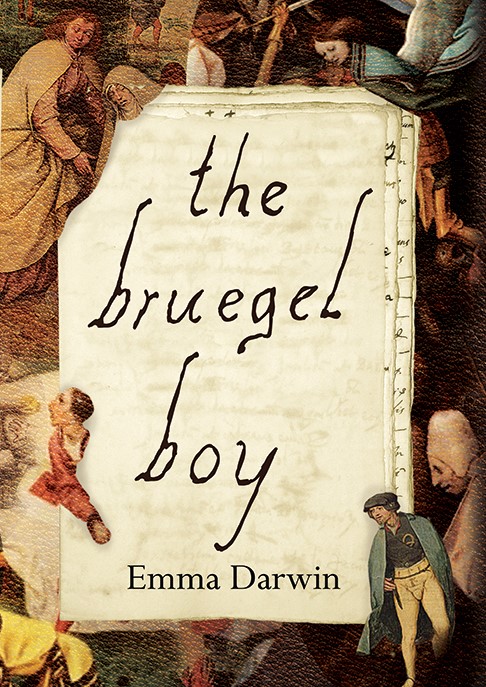
Weaving the Rainbow: Emma Darwin Discusses Her Novel, The Bruegel Boy
WRITTEN BY JENNY BARDEN
 “Why unweave the rainbow?” This was Emma Darwin’s response when asked whether she would have liked colour illustrations of the paintings referenced in her latest novel, The Bruegel Boy (Holland House, 2025). The story focuses on an imagined relationship between Pieter Bruegel the Elder and his model Gillis Vervloet (‘Gil’), an aspirant seminarian. “I’m very wary of drawing straight, obvious lines from the real-world materials that we appropriate to fiction.” So, this book is as much about what Darwin invents as it is about fleshing out what is known of Bruegel’s life and the turbulent history of his time. That history is fascinating, not least for the way it is reflected in Bruegel’s art. The backdrop was intellectual ferment, the struggle for independence from Habsburg control in the Low Countries, and the religious conflicts that came to a head in the great Beeldenstorm of 1566, a wave of iconoclasm only a few years before Bruegel’s death.
Darwin clearly relishes that she has been left with “plenty of room for my imagination to take charge”, and take charge she does in a way that is bold, challenging, intriguing and compelling. To get the most out of this book, the reader has to pay close attention to all the versions of Gil’s narrative that are preserved in his memory when, as an old man in his eighties, he arrives in the imaginary province of Altstadgott in the Saarland. Only by digging deep into these subtly different approaches to the truth can Gil achieve the understanding he needs to find the missing statue of St Michael which will enable him to enter the monastery there. We follow Gil’s efforts to find the statue in the present, interwoven with his formal account of his past to the abbot, and memories of his early life, particularly of his association with Bruegel which began when he was fifteen and Bruegel a well-established master painter in his thirties.
“We remember differently,” explains Darwin, “depending on why and what we’re remembering. Gil is only entirely honest in his thoughts, while just occasionally in the ‘Young Gil’ strand we’re reminded that this is all ‘Old Gil’s’ memories.” Interestingly, this was a change from the original concept which was to present “a single narrative in present tense, sliding back into various parts of the past, in past tense,” an approach which was found to be “a bit distancing for showing us the Young Gil story.” Thus, in the novel as it has evolved, the reader follows Gil’s early life in Antwerp, Brussels and beyond as if reliving it, and this treatment invests all threads of the story with immediacy. The occasions when discrepancies occur in the strands of Gil’s tale are illuminating for revealing how we all arrive at an accommodation in our minds for dealing with the past, particularly troubling episodes; the interpretation of recollections can shift as maturity and understanding are gained. This is also reflected in the way Darwin presents Bruegel’s art: as a prism through which a greater appreciation and insight into human nature can be achieved. “I wanted the story to be about how, through living with Bruegel and coming to see the world through Bruegel’s eyes, Gil comes to understand and deal with the world in a way which is psychologically more sustainable.”
In the world of the novel, contradictions abound, and Gil has to navigate a tortuous course around them. There is tension between the spiritual purity of Gil’s mentor in faith, the blind Father Paulus, and the iconoclasm that the Protestant doctrine of Sola Scriptorum (‘by scripture alone’) eventually leads to; conflict between Gil’s love and lust for women, and his longing for a chaste life devoted to the church; between his inclination to accept the designation of sin in the Bible without reservation, and loyalty to his homosexual brother Roeland; or between telling the truth, and his promise of secrecy to the Protestant Fra Thorne when he searches for the statue. “We are all profoundly, apparently, contradictory,” says Darwin. “Bruegel sets such contradictions up very emblematically sometimes – I’m thinking of paintings such as The Battle Between Carnival and Lent – but when you look there are also always people doing perfectly normal things: finding the middle way, if you like. Gil’s story is partly about finding the middle way, but to do that he first has to understand that cleaving to an absolute way may make you feel secure, but it will probably also destroy you.”
So, this is a novel with a message, but there is a numinous quality to it as well, an exploration of the transformation that painting can achieve, from flat line and colour to a vivid depiction of reality in the mind of the viewer (even of life itself invested with emotion and feeling), and the transcendence through faith and love to spiritual enlightenment. Whenever Gil is transported away from conflict, confusion or mundanity by contemplation of the divine, or beauty, or an appreciation of significance, time ceases to have any meaning for him. Time passed. Time stood still is a recurring motif. Darwin displays some of her most evocative writing around these episodes, as when Gil first arrives in Altstadgott in old age to find, not a bare Protestant church, but “incense coiling and billowing up into the spire, the gleam of gold and lapis lazuli and cinnabar, the altars dressed in silk and lace and cloth of silver… He found, in other words, the sights, sounds, scents of his oldest home, when he was youngest… Here in dimness that lay soft as silk-velvet between the columns, the points of candlelight flickered until the angels almost seemed to breathe.”There is a magical quality, too, in the way the narrative weaves around the execution of Bruegel’s paintings, so as to bring the scenes and their development vividly to life, as if we were there in Bruegel’s home and studio at the time when they were made. We see the tall, thin, red-headed Gil posing as the Archangel Michael for the Fall of the Rebel Angels, and Bruegel adjusting Gil’s position as he kneels in the role of a king for Adoration of the Magi in the Snow. We hear Bruegel instructing Gil to strive for “the moment of longing – of desire overwhelming even bodily pain. You have lived to see this and now you’re seeing it… but you don’t dare touch.” Then, when the Adoration is ready, and those close to Bruegel think it is perfect, we watch Bruegel adding snowflakes: “the snow seemed to fall so close that you might almost have reached out a hand to this Bethlehem and found a snowflake landing on your palm.” In this way, Darwin beautifully describes the moment of what is thought to be the first depiction of falling snow in a western painting.
The author has a fascinating explanation for Bruegel’s compassionate mind-set as she sees it exemplified in his art: he could have been a member of the secret Anabaptist ‘Family of Love’ founded by Hendrik Niclaes. “There were many Familists in the highly educated, liberal circles in which he moved in Antwerp,” she says, “including the geographer Abraham Ortelius, and the printer Christophe Plantin… I see a broadmindedness, a tolerance, an awareness of the difference between public face and private belief, in both Bruegel’s take on humanity and aspects of early Familism.” The possibility is an intriguing one that Darwin melds into the history by suggesting Bruegel too might have been a Nicodemite, in conforming outwardly to Catholicism while being a Familist. “It’s completely unprovable either way,” she says, “but proof isn’t what historical fiction is about.” The result is that Bruegel as portrayed in the novel is particularly empathetic to readers today.
What was Darwin’s approach to researching the mass of information needed to craft this story? “In a way, it started with reading Michael Baxendall’s Painting and Experience in Fifteenth-Century Italy when I was a teenager,” she answers. “It revolutionised Art History by situating the study of artistic creation in its social and economic context: the price of lapis lazuli matters as much as the presence of genius.” The author grew up partly in Brussels, but she did go back there, to Antwerp, and to Luxembourg to find a setting for the invented Altstadgott. “You need vivid and specific materials,” she says, “but you also need to ‘leave the research behind’, as Rose Tremain puts it: to let the ‘inert data’ compost down till it’s no different, has no greater privilege in your mind, than things you imagine or have always known.”
As for influences, Hilary Mantel’s Wolf Hall gets pride of place, then comes Antonia Forest’s two novels about Shakespeare’s theatre, The Player’s Boy (1970) and The Players and the Rebels (1971). “The Bruegel-Gil relationship stems from that sense of an older master/mentor who is deeply flawed but whose mentorship changes the orphaned protagonist’s life.”
This is a profound, thought-provoking and rewarding story with themes as relevant today as they were over four hundred and fifty years ago. “The novel is built on the tension between a powerful vocation or calling, and the other realities of self and society such as love, work and family,” says Darwin. “The tension is still there for us: just ask anyone in a cross-cultural marriage, or whose spouse’s dream job is on the other side of the world, or who’s trying to work out how to have children without destroying their career.”
The rainbow will continue to shimmer after the last page of The Bruegel Boy is turned.
About the contributor: Jenny Barden is a historical novelist who has at various times been a farmer, artist and city solicitor. She is published by Ebury Press and has just finished a psychological thriller set at the time of the Spanish Armada.
Published in Historical Novels Review | Issue 115 (February 2026)