The Inspirational Abigail: Stephanie Dray & Laura Kamoie’s A Founding Mother
WRITTEN BY KATE BRAITHWAITE
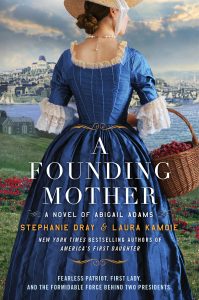 For Americans, Abigail Adams is a household name. Historian Woody Holton, for example, declared that she “lives in the American memory as the most illustrious woman of the founding era.”1 Born in Massachusetts in November 1744, Abigail was the daughter of a parson. Aged twenty she married John Adams, a lawyer nine years her senior, who would in time become Vice President to George Washington and then the second President of the United States from 1797 to 1801. Their son, John Quincy Adams, became the sixth president in 1825: although Abigail did not live to see it, as she died of typhoid fever in 1818, aged 73. She’s known for being one of her husband’s closest advisors, and for holding radical ideas about women’s rights and women’s place in society. But these are just the basic headline facts. There is so much more to know. In 2026, the two hundred and fiftieth anniversary of the July 4th signing of the Declaration of Independence, what better way to intimately explore the story of one of the great figures of that period than in the expert hands of biographical novelists Stephanie Dray and Laura Kamoie? What was Abigail Adams’ character? What did she do, think, and say?
After a brief prologue, A Founding Mother (William Morrow, 2026) opens in 1765 with Abigail and John newly married. Abigail is heavily pregnant but determinedly independent. We meet her ‘waddling’ down the road to avoid being confined at home. The scene sets the tone and establishes Abigail’s singular character. “Her greatest strengths stood out to us immediately,” the authors explain. “She was noble of spirit. She had a strong moral compass. She had a strong mind, a strong personality, and a certain fearlessness. Of course, her weaknesses are a darker reflection of her strengths. She could be quite stubborn. She could be judgmental. And every so often a little bit reckless.”
Match such a character with the tumultuous years between 1765 and 1818, and you have a page-turning novel full of famous names, Abigail’s unique perspective, and a story that goes places many readers won’t expect.
“Readers may be surprised to learn that Abigail was often more radical than her husband,” say Dray and Kamoie. “Her opinions were less measured than his. She was often two steps ahead of getting to the place he might eventually land. I think readers may also be shocked to find that she was an entrepreneur and that John’s public career was enabled not just byher sacrifices on the farm, but also by her business acumen as an investor.”
The ways in which Abigail managed long periods of separation from her public servant husband, and creatively kept the family afloat financially, make for fascinating reading. Her experience surely reinforced her believe in women’s innate abilities, despite their lack of rights. In a famous 1776 letter, for example, Abigail wrote to her husband, urging him to “remember the ladies” when establishing the laws of their new nation. She wrote of men’s tendency toward tyranny over women and questioned whether women should be bound by laws made by bodies where they had no representation and no voice. For his response, you’ll have to read the book.
Of course, with such a well-known and beloved figure, the research must be impeccable.
Dray and Kamoie “started in the usual place. Biographies. Then primary sources—all the letters. So many letters! The National Archives has actually digitized them at Founders.archives.gov. What a gift to every American that these letters are so publicly accessible to every citizen. If that doesn’t make you want to kiss a historian, what will?
“At any rate, reading those letters, it was shocking to see how tart and funny Abigail really could be. And how direct she was, especially compared to the other women we’ve written about. Abigail was not one to suffer fools. And she had a Yankee no-nonsense way about her that was delightful. So one of the most fun things about the research this time is that we reached out to an expert Abigail Adams re-enactor, Carol Cohen, who gave us many juicy details about Abigail… including the part about her making bullets!”
It’s with full confidence then, that the reader can settle into A Founding Mother and enjoy a lively first-person account of her life. Her voice, in this telling, is one of its great strengths. Here for example, speaking of women’s role during the Revolution, she declares: “We, too, were patriots. Which, considering our situation, I considered heroic. After all, excluded from honors and offices, we would never be rewarded for it. Our property was still subject to the control of our husbands. Deprived of a voice in legislation, obliged to submit to laws imposed upon us without our consent, we ought to have been indifferent to the public welfare.”
She also has choice words at times for her husband and some of his famous colleagues. “What a little cock-sparrow general he made,” she observes of Alexander Hamilton, and of Thomas Jefferson she declares, “Oh, no one on earth knows Jefferson truly. He’s always been a riddle worthy of the sphinx.” I listed a few of the famous men we encounter in the novel, and asked Dray and Kamoie what they felt Abigail really thought of them:
“The truth is that Abigail Adams admired every single man on that list. But she didn’t always like them. And I think that includes her own husband. There were times she clearly wanted to throttle him. There were also times she was extremely frustrated by her own son. Now, of course, she truly did love Thomas Jefferson, and their falling out was incredibly painful to her. She loved his mind and his manners but came to suspect his morals and detest his politics. And as for Hamilton, of course, she thought he was a brilliant but dangerous devil. So there were times she was rooting for him, but ultimately, I don’t think she shed a tear when Aaron Burr shot him dead.”
As insightful as the novel is to the time and events of Abigail’s lifeline, where it really shines is in its exploration of the ways Abigail and John’s choices impacted their children and wider family. “This is a theme that runs through all the books that we’ve written together,” the authors confirm. “Certainly, the public service of our Founding Fathers demanded sacrifices and risks from them. But the sacrifices and risks were not theirs alone. They burdened their families tremendously; think of modern military spouses—a spouse may sign up to put his life on the line, but military families are asked to make sacrifices they never signed up for. Especially the children. That was the case for the Adams family as well. It was all well and good for John and Abigail to decide together that they were willing to be ruined in the cause of the new nation; but I doubt they understood, as young parents, what they would be asking of their children. The long absences. The pressures of having to live up to a famous parent. The danger of sea crossings during wartime. And much, much, more.”
The best historical fiction has the capacity to show us how people in the past felt and acted and leave us asking ourselves what we can learn from it. In A Founding Mother we see political divisions in the new nation form quickly, and so I asked the authors if there were lessons to be learned here.
“People often forget that the American Revolution was also a civil war,” they responded. “So there was never a time when Americans were all perfectly united in purpose and opinion. And some of those disagreements between Loyalists and Patriots were very bloody. Because of that, it probably shouldn’t be shocking that practically the moment the new nation is born, the people who survived the war are already divided into camps. And there is some bitter polarization.
“But what strikes us is that the polarization never reaches the level of violence that we see in revolutionary France at the same time, and the nature of the men and women who contributed to the American Revolution was such that they all wanted to see this enterprise succeed. This is why it seems almost quaint to read the letters between Jefferson and Hamilton when they were both in the cabinet. They absolutely hated each other. They were lashing out at each other in the press, and using surrogates to do it. They probably wished each other dead.
“And yet, the letters they exchanged were civil—on matters of government, even quite cooperative. I was a bit surprised by Hamilton asking Jefferson to remind him of something that had been decided in a cabinet meeting that he could not remember. They had mutually birthed this new nation—so they weren’t going to kill the baby, no matter how much they wanted to kill each other. Honestly, we could use a lot more of that civic spiritedness now.”
Never doubt, however, that this is Abigail Adams’ story. She’s a mother to a nation, but also to a large family, and it’s the depth of her character and experiences that will make this novel popular with readers and book clubs. Abigail’s consistent, determined, advocacy for women makes for a remarkable read from the first page to the last, and the authors aren’t shy about joining the dots between the past and present:
“We particularly want to emphasize what Abigail Adams means to women in 2026. This novel isn’t about a bunch of dusty lace and powdered wigs. It’s shockingly relevant to our world today. Abigail was struggling with many of the same political, economic, and family challenges that we struggle with now. And she speaks to us in a shockingly modern way. We’re all trying to find meaning and courage—fortunately, through historical fiction, we can borrow some of Abigail’s.”
References:
- Woody Holton, Abigail Adams, A Life, Atria, 2009.
About the contributor: Reviews editor, reviewer ,and feature writer Kate is also the author of four historical novels, including The Scandalous Life of Nancy Randolph. Her Substack, Sis-Stories, features notable historical novels,where sister stories take center stage.
www.kate-braithwaite.com
Published in Historical Novels Review | Issue 116 (May 2026)