Launch: Carol Baldwin’s Half-Truths
INTERVIEWED BY LESLIE S. LOWE
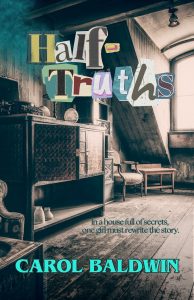
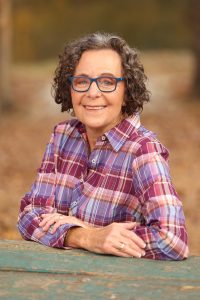
Carol Baldwin’s debut YA historical novel, Half-Truths, was published in April 2025 by Monarch Educational Services. It won the 2025 NC AAUW Award in Young Adult Literature, is a Historical Book winner from the North Carolina Society of Historians, the winner of the 2025 Hindi award, and the recipient of the Bronze Medal in the Coming-of-Age category from Reader’s Favorite. When she’s not working on her next book, Carol enjoys reading, exercising, networking with other writers, and blogging.
 How would you describe Half-Truths to someone unfamiliar with your work?
In 1950s Charlotte, North Carolina, Half‑Truths follows a White girl, Kate Dinsmore, and a Black girl, Lillian Bridges, as they uncover a hidden connection that forces them to confront racism, family secrets, and the cost of truth.
What inspired and attracted you to writing historical fiction?
I love how good historical fiction makes history come alive for readers. It allows us to step into the past and realize how it impacts the present and the future.
Does any part of your own life experience connect with any character or events in the story? What difficulties did you have in writing this story?
Like my protagonist, Kate Dinsmore, I moved from a place where I felt at home—the Northeast—to a region that felt culturally and historically different. Although Kate’s move was within North Carolina, we both experienced the challenge of not fitting in right away and needing to build new friendships. Like Kate, I am a writer, curious by nature and a seeker of truth.
My primary goal was authenticity. To achieve this, I interviewed nearly one hundred people—both Black and White individuals—and read extensively to ensure that I portrayed the period accurately. One of the most difficult aspects of writing the book was giving each character a distinct and believable voice.
What kind of research did you have to do for this story? Did you get to do any interesting interviews during your research?
Research was central to writing Half‑Truths. I conducted numerous interviews, sometimes talking to the same person multiple times. When I began researching the book over twenty years ago, some people who had lived through the Jim Crow era were still alive; sadly, many of them have since passed away.
Two graduates of Second Ward High School—the Black school that Lillian attends—generously shared their life experiences. I think of myself as a story‑weaver. Sometimes I used the stories I heard as background material; other times actual stories became scenes in the novel.
In addition to interviews, I visited historical sites around Charlotte, including the Second Ward Alumni House, a former Rosenwald School, and the Myers Park and Cherry neighborhoods. These visits helped ground the story in the specific time and place.
Is there a key historical event you discovered in your research that inspired you to write this story or highlights a message still relevant today?
The book opens with a Ku Klux Klan parade through Tabor City, North Carolina, in 1950. I had struggled to decide where Kate should grow up and how to begin it. When I shared this historical event with my mentor, she said, “That’s the beginning of your book.” It set the stage for the racial tensions present in North Carolina at the time and mirrors the tensions within Kate’s own family.
One of the key messages I hope readers take away is that prejudice is often passed from one generation to the next—and that it can be challenged only when people are willing to confront uncomfortable truths. Ultimately, I hope Half‑Truths encourages readers—especially young readers—to question inherited beliefs and choose empathy over silence.
What are you working on now? Is it connected to this book in any way?
When Kate moves from Tabor City to Charlotte, she lives with her paternal grandparents. I am currently writing her grandfather’s story, set in 1893, when he worked as a young man in a glass factory in New Jersey. This child-labor story reaches even further back to another young glassworker in 1745.
How do you think readers will connect with Kate and Lillian? Is there one character you feel especially connected to?
I hope readers connect with both girls as they struggle to maintain a friendship despite racial and social barriers. I also hope readers empathize with their dreams of pursuing careers that were largely closed to women at the time. Above all, I want readers to see the value of speaking the truth—and the painful consequences of keeping generational secrets.
I admire both Kate’s and Lillian’s spunk and determination.
Every author has their own publishing journey. Tell us about yours.
In 2008 I wrote my first rough draft during NaNoWriMo. After that, I began researching in earnest and wrote multiple revisions from Kate’s point of view. Several years later, an editor at an SCBWI conference suggested telling the story from both girls’ perspectives. I was hesitant, especially since I am White, but I spent two years developing Lillian’s story.
When I felt ready to query agents, an agent colleague told me it was unlikely I would find a publisher. Discouraged, I set the manuscript aside for several months. Eventually, my love for the story brought me back to it, and I revised the book again.
Throughout the eighteen years in which I researched, wrote, and revised, I attended many writing workshops, worked with critique partners, and received valuable feedback from developmental editors. Although several agents expressed interest, it always ended with, “This book just isn’t for me.”
A friend introduced me to Monarch Editorial Services, a small independent clean‑reads press. I submitted my query on a Saturday and immediately heard back from the publisher, who described the manuscript as “stellar.” Several months later, I signed with the press.
Half‑Truths was published in April 2025 and has since received four awards, including the North Carolina YA Book of the Year. Each recognition reinforces my belief that a strong story, combined with perseverance and skilled editing, will ultimately find its home.
 What advice would you give to other aspiring historical fiction writers?
I always encourage writers not to give up and to remain open to learning from others. Receiving feedback without defensiveness is essential. For historical fiction writers specifically, I recommend:
· Create a system to track research, including interview dates, sources, and where information can be found later.
· Use mybib.com to keep track of research.
· Research at local, regional, national, and international levels to enrich the setting.
· Avoid the trap of perfecting details too early—use placeholders and keep writing to maintain creative flow.
· Reading widely within the genre to understand what works, what doesn’t, and why.
What is the last great book you read, and why?
I recently read The Miniaturist’s Assistant by Katherine Scott Crawford and The Glassmaker by Tracy Chevalier. Although I don’t share some of the values expressed in these books, both authors use innovative narrative structures. I recommend them as examples of how historical novels can be told in fresh and compelling ways.

HNS Sponsored Author Interviews are paid for by authors or their publishers. Interviews are commissioned by HNS.