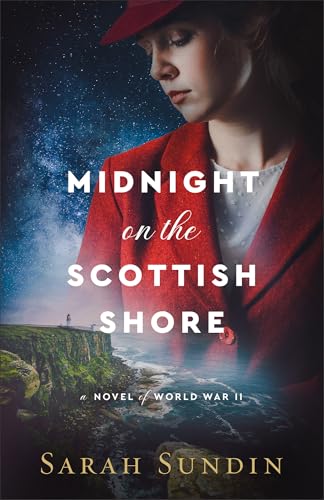
Midnight on the Scottish Shore
In February 1941, the Nazis control Holland. A young Dutch woman, Cilla van der Zee, pretends she has joined the Nazi movement. Fluent in English and adept at Morse code, the Nazis train her in spy craft and then deposit her on the Scottish shore via a night submarine run. A local naval officer, Lachlan Mackenzie, spots her along with her radio transmitter, weapon, and money. Though Cilla wants only to evade Germans and save her relatives back in Holland, the English treat her as a bona fide German spy, throw her into jail, and interrogate her endlessly. Eventually the English Secret Service recruits her as a counterspy working in a Scottish lighthouse and transmitting useless ship movements and other war-related information to Germany.
The story unfolds in two main themes: a forbidden attraction between Lachlan and Cilla, and spy games. For most of the novel’s eighteen-month timeline, the Cilla/Lachlan personal connection slowly builds alongside Lachlan’s family crisis. Lachlan’s younger brother hates him, rails against imperious English rule, and wants a free Scotland. Complicated spy games and counterspy games heat up in the last third of the novel.
Sundin’s settings, from Holland to the Orkney Islands north of Scotland with their natural beauty carved by nasty weather, feel very real. Detailed spy and counterspy moves become page-turners. The truth behind Lachlan’s family saga unfolds in a sensible way. Unfortunately, some overly dramatic prose distracts. For example, eyes “slam” shut multiple times, and “Hurt pulsed in the blue green of her eyes”. People do not simply turn. They “spin” and “whirl” even while carrying a load of dishes. Nonetheless, this spy romance built on little-known Scottish WWII history will keep most readers engaged.