Researching Life in the Great Depression: 1930s

Unemployed men queued outside a depression soup kitchen opened in Chicago by Al Capone, 02-1931. Credit: Wikimedia Commons. Public domain
BY B.J. SEDLOCK
I would count the Great Depression as one of the periods of Western history which stands out as a particularly interesting setting for a historical novel. The struggle of the ordinary citizen to make ends meet in a huge economic downturn should provide plenty of drama for your novel’s plot.
Below are some print books and websites that can get you started researching the period in the English-speaking countries of the West in that time. Consider asking older members of your family whether they have personal stories to relate about how your own family survived. For example, I understand that my grandparents on both sides moved from the city to the country so they could grow their own food for their large families.
U.S. PRINT BOOKS
CHILDREN OF THE GREAT DEPRESSION, By Russell Freedman. Clarion Books, 2005. 9780618446308
A good place to start if you know little of the period, it’s aimed at middle school children and covers the basics of how children coped, with plenty of period black and white photographs and a good bibliography.
DEPRESSION DILEMMAS OF RURAL IOWA, 1929-1933, by Lisa L. Ossian. University of Missouri Press, 2011. 9780826219466
There are books out there like this one which focus on the topic in one geographical location. If you are setting your novel in the rural Midwest, this book may give you story ideas.
DOWN & OUT IN THE GREAT DEPRESSION: LETTERS FROM THE FORGOTTEN MAN, edited by Robert S. McElvaine. University of North Carolina Press, 2008. 9780807858912
Originally published in 1983, the editor includes selections from letters written during the era from various government and private archives. Sections include middle-class hardship, rural areas, Black Americans, children, and attitudes towards the President.
THE FORGOTTEN MAN: A NEW HISTORY OF THE GREAT DEPRESSION, GRAPHIC EDITION, by Amity Shlaes, illustrated by Paul Riuoche. HarperPerennial, 2014. 9780061967641 (original non-graphic version also available, published in 2008 by same publisher)
If you prefer looking at pictures over text, you might enjoy this graphic novel edition of Shlaes’ history of the era, and the b&w drawings might give you ideas for scenarios for your story.
THE PATH WAS STEEP: A MEMOIR OF THE APPALACHIAN COAL CAMPS DURING THE GREAT DEPRESSION, by Suzanne Pickett. New South Books, 2013. 9781588382610
A memoir by the child and wife of Alabama coal miners, on how the family lived through tough economic times and strikes.
THEY NEVER THREW ANYTHING AWAY: MEMORIES OF THE GREAT DEPRESSION BY AMERICANS WHO LIVED IT, by Ed Linz. Exchange Publishing, 2021. 9781736734803
The author traveled through the US in the 1990s gathering memories of ordinary citizens about the Great Depression. Good primary source material for story ideas.
TO ASK FOR AN EQUAL CHANCE: AFRICAN AMERICANS IN THE GREAT DEPRESSION, by Cheryl Lynn Greenberg. Rowman & Littlefield, 2011. 9780742551893
The subtitle sums the book up, chapters cover Black life before the crash, political activity, and how culture survived during hard times. Has an impressive bibliography.

Spencer, Iowa. Interior of a shack in “Shantytown“, 1936. Credit: Library of Congress control number 2011661534
WHAT CAN WE LEARN FROM THE GREAT DEPRESSION?: STORIES OF ORDINARY PEOPLE & COLLECTIVE ACTION IN HARD TIMES, by Dana Frank. Beacon Press, 2024. 9780807046906
Stories of four instances of collective action by sufferers during the Great Depression to try to better their conditions. Examples: Mexicans being repatriated from the U.S., and Black women wet nurses (who sold their breast milk to the city of Chicago) who went on strike for a pay raise.
U.S. WEBSITES
DOROTHEA LANGE DIGITAL ARCHIVE: THE DEPRESSION
Lange was best known for her documentary photographs of the Depression. This site hosted by the Oakland Museum of California has some of her most iconic images.
THE ECONOMIC AND SOCIAL IMPACT OF THE GREAT DEPRESSION ON TEXAS
From the Texas State Historical Association, the title is self-explanatory.
How a large university, Pennsylvania State, endured the Depression years. Could give story ideas if you want to set a novel at a college/university during the era.
EVERYDAY LIFE DURING THE DEPRESSION
The University of Washington offers this overview of what Depression life was like on the upper West Coast.
From the American Archive of Public Broadcasting, 6 interviews of people who lived through the Depression. Click on a thumbnail and you can watch the video or read the transcript.
HUMAN TOLL OF THE GREAT DEPRESSION
From the Gilder Lehrman Institute of American History, a brief overview of the era.
GREAT BRITAIN PRINT BOOKS
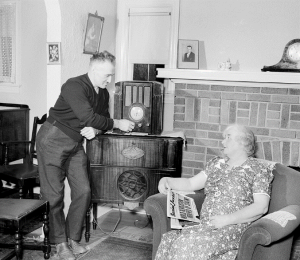
Listening to the radio was a popular 1930s form of entertainment. Credit: Wikimedia Commons. Public domain
THE SLUMP: BRITAIN IN THE GREAT DEPRESSION, 3rd ed., by John Stevenson and Chris Cook. Longman/Pearson, 2010. 9781408230107
The original edition of this classic was published in 1977; this revision was prompted by the recession of 2007/08, to further compare conditions with the 1930s. The authors note that much more archival material has become available since 1977, another reason for the revision.
THE THIRTIES: AN INTIMATE HISTORY, by Juliet Gardiner. Harper Press, 2011. 9780007314539
“Hundreds of interwoven stories…all fitting into a panorama of Britain in the thirties, a decade that haunts us today with the magnitude of its problems…”—preface. Covers the arts, society both high and low, politics, unemployment, etc.
THE WORST OF TIMES: AN ORAL HISTORY OF THE GREAT DEPRESSION IN BRITAIN, by Nigel Gray. Barnes & Noble, 1985. 0389205745 (American reprint of a British edition)
Gray interviewed people in their homes and edited and transcribed the information for this book. It was published during the Thatcher administration, Gray wanting to compare conditions between the two eras. Chapters are the names of cities where interviews took place, such as Manchester, Barnsley, and Aberdeen.
GREAT BRITAIN WEBSITES
While it’s a .com site, Historic Britain is authored by both professional and amateur historians. This gives an overview of the era in the UK, with a few photos.
Article by Christine Collette on the BBC website about a march by 200 men sparked by unemployment and poverty, who walked 200 miles to London as a protest.
THIRTIES BRITAIN: THE DEPRESSED DECADE?
Intended as a school resource, this page offers primary source documents on the era from the UK National Archives.

Road construction at Kimberly-Wasa, BC, Canada, as part of 1933 federal relief projects during the Great Depression. Credit: Wikimedia Commons. Public domain
CANADA PRINT BOOKS
DIRTY THIRTIES: CANADIANS IN THE GREAT DEPRESSION, ed. By Michiel Horn. Copp Clark Publishing, 1972.
“An attempt to capture something of the experience of all Canadians…, of the responses they made to the economic catastrophe…”—p.16. One section contains excerpts from letters written to the Prime Minister by ordinary Canadians begging for economic help, a source of story ideas.
DROUGHT & DEPRESSION, ed. By Gregory P. Marchildon. University of Regina Press, 2018. 9780889775398
This collection of essays concentrates on how the Depression affected the Canadian prairie provinces.
GOLD DIGGERS OF 1929: CANADA AND THE GREAT STOCK MARKET CRASH, by Doug Fetherling. Macmillan Canada, 1979.
The author “shows how speculation in prairie grain futures was at least as important a contributing factor to the collapse as the eastern speculation in stocks and bonds”—viii. Chapters include “Con men and suckers,” and “Surviving the Thirties.”
THE GREAT DEPRESSION, 1929-1939, by Pierre Berton. Anchor Canada, 1990. 0385658435
The author says that in the worst of the Depression, “half the wage earners in Canada were on some form of relief”–p.9. A child could only attend school when it was her turn to wear the family’s single dress, and there was a case of a landlord collapsing in the street from hunger because his tenants could not pay him their rent. The author believes that the government was more concerned about maintaining the country’s credit than helping its citizens in need.
GREAT DEPRESSION OF THE 1930S IN CANADA, by Michiel Horn. Canadian Historical Association, 1984. 0887980996
This brief booklet would be a good place to start as an overview of the era. The author blames weakening European economies and falling demands for Canada’s products of wood and wheat as reasons for the times being so hard in that country.
TEN LOST YEARS, 1929-1939: MEMORIES OF CANADIANS WHO SURVIVED THE DEPRESSION, by Barry Broadfoot. Doubleday Canada, 1973.
Excerpts of interviews the author did with ordinary Canadians who lived through the Depression; he shortened some, but did not alter any facts. A great primary source for the era and place.
CANADA WEBSITES
DEPORTATION FROM CANADA DURING THE GREAT DEPRESSION
From the Canadian Museum of Immigration at Pier 21, immigration issues caused by the Depression.
GOOD TIMES IN BAD TIMES (THE GREAT DEPRESSION)
To get a really local viewpoint, this site is from the Lambton County Museums in Ontario, describing how the Depression affected one particular county in one province.
An overview chapter on the Depression in Canada from Canadian History: Post-Confederation, by John Douglas Belshaw.
THE GREAT DEPRESSION: FEDERAL WORK CAMPS IN ONTARIO
From the Toronto Public Library, an overview of the work camps created in Ontario for the unemployed. Has several nice photographs.
THE GREAT DEPRESSION IN CANADA
An overview of conditions from the Canadian Encyclopedia.
THE GREAT DEPRESSION OF THE 1930S IN CANADA
A PDF of a booklet by Michiel Horn which gives an overview on the topic.
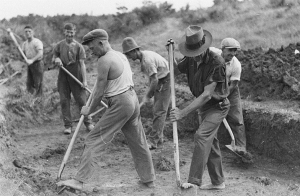
Gangs of Australian men on relief work during the depression, 1930s. Credit: Wikimedia Commons. Public domain
AUSTRALIA PRINT BOOKS
A FINE COUNTRY TO STARVE IN, by G.C. Bolton. University of Western Australia Press, 1972. 0855640618
The author’s aim was to “piece together the first-hand recollections of some of those who felt the impact of the Depression” on Western Australia. Has a section of interesting photographs from the era, like the rude huts built to house the unemployed.
THE MYTH OF THE GREAT DEPRESSION, by David Potts. Scribe, 2006. 1920769846
The author is an Australian academic who had students interview Australians between 1965-1986 about their experiences in the Depression. His “myth” is that history books tend to overemphasize the miseries of the period, suppressing people’s mental resilience and discounting the happy times they remember, despite being poor. There are some great story ideas in the interview excerpts.
AUSTRALIA/NEW ZEALAND WEBSITES
The University of Tasmania offers this overview of the Depression in that Australian state.
EXCITING NEW WORLD: AUSTRALIA IN THE 1930S
From the Royal Australian Historical Society, also covers other non-economic aspects of life such as the arts in the 1930s.
From the National Museum of Australia, an overview of the topic in that country.
THE GREAT DEPRESSION — LIFE IN AOTEAROA NZ
26 primary source documents from the National Library of New Zealand on the topic.
THE GREAT DEPRESSION — WORK CAMPS, RIOTS AND SOUP KITCHENS
A page from DigitalNZ with images of work camps for the unemployed, riots and soup kitchens in New Zealand.
SKINT! MAKING DO IN THE GREAT DEPRESSION
From the Museum of History New South Wales, a lengthy article by Annie Stevens on 1930s life in New South Wales, including a section on Aboriginal Australians. Good story ideas here.
About the contributor: B.J. Sedlock is a retired librarian and now part-time archivist at Defiance College in Defiance, Ohio. She writes book reviews and articles for The Historical Novels Review, judges the First