Eight Strings
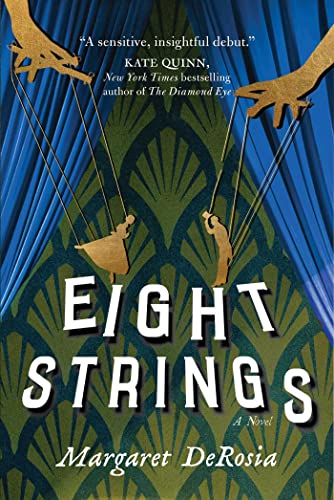
Like the puppet plays that form the center of this novel, DeRosia imbues a melodramatic plot with layer upon layer of social and emotional complexity. Her invented protagonist, Franco Colareggio, transforms himself from a frightened girl escaping an arranged marriage into a charismatic, talented marionette performer. He headlines the celebrated Teatro Minerva and becomes a darling of Venetian society in the 1890s while championing the art forms beloved of working-class audiences.
Franco’s choice to create a male identity for himself – and the emotional realism of the way he grows into it – will appeal to modern readers on the lookout for LGBTQ+ perspectives in earlier historical time periods. Franco creates a “chosen family” for himself among his theatrical colleagues (with the historical maestro Pietro Radillo as a kindly father-figure) and has a queer romance with a childhood friend whose own identity as a Jewish lesbian puts her in frequent peril. Those actions, and his dedication to the populist art form of puppetry, allow DeRosia to imagine Franco as a symbol of the modern age on the cusp of the 20th century.
His artistry, open-heartedness, and quick wit make him many friends but also embroil him in the plots of a cartoonish villainess who wants to use the Minerva as a cover for her activities in human trafficking. (A couple of explicit sex scenes keep the narrative out of the YA category, but no sexual violence is depicted.) Although the plot is contrived and mechanical at times, the characters are complex and full of good humor. Readers will feel themselves part of the vibrant street life of fin-de-siècle Venice and will learn a great deal about the art of puppetry and the lived experience of queer artists.