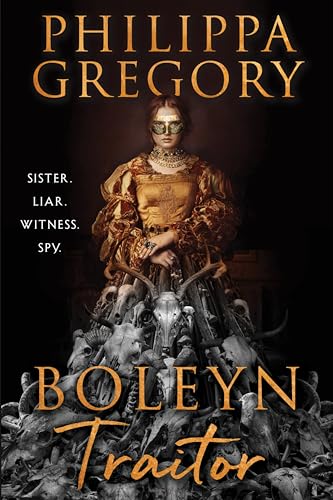
Boleyn Traitor
Philippa Gregory continues her fascination with the Boleyn women which began with Anne Boleyn’s sister, Mary, in The Other Boleyn Girl (2001). In Boleyn Traitor, she retells the story of Jane Boleyn, already begun in her earlier books, and we see four wives of Henry VIII through her eyes. Jane is appointed as a high-ranking lady of the bedchamber to her husband’s sister, Anne Boleyn. After the downfall and execution of her husband, George, and Anne, she is redeployed, with Thomas Cromwell’s connivance, to attend Henry’s next three wives: the unblemished Jane Seymour; the lucky escapee, Anne of Cleves; and the last Howard family pawn, the unfortunate teenager, Kathryn.
This proximity to the queens makes Jane a key informant for Cromwell, the man who must know everything, until he too becomes a target of Henry’s judicial scrutiny. Left to strategise for herself, her mentoring of Kathryn Howard reveals Jane as a political risk taker, perhaps gambling that Kathryn will outlive her old, ailing husband. Readers of Hilary Mantel’s Wolf Hall will be familiar with Jane Boleyn as Cromwell’s catty but willing informant.
In this telling, Gregory wants to detach Jane’s story from its historic narrative, which first emerged as Elizabethan propaganda, as the woman whose evidence condemned George and Anne Boleyn to death. This accusation, argues Gregory, has no supporting historical evidence. Boleyn Traitor is a persuasive portrayal of Jane as professional courtier, serving at court from the age of 11, who has learned to survive and prosper in an addictive and dangerous world of courtly codes, especially to do with love. Gregory paints Jane convincingly into Henry VIII’s court machine, one which could promote or judicially kill its parts. Jane’s story shows us how it was a mechanism easily deployed against whomever he wished.