Launch: Carlo Gibbs’s Silver’s Phoney War
INTERVIEWED BY LESLIE S. LOWE
Carlo Gibbs(opens in new tab) is a new author whose Oscar Silver series is the product of a lifelong interest in World War II naval history and extensive research. Carlo can often be found reading through diaries and official papers at historical archives, in his quest to bring the remarkable true stories of unsung heroes to life. Born in Cambridge, Carlo now lives in the East End of London with his two children. He has held a varied career in public affairs, communications, and central government.
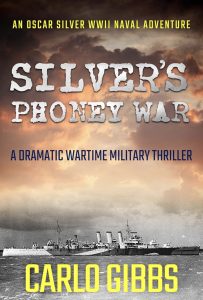
Silver’s Phoney War
How would you describe this book?
Silver’s Phoney War(opens in new tab) is about what it means to prepare for, and come to terms with, the impending horrors of the war. How the lives of the people across the country, such as the protagonist Oscar Silver, were turned on their heads. It follows him as he discovers the traditions of the Royal Navy and makes friends that are prepared to die for one another.
What inspired you to start writing historical fiction, and what has been the most rewarding about it?
I have always been fascinated by history, and particularly World War II. From wondering around Duxford as a child or watching old war movies. From extensive archives of official documents to footage and real-life stories from people we have met, this era is most interesting as the history is documented in a way others aren’t. It’s not history written by scholars, but by the people who went through it. Bringing this to life has been incredibly rewarding.
How has your career experiences in public affairs, communication, and central government assisted you in writing the Oscar Silver WWII Adventure Series? How have you incorporated your experiences into this story?
The most helpful experience is the ability to explain the complex in a clear and engaging way. There is a lot of technicalities in the Navy that can be impenetrable to some readers. I aim to create engaging stories that will bring the complex to life. I’m also interested in how people perceive the actions of government impact their everyday lives. What they are willing to accept or sacrifice for their country. Which I weave into the story too.
Why the focus on this topic now? Is there a key historical event you found in researching that inspired you to write this story to portray a key message prevalent now?
The Phoney War is an interesting period but is often glossed over. This is when people, country and international community changed significantly, particularly with regards to their attitudes towards war. The incidents that took place, like countries trying to annex others because of historical claims, public discontent, polarized political extremes, leaders pushing constitutions and democracy to breaking point are recognizable in our world today.
How does Oscar Silver transform within the story? What did that journey mean to you as you wrote it?
He has to become desensitized to the reality of war and get used to a more dangerous life that he wasn’t expecting. I tried to image what it must have been like to go from being a trainee teacher to facing the Kriegsmarine. As a father, writing about the young losing their innocence was emotional too. But while he changes, he stays rooted to his core personality. He’s a natural leader, loyal friend and has a strong sense of duty. This endures throughout.
How do you think the reader will connect with Oscar Silver in the book?
He is just a normal young man, plucked from his local town where he plays cricket and attends church, and thrust into the Navy. I wanted to portray that human side. While they performed heroically, they were not infallible superheroes. They were just people like me or you in extraordinary circumstances. They acted with valor but carried the scars of their experiences.
What character was the most challenging to write and why?
Oscar’s mother, Evelyn, and love interest, Lizzy, were ones I spent a lot of time on to try and get right. I extensively researched the Women’s Royal Naval Service (Wrens) and Women’s Voluntary Service (WVS). I loved their tenacity. They weren’t daunted or despairing. For most it was an exciting opportunity that they would otherwise never had. They exceled at jobs they were told they could never do. Driving vans, staffing anti-aircraft guns, being engineers. I wanted to do justice to their gumption and contribution in an otherwise male dominated Navy.
What are you working on now? Is it part of the Oscar Silver WWII Naval Adventures Series?
I have finished writing the next two instalments, Silver’s Dunkirk and Silver’s Bismark, which are being edited. Silver’s Dunkirk is available on pre-order and will be published in January. My mind and research is turning to the relief of Malta for book four. I just hope enough people like them so I can keep writing new stories!
Research has been part of your life for years. How did you balance the research with writing this story? Did you get to do any interesting interviews for your research?
Researching took many more hours than writing. To immerse the reader into 1940s Britain, I needed to get the details right. I spent hundreds of hours at the archives reading diaries, letters, newspapers, official documents and listening to interviews. Writing is much easier after extensive research because there are so many good stories characters already there. The most interesting were the letters home from the Ratings asking for home comforts and telling stories of the camaraderie and mischief.
Tell me about your publishing journey.
I always wanted to write, but finding time was hard with a busy job and two children. But I committed to it and started writing out my ideas whenever I could. Plays, books and films. Different genres. Mostly while commuting or lying on my children’s floor waiting for them to sleep! I don’t write chapter by chapter, but any part of the book comes into my head. It flows much easier for me that way. I have the overarching narrative in my head and then stitch it together. I read advice, submitted works and got feedback. I was rejected hundreds of times but kept working at it. I then found Sapere Books and submitted a sample for the Oscar Silver series. I was delighted when they picked it up and have learnt so much going through the publishing process.
 What advice would you give to other aspiring historical writers?
Write in a way that is true to you and your passion. Find your writing style and period of interest and let the knowledge and enthusiasm for that shine through.
What is the last great book you read? Why?
I’m reading The Wager. It’s one of the best books I have read for some time. It’s an intriguing story brilliantly told. David Grann’s writing is so rich and descriptive, yet it’s also succinct.

HNS Sponsored Author Interviews are paid for by authors or their publishers. Interviews are commissioned by HNS.