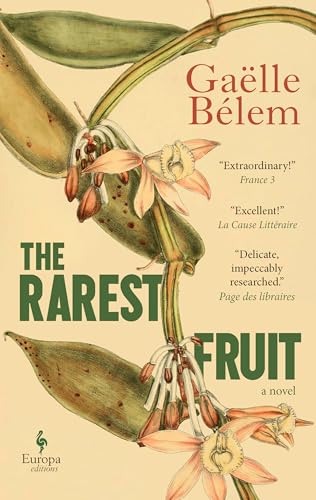
The Rarest Fruit
In 1829, a boy is born into enslavement on the French island of Bourbon. His mistress gifts him to her brother Ferréol, a widowed botanist and orchid enthusiast. The boy, named Edmond, grows up amid Ferréol’s greenhouses and is treated as a son and protégé despite his enslavement. One of Ferréol’s dreams is to find the secret to pollinating the finicky and fragile vanilla orchid, a plant that only produces vanilla beans in its native Mexico. Young Edmond experiments in secret until he discovers, at the age of twelve, an easy and reliable method to hand-pollinate vanilla orchids. The botanical world is shocked to learn that this centuries-old mystery was cracked by an enslaved boy. Ferréol’s pride in Edmond’s accomplishment and his determination to share this knowledge brings Edmond to international attention at a time of political and economic upheaval.
This is a stunning and assured novel. One of the truly fascinating and impressive things about it is that it hangs on a visible framework of research. As a celebrity, Edmond Albius appears in the writings and correspondence of contemporary botanists and horticulturists. But as someone born into slavery, he appears little in the historical record. Bélem does not shy away from these gaps but rather weaves them beautifully into the text with a narration that keeps its distance from the characters but still manages to humanize and empathize. When musing about Edmond’s relationship to Ferréol, Bélem admits that “there’s a resounding silencing, reminding us that all that we know of their story fits onto just one leaf. Not of paper, that’s too big. The leaf of a vanilla plant,” a line that made me stop and ponder the absence of so many voices in the historical record and the sometimes-challenging job historical novelists have in bringing those voices to life. At this, Bélem succeeds.