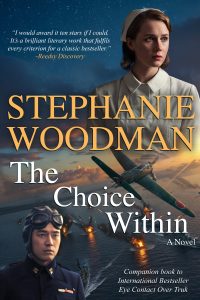
Launch: Stephanie Woodman’s The Choice Within
INTERVIEWED BY ANNE EASTER SMITH
Stephanie Woodman, author of Eye Contact Over Truk, is a retired engineer and teacher who has discovered a passion for writing. She is the mother of one son and now lives in the Pacific Northwest.
 How would you describe The Choice Within?
An historical epic contrasting two different experiences of war, yet with striking emotional parallels. At the same time a US Army nurse on a hospital ship sails into the front line, a young Japanese man is conscripted as a fighter pilot, their lives destined to horrifically intersect…
What was your first inspiration for writing this novel?
While researching my first novel, Eye Contact Over Truk, I came across the snippet of history where the USS Comfort hospital ship had been attacked by a kamikaze during World War II. And so I liked the idea of my protagonist nurse Jeanette from Eye Contact Over Truk having to deal with that.
Do I understand that this book is part of a series, and if so, does one have to read the books in order?
Yes, the books are linked, but they don’t have to be read in order. In fact, this new book comes chronologically before Eye Contact Over Truk, the story I wrote first. Some characters appear in both books. This new one shares the two characters from the first book—Jeanette, the nurse, and her love interest, Nick, who is featured only briefly in The Choice Within. The other protagonist with Jeanne is Akira, a Japanese pilot. Both books’ stories are their own, however, and can stand alone.
How long did it take you to research and write The Choice Within?
I never expected to find everything that I did find, but it was fascinating how the research came so quickly. To answer your question, duration-wise… six months for research, I’d have to say. Maybe seven. So from start to launch, this book took a year and a half. I actually wrote the two protagonists’ stories separately.
I had found the tidbit about the USS Comfort, and it was the opposing perspectives that drew me in. And I just felt this was a story that needs to be written, and it came out of a scuba diving trip in 1996, when I was diving over the ships we had sunk at Truk. A thought stuck in my mind, and I finally said, Okay, I have to try and do this.
But if you only show one perspective, it’s really such an incomplete story, so the obvious second perspective was the nurse’s exact opposite—the Japanese pilot. I wrote Akira’s story first. A retired Marine living in Japan who had read my first book had several connections to that story. And in the course of our email exchanges, I brought up the idea of another book, because although I had wanted to write it, I never thought I could write and represent a Japanese pilot in World War II. I mean, we’re talking different country, different era, different sects, different, you know, everything.
I spent a good four months researching for the early drafts of Akira. For Jeanette, I spent another three months researching for the first draft. It really did fascinate me how quickly the sources came. In a bizarre sense, I want to say that the universe decided this book needed to be written!
Tell us a bit about finding Jeanette’s character. It sounds as though she was the more difficult of the two to write.
I admit it took me a while to find her character arc. But I found it when I was researching combat fatigue. Fortunately, many, many books have been able to capture that, but mostly post World War II. There wasn’t one particular element that attracted me to Jeanette but several—but which story did I want to bring out for her?
As I was placing her on the ship and the different rotations that a nurse could be exposed to, one of the things my research showed was how little training the nurses had for the psychiatric side. The psychological side of battle always remains, and so, as I was researching that, I found a wonderful retired Army nurse who had a lifelong career in the military. She admitted that, for her, upon hearing the guy’s stories, she internalized them so deeply that it was almost driving her crazy. She literally couldn’t take anymore. So I chose to put Jeannette more in the psych ward.
So the Comfort was a real ship, but you had fictional characters on it. Did you follow its path faithfully?
Yes, I have the Navy records of where and when they stopped and for how long. So that’s where I found the reference to the friendly fire attack, for example. I did, however, take one literary license with regard to the Comfort’s journey that I do speak to in my author notes.
What surprised you the most during your research?
Well, I’ll say the biofuel story from Japan. I knew that one of the primary reasons for the attack on Pearl Harbor was because the United States had cut off oil to Japan. I am a chemical engineer by background, so I mean, from an engineering perspective, when I came across the note that they had sufficient coal reserves and had perfected the process to convert coal to oil from a laboratory to full scale without a pilot plan, it completely floored me. I was also surprised to find that the Japanese government was hiding things—how little the populace really knew about the defeats and deaths. They were lied to.
 You tackled a tremendous amount of technical information. Did your background help you as far as the nursing, the flying, or the Japanese culture was concerned?
Well, as an engineer, I had some technical background. But mostly, as well as written resources, I had people to help me.
I had the Army nurse who helped me immensely with the medical sections, because we had to research what did and did not exist in 1944, including the interactions between nurses and doctors and their patients. The flying and the planes themselves, I had to research on my own. Also, the Marine gentleman was kind enough to not only send me information about the Japanese pilots, but he also reviewed everything I wrote. I am tremendously grateful.
Have you read anything lately that really spoke to you?
It’s actually an autobiography in three parts, but it reads like a historical fiction. It’s called The Spy Wore Red by Aline, Countess of Romanones. She was a young model in World War II, was bored and was recruited into the OSS and sent over to Madrid. I love all three books, and I reread them constantly.

HNS Sponsored Author Interviews are paid for by authors or their publishers. Interviews are commissioned by HNS.