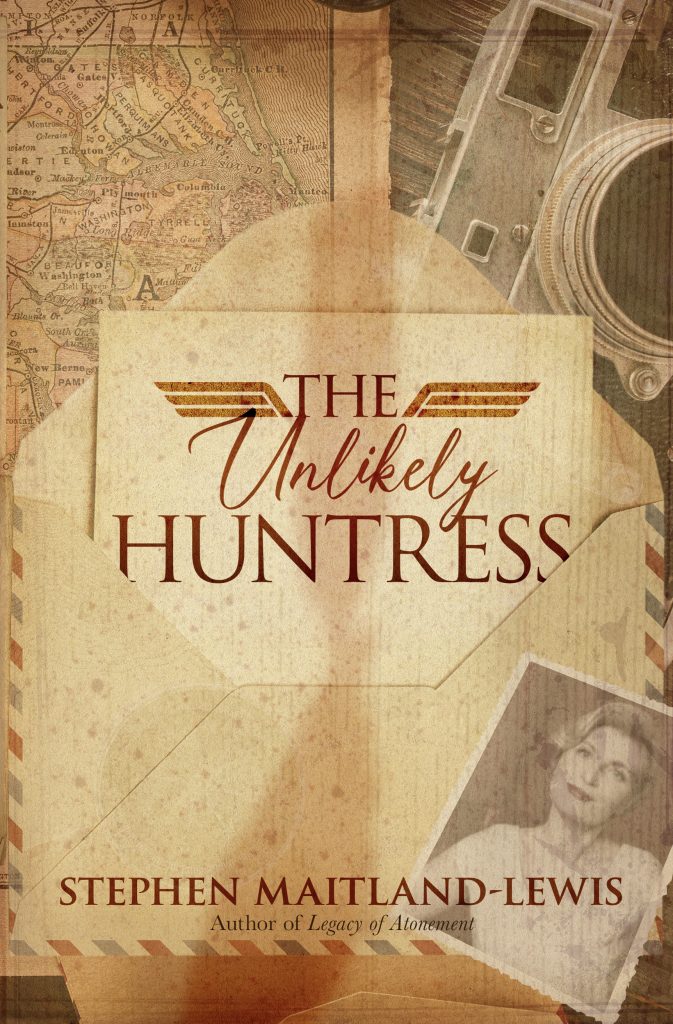
Launch: Stephen Maitland-Lewis’s The Unlikely Huntress
INTERVIEWED BY SUSAN FRAGER
Stephen Maitland-Lewis is an award-winning author, a British attorney, and a former international investment banker. His novels have received numerous accolades, including Hero on Three Continents, Emeralds Never Fade, Ambition, Botticelli’s Bastard, Duped and Legacy of Atonement. His short stories have appeared in various magazines and selections were published as a collection entitled Mr. Simpson and Other Short Stories. Maitland-Lewis’ short story, “Mr. Simpson,” was developed as a play and has been performed by various theatre companies.
 How would you explain The Unlikely Huntress to someone who isn’t familiar with your books?
The Unlikely Huntress is an international thriller that is triggered by a belief, based upon reasonable grounds, that Adolf Hitler did not commit suicide in 1945 in Berlin and is still alive in the 1960s, when the novel takes place. It is imperative that the search for him, wherever he may be hiding, continues. Readers will appreciate from my earlier books such as Emeralds Never Fade, Botticelli’s Bastard and Legacy of Atonement, that I have a strong interest in researching and writing historical thrillers, especially Nazi and Holocaust related topics.
What are the reasonable grounds for believing that Hitler didn’t die by suicide in 1945? Without spoiling any of your plotlines, can you talk more about that and what you think might really have happened instead?
My novel presumes that Hitler did not die in 1945. There has been speculation for decades that he did not die and, in fact, like Mengele, Bormann, Eichman and Barbie that he also escaped.
If these villains managed to flee Europe with the assistance of the Vatican, the Red Cross and others such as Juan Perón in Argentina, why not Hitler? My book is fiction. As far as I know there is no definitive evidence that Hitler survived in 1945. Nevertheless, it took forty years after the war for Mengele’s body to be found in 1985 in Brazil. Hitler was born in 1889. He would have been 56 at the end of the war, so it would not be improbable if he would have lived to the age of say 90 in 1974.
Do you think reading Legacy of Atonement first will enhance understanding and/or appreciation of The Unlikely Huntress?
Yes, most definitely, but I was also determined to ensure that The Unlikely Huntress is a stand-alone novel and that it could be read without any reference to Legacy of Atonement. Certainly, a reading beforehand of Legacy of Atonement would provide some background and provide further insight into the story and characters. For example, in The Unlikely Huntress, Giselle is the principal protagonist. She is a mother and a wife living in Buenos Aires.
In Legacy of Atonement, twelve years earlier in the story, she is an ingénue, barely out of college in Switzerland and in her first job. She is basically the intermediary in a triumvirate that embarks on a worldwide search for Hitler. In The Unlikely Huntress, twelve years later, she is the fearless, driven leader of the same triumvirate, dealing with the consuming dilemma of pursuing the search at the risk of forever destroying a friendship. Simply put, the ingénue of the fifties has become a heroine in the sixties.
One of the five-star reviewers on Goodreads stated that The Unlikely Huntress “explores how extremist ideologies survive across generations.” Was this theme a conscious choice on your part, given that the world is now experiencing a resurgence in extremist ideologies?
No. It was not a conscious choice of mine when writing The Unlikely Huntress. But, when I completed this book, and only then, it was evident to me that there was a resurgence of far-right movements worldwide. Thus, the impetus to perhaps write a sequel to The Unlikely Huntress, evidenced by sympathetic revisionist attitudes towards Hitlerism and Holocaust denial, might be a possibility. A trilogy to the novels is on the horizon but as at this time, I do not feel ready to embark on such a task. I need to have some space from writing about this genre. In fact, together with a co-author, I am currently working on a non-fiction book, which is an exciting change for me and as far away as possible from Nazism as it possibly could be.
It’s often said that those who don’t learn from history are doomed to repeat it. Would you say that novels that look at history from the perspective of “what if this one thing was changed” have any lessons for the reader?
No, I don’t think that “what if” novels necessarily have any lessons for the reader. Certainly, if they do, it is purely accidental and in no way my intention as a writer of historical fiction is to deliver a lesson. It would be most presumptuous of me as a non-academic to give lessons. Yes, if a what if novel creates a stimulating thought or conversation, that would be most satisfying for an author but that is all.
Of course, from a serious non-fiction historical work, written by a trained and acclaimed historian, a thoughtful and informed discourse on what if facts had moved in a different direction, then lessons could be learned. For instance, if the noted British Historian Sir Martin Gilbert had authored a book on British History from 1939-1945 to explore if Churchill had not been Prime Minister, then the reader would sit up, take note, and that book would indeed be a serious lesson.
 Speaking of the lessons that can be learned from history plus your strong interest in the Holocaust and the Nazis, what, in your opinion, do future generations need to understand about the events of the period?
In my opinion, future generations will gradually, if they have not done so already, lose interest in the events of 1939-1945. That is unfortunate, but it is what I believe to be the case. Sadly, the teaching of history is not given the same priority in education as before. It is now close to 100 years since Hitler came to power. Society needs to be mindful that bigotry, racism and intolerance can, as long as there are rogue regimes, lead to the horrors of the Holocaust.
If we step back from the period 1933-1945 and look at what is happening in certain countries today, we can see the horrors that can still take place in totalitarian regimes. So, what has been learned from the Holocaust? Of course, future generations should learn from the Dante’s Inferno of those years, but frankly, it is fair to say that many have not.
How does the current resurgence in far-right ideologies pose a danger to understanding the legacy of the Holocaust? In your opinion, what, if anything, should be done differently in terms of teaching future generations?
The concept of free speech is all well and good, but in my opinion, the Internet presents the biggest challenge. The amount of hate that is generated by lack of meaningful and effective media control of the dissemination of bigoted propaganda has given rise to ideologies that have resulted in outrageous attacks on various minority groups as evidenced by the rise of ‘anti’ this, that and the other.

HNS Sponsored Author Interviews are paid for by authors or their publishers. Interviews are commissioned by HNS.