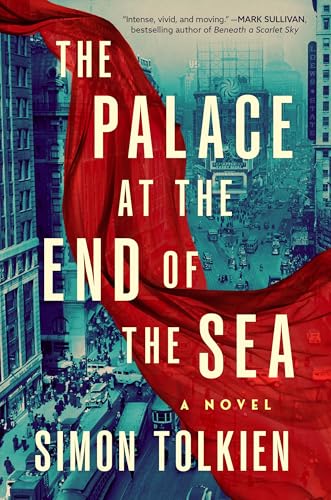
The Palace at the End of the Sea
Theo’s childhood in 1920s New York City is upended when his grandfather, an Orthodox Jew, kidnaps him and takes him to meet his extended family, even though they disowned Theo’s father when he married Theo’s Mexican mother. Disappointingly, this engaging plot thread is not pursued. Instead, Theo’s life continues to be upended, first by the failure of his father’s garment factory in the Great Depression, then his father’s death. Theo gets a taste of tenement life and then is saved by a British aristocrat who falls in love with his exotic mother, marries her, and whisks them both to England where Theo manages to find some happiness at a horrible boarding school. He spends his summers at his father’s hacienda in Spain where he gets sucked into the unrest that will lead to the Spanish Civil War. Theo’s love for Andalusia and its people is beautifully depicted in a book rich with lyricism as well as pain.
The Palace at the End of the Sea is Simon Tolkien’s (grandson of J.R.R.) sixth novel and the first of a duology about Theo Sterling (the second will be published later in 2025). The book’s closest literary kin is James Joyce’s Portrait of the Artist, though Theo is a political philosopher. Tolkien tells his story from a distant third point of view that enables him to share different characters’ outlooks, though the story mostly stays with Theo. Real violence is also kept at arm’s length. Careful explanations of the politics of the Communists, Anarchists, and Fascists help, but slow the pace. What holds us is Theo himself, a pure soul influenced by events and people around him who gradually comes into his own, maturing in fits and spasms that match the fits and spasms of the early 20th century.