Launch: Anna Belfrage’s Queen of Shadows
INTERVIEWED BY MARTHA HOFFMAN
Had Anna Belfrage been allowed to choose, she’d have become a time-traveller. As this was impossible, she became a financial professional with three absorbing interests: history, romance and writing. Anna has authored the acclaimed time travelling series The Graham Saga, set in 17th-century Scotland and Maryland, as well as two equally acclaimed medieval series: The King’s Greatest Enemy which is set in 14th-century England, and The Castilian Saga, set in 13th-century England. More recently, she has published The Whirlpools of Time and its sequel, Times of Turmoil—both of these are time-travel stories.
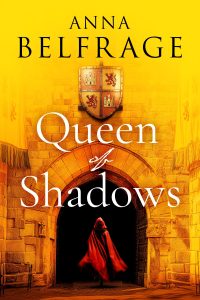 How would you describe Queen of Shadows and its themes?
He loved the fair Leonor—but was wed to Maria. Based on the true story of King Alfonso XI of Castile and his complicated relationships with his beloved mistress and his spurned wife.
Your story is based on the story of Alfonso XI of Spain and Leonor de Guzmán and follows their timeline fairly closely. Are Alma and Rodrigo entirely fictional? What bits and pieces of real people and places did you use to create them?
By now, I’ve written quite a few books centred round real people but where the story is predominantly told through my invented characters. It allows me to stir things up a bit—although in the case of Doña Leonor and el Rey Don Alfonso things are pretty stirred up anyway…
So yes, Alma and Rodrigo are purely fictional. Rodrigo is one of the king’s doncels—young men trained to become members of the king’s personal guard/mesne. This puts Rodrigo in constant proximity to the king, allowing me to have him comment on various events.
In Alma, I have a character who, due to her Moorish ancestry, stands a bit apart from the rest of my cast. This gives her leeway to reflect on everything from Christian saints to the very complicated (and sinful) nature of Doña Leonor’s relationship with the king.
Your story is told from the third-person point of view of four characters: Alma, Leonor, Rodrigo, and María. Why is King Alfonso not included?
In my first draft, he did have his own point of view, but I found the story of him and his women became more forceful without his voice. Also, Alfonso spent much more time on campaigns—against Moors, rebellious noblemen, in Navarra—than he did with his woman, and I worried we’d end up spending way too much time on various skirmishes, thereby detracting from the scenes featuring the Battle of Salado in 1340, a pivotal event in Castilian history.
Which of the main characters challenged you the most?
María of Portugal was the character that I spent the most time polishing. This is a woman entitled to her bitterness—she is young, pretty, evidently fertile, well-educated, but she is repeatedly humiliated by her husband’s preference for Leonor. A medieval queen likely did not expect her husband to be faithful, but she did expect—should expect—that he treat her with the respect due a queen.
I didn’t want María to be a weepy victim. I wanted her to be strong—if hurt. I also wanted the reader to understand how initial hurt and humiliation could harden into such corrosive hatred.
Who is your favourite minor character and why?
That’s easy. My favourite minor character is Cesaria, Alma’s talkative midwife mother, who cooks on the sly so that people won’t realise she’s too poor to hire a cook while dispensing hardnosed advice to those around her, including the less-than-appreciative Doña Leonor.
How important is it to you to travel to the places you write about? What details from your journeys did you weave into the story?
I think it is important to travel—if you can—to the places in which a story is set. In this case, I have spent many, many hours walking up and down Sevilla, Córdoba, Tarifa and Cádiz.
I have visited the site of the Battle of Salado (much closer to Tarifa than I first realised, which resulted in some serious rewriting) and walked the surprisingly mountainous terrain of Andalucía. I have sat in old, old patios where water whispers and burbles, offering relief from the browbeating heat of a southern summer, I have heard doves cooing in the holm oaks that clamber up the hillsides—and these are details I’ve included in my writing.
Looking at other books you’ve published, I see settings in 17th-century Scotland and Maryland and 14th-century England, as well as other periods in Spanish history. I assume your time-travel romances also involve various settings. What draws you to an era? How do you plunge into a new setting?
Generally, I am drawn to a period by an event. As an example, my interest in Maryland arose from a text I read about Lord Calvert and his Act of Toleration—a very novel approach in the 17th century, to welcome settlers of all Trinitarian faiths to his new colony. My fascination with 14th-century England is due to the enforced abdication of Edward II—and his presumed death.
So, it is much more about the history than the setting—initially. But to tell a story without a sense of landscape and surroundings is to leave it untethered and flat. You need colour, you need scents, light, a sense of terrain, of views, to anchor your story to somewhere.
So, once I find my setting, I do a lot of research about history, geography, climate, fauna and flora. Sometimes, I do way more research than I need to (very many months have been spent on medieval Bristol, where my characters mainly just pass through) because it is so fun! And then, as discussed above, I try to visit as well.
 What is the best writing advice you have to share?
Never write for the market. Always write what makes your heart sing. Okay, so sometimes the heart doesn’t sing all that much, it groans due to uncooperative characters or writer’s block. That’s when you need to persevere, when you need to type those 500 words a day—knowing you’ll end up deleting them because they’re c***—because at some point, your character will deliver, and your words will flow.
What is the last great book you read?
Escape of the Grand Duchess by Susan Appleyard

HNS Sponsored Author Interviews are paid for by authors or their publishers. Interviews are commissioned by HNS.