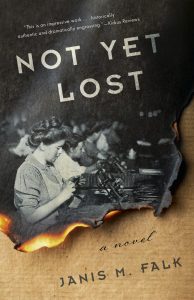
Launch: Janis M. Falk’s Not Yet Lost
INTERVIEWED BY WAHEED RABBANI
“Rivera’s mural taught me to find beauty and worth in the working class, in my family, my heritage, and me,” writes Janis M. Falk on her website. Falk, born in Detroit, resides in a 157-year-old log cabin on an organic farm in Door County, Wisconsin. Her Not Yet Lost is an impressive debut novel of East European emigrants’ experiences and struggles in Depression-era Detroit.
 How would you describe this book and its themes?
Not Yet Lost is an underdog story about Eastern European immigrant women who fight against worker oppression in Depression-era Detroit, despite opposition from many—even their husbands. It is gritty, cinematic, morally ambiguous, and based on true events.
It seems this is your first historical fiction novel. Why did you choose to write about this pre-WWII period in Polish and US history?
While conducting genealogy research on my father’s family and the Polish neighborhood of Detroit in which he grew up, I came across the story of women working in the cigar factories who were attacked with smoke bombs and fire hoses by police and government officials—only because they dared to seek better wages and working conditions. I was incensed that people could be treated that way by people with glorified legacies. Also, I see parallels to today’s socioeconomic environment, in which private equity dominates our world at the expense of workers.
What was the inspiration for choosing the intriguing title, Not Yet Lost?
Not Yet Lost is the title of the Polish National Anthem. The phrase refers to Poland’s fight for survival. The country has been “partitioned,” at least three times and occupied several times, but if Poles retain their culture and community, they are not lost.
In the novel, women occupying the factory dance to the anthem, which serves as a metaphor for the women refusing to be silenced by the powers that be and the Polish diaspora in general. Incidentally, Ukraine’s national anthem is similar in title and in sentiment. Ukraine, like Poland, has been overrun repeatedly.
Have you been to your novel’s settings? What details from your journey did you weave into the story?
I grew up in Detroit. The Poletown neighborhood has changed significantly since the Depression era, and the cigar factories shuttered long ago. Paradise Valley and the Black Bottom neighborhoods were destroyed in the mid-twentieth century for construction of a freeway. Many locales were informed by snippets of family lore bolstered by research.
I have, in fact, been to several of the locales, which are longstanding Detroit icons, Boblo Island, Jacoby’s Bar, Detroit Institute of Arts, and the general residential neighborhood of Poletown. Since the novel is set almost 100 years ago, much of the detail was mined from family stories, my own as well as my in-laws.
Is there a specific building or item within the story that means a lot to you?
The courtyard at the Detroit Institute of Arts in which the Diego Rivera Detroit Industry murals reside is a special place to me. I saw the murals at a young age on a school field trip, and they made a huge impression on me. As a working-class kid attending an elite school on scholarship, the murals taught me to find beauty, worth, and pride in the working class and in my heritage. The murals exalt creativity and work, secondary to the actual end product and subsequent financial rewards. I bring Diego Rivera alive in the novel to serve as an observer and moral compass.
Which of the novel’s characters challenged you the most?
Florence proved the more difficult character to flesh out, at least in the beginning of the book, though her transformation provides the central story arc. A sassy instigator like Basia is easier to write. Conflict comes naturally. A quieter, more complacent character like Florence challenges a writer to properly present interiority without excessive exposition. I worked hard to deepen her character so the reader would care about her dilemma and cheer for her as she found her voice to lead the labor movement.
Given the emotional ending of the book, do you plan a sequel? Or if not, what book is next in your writing plans?
I like how I ended the book. I hope readers would sit with it a bit and consider the meaning. Yes, the ending leaves the opportunity for a sequel open. Following the characters through the wartime experience in Detroit would be engaging to me. Detroit powered World War II, and without its manufacturing and engineering prowess, who knows where we would all be? Many of the same themes of societal pressures and prejudices against immigrants, in general, and Eastern Europeans in particular, run through the 1950s, the McCarthy Era.
Picking up the story in the 1950s illustrates how the wartime experience continues through generations. Some of the immigrant characters in Not Yet Lost left family members back in Europe, which would enable me to share their war time experiences in Poland. I hesitate to offer more spoilers, but maybe I’ve started to write it!
 Based on your writing experience, what advice can you share with HNS members, particularly writing from the point of view of a European American?
My closest relative from Europe was one grandfather, who emigrated from Russian-occupied Poland through Canada to the US in early 1900s. If writing for the American market, take extra care to contextualize nuances of history. As authors, we become immersed through experience and research in our subject matter and fail to realize others may not share the same knowledge of our cherished topics. People likely are reading our books to learn something.
Consider erring on the side of too much explanation, artfully rendered, especially now, when school curriculums focus on STEM (Science, Technology, Engineering, and Mathematics) subjects and are broadening the scope of history and literature to take a wider world view.
Additionally, as we are now at the 250th-year mark of America’s existence, our population has become more diverse and less European centric. With advancing generations, connections to the “old world” and oral histories fade.
What is the last great book you read?
The Sympathizer by Viet Thanh Nguyen

HNS Sponsored Author Interviews are paid for by authors or their publishers. Interviews are commissioned by HNS.