The Falcon’s Eyes
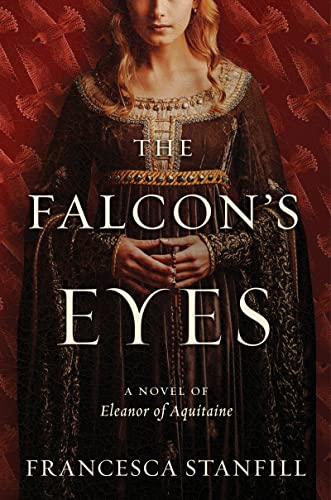
This weighty, rambling novel will please readers who like traditional medieval epics about damsels in unhappy arranged marriages, as long as they’re not too particular about psychology or history. The Falcon’s Eyes narrates in painstaking detail the life of an unremarkable but persistent young woman who happens to enter the orbit of Eleanor of Aquitaine near the end of her eventful life. Isabelle comes from impoverished French nobility and is married off to a mysterious gentleman obsessed with falconry and his family lineage, and not much else. Remarkably naïve even for a teenager, it takes her several years to discover that her lord and master is a rotter; she escapes with the help of a rich patroness and a wise woman in the woods, and is lucky enough to gain entry into the Abbey of Fontevraud, Queen Eleanor’s final home, where she gets to enjoy a conveniently well-funded second chance at a meaningful life.
Stanfill’s novel is nothing if not ambitious, and she crams it full of details about 13th-century manor life, Anglo-French politics, and the beautiful landscapes Isabelle traverses, seemingly endlessly. Stanhill’s style is more Regency than medieval, which isn’t necessarily a problem, but the novel contains numerous anachronisms as well; embroidery hoops, nativity scenes, and Christmas trees all make an appearance many years ahead of their time, and the action often stops cold for long, intricate descriptions of Disney-princess-style gowns.
Ultimately, Isabelle is an inconsistent heroine—everyone keeps telling her how intelligent she is, but she makes one questionable choice after another. She’s innocent and conniving, wary and credulous, scientific and superstitious, whichever it suits the author that she be in a given moment, so she never quite gels as a character through the 800+ pages of the narrative.