Launch: J. M. Elliott’s Of Wind and Wolves
INTERVIEWED BY LESLIE S. LOWE
J. M. Elliott lives on a Hudson Valley farm, away from the hustle of modern life. She prefers hiking boots to heels, work gloves to manicures, and humble stories to showy prose. When not reading historical fiction, she might be riding a horse, exploring archaeological sites, or trekking where cell signals don’t reach.
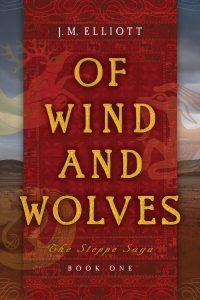 How would you describe this book and its themes?
Of Wind and Wolves is a historical novel set on the ancient Scythian steppe. It follows an untested young “Amazon” warrior who must take an enemy’s scalp to earn the right to marry—but the choice between duty, freedom, and conscience may cost her everything.
What attracted you to writing historical fiction?
Before I began this project, I’d never thought about writing fiction. If this story hadn’t been swarming around inside my head, I probably never would have tried. But my background, if I can call it that, is in archaeology, and I’ve been mildly obsessed with ancient history since I was a kid, so if I was ever going to write fiction, it was bound to be historical. This story and the culture it’s based on seized my imagination, probably because it combined so many things I love: horses, antiquity, and barbarians.
What are you working on now, and is it related to The Steppe Saga series in any way?
I’m getting The Gifts of Heaven, Book Two of The Steppe Saga, ready for publication early next year. I’m eager to continue this story, which expands on Herodotus’s account of Scythian King Ariapeithes and the rivalry among his three sons, while further developing Anaiti’s story and her role in these events.
What difficulty did you have in writing this one, and how did you overcome it?
Like many writers, I find time is my biggest challenge. I work a full-time job, have a three-hour commute, and manage a large farm on my own. A while back, I took flying lessons and repurposed a kneeboard to take notes while driving. That’s often when my best ideas come—when my mind isn’t busy with work. About 75 percent of my writing happens in the car. At night or on weekends, I transcribe whatever’s legible—it’s a mess because I can’t look while I write! But I make it work.
Is there a key historical event you found in researching that inspired you to write this story to portray a key message prevalent now?
I was inspired by Herodotus’s account of a Scythian king’s assassination and the ensuing struggle for succession among his three sons—each with a different mother (one Greek, one Thracian, and one Scythian). Set amid tribal warfare and Greek colonization, the events center on the conflict between Greek colonists and Scythian natives. Herodotus largely blames xenophobia for the violence, but my understanding of Scythian culture led me to question this view, as we have only Greek accounts. I wanted to explore the story from a Scythian perspective. The narrative intrigued me, especially the contrasting Greek and Scythian views on women’s roles and the natural and spiritual worlds. Although it’s tempting to map all this onto the present, I prefer to let the story stand on its own, without any particular agenda.
What kind of research did you do for this story?
Texts and artifacts were the only firsthand testimony I wanted for my story. When putting this narrative together, I drew on fields as diverse as archaeology, anthropology, ecology, history, and linguistics. I don’t know if there is such a thing as “method writing,” but I also learned skills like traditional archery, foraging, cooking over a fire, and blacksmithing/bladesmithing because I felt my characters would know those things in a visceral way and I should too. I also live on a farm and have worked as a horse trainer for most of my life, and that experience was probably invaluable.
How do you feel readers will connect Anaiti? What did writing her journey mean to you personally?
Some may love Anaiti; others not so much. And that’s okay. I just hope she comes across as a convincing female warrior, especially since this kind of character can sometimes feel unrealistic. I personally find exaggerated female traits patronizing, as if real women aren’t enough and we need to create these idealized fantasies to boost self-esteem. Overcompensation is a tacit admission of inferiority. For me, making Anaiti an ordinary woman—someone who’s vulnerable and doubtful but also capable and resilient—felt important. I wanted her to be grounded in physical and historical reality. She’s not superhuman or sexy, but she feels real. That’s what matters most to me.
Every author has their own publishing journey. Tell me about yours.
My path to publishing has been kind of crazy. I never planned to publish the book. For me, writing was more like working on a narrative jigsaw puzzle, a mental exercise. But as the story developed, I wondered whether anyone else would find it interesting. In 2018, I attended a conference and unexpectedly found an agent. It didn’t sell, though. I eventually concluded that my unconventional book was probably too far outside the industry’s field of vision to really be seen and decided to keep writing purely for my own enjoyment. In 2022, I serialized it on my Substack, where it received support from a wonderful bunch of readers. So, in 2025, I took the indie publishing plunge. Overall, it’s been a fantastic experience, and I never could have imagined the positive response—several starred reviews and now an IPPY Award in historical fiction!
 What advice would you give to other aspiring historical writers?
This will sound weird, but to (mis)paraphrase Nietzsche, when you gaze long into the past, the past also gazes into you. Writing evocative historical fiction demands deep sympathy for your subject, which you gain by looking through others’ eyes and living in their world—not as a tourist or spy, but as a citizen. If you’re genuinely interested in portraying your setting, characters, and subject fairly—not just using them as props—you have to suspend your biases and agendas and, as much as possible, become one of them while you write. History (ideally) employs objectivity and detachment, but historical fiction requires immersion, perception, and empathy. Some anthropologists even “go native” when studying a culture for these reasons. You might personally disapprove of aspects of the setting or characters you’re writing about, but to write authentically from another perspective, you have to be willing to “go native,” at least in your imagination.
What is the last great book you read? Why?
The last book I finished was William Ian Miller’s Humiliation, which explores humiliation and reciprocity, especially in relation to ancient honor codes and their continued relevance. I’m fascinated by honor and the various honor cultures. We’ve attempted to eradicate their values from our society, but the underlying motives never leave us. Miller thoroughly examines this powerful element of social behavior, which I keep front and center when I write about ancient cultures. There’s also a wonderful chapter on gifts, which I especially enjoyed because the theme appears repeatedly in The Steppe Saga. It’s a thoughtful and surprisingly engaging book for such an uncomfortable subject, and I only wish I’d read it sooner.

HNS Sponsored Author Interviews are paid for by authors or their publishers. Interviews are commissioned by HNS.