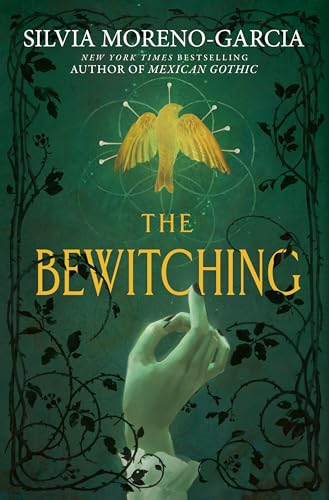
The Bewitching
In spellbinding gothic horror, The Bewitching tells three women’s stories: Minerva at a New England college in 1998, Virginia at the same college in 1934, and Alba in rural Mexico in 1908. Minerva had taken care of an aged Alba, her great-grandmother, and been told “tales of witches who drank the blood of the innocent on moonless nights.” Minerva and Alba narrate their own stories, but Minerva uncovers Virginia’s life through a found manuscript and interviews as she researches her thesis. That research turns threatening as she battles uncanny forces in the college town. Over the years, people have disappeared. Will Minerva suffer the same fate?
In what appear to be neutral setting details, Moreno-Garcia contrasts scholarship students and migrant workers, foreigners without money or societal protections, with the privileged class that populates the college and its donors. On scholarship far from her sole family member, Minerva “couldn’t afford to be anything except excellent… now she was slipping up.” Within the Mexican setting, a similar elite are juxtaposed with poor farmers. But with brilliant craft, Moreno-Garcia deploys the vulnerabilities these systemic imbalances create to infuse driving suspense throughout the novel.
At the core of The Bewitching lies an eloquent warning to pay attention to the resonances of folklore about witches. A character makes a passing reference to Jung and the universality of magical folklore, but for Moreno-Garcia, folk traditions must hold an even more pressing, flesh-and-blood place in our lives. In dramatic, page-turning scenes the characters wield passed-on magical knowledge as weapons against creeping shadows of evil. Whether witches and warlocks are real or not doesn’t alter the value in such generational attention to folk traditions. Creeping evils never disappear, and the innocent are still bled dry. A highly recommended, gripping, intelligent novel.