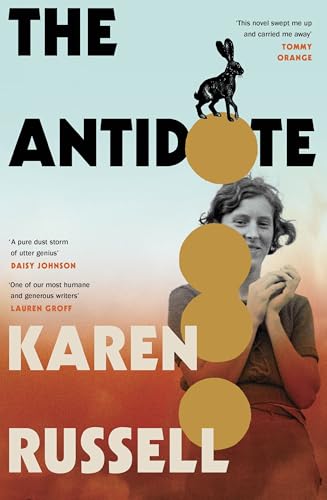
The Antidote
Harp’s earliest memory is the killing of the jackrabbits, crying and dying. Orphaned—Dell’s mother Lada ran away with ‘a roustabout’ and got murdered—she has come to live with Uncle Harp in Uz, Nebraska, in the middle of the Depression and a four-year drought. It is an ‘edgeless prairie’ where ‘cored cottonwood trees told a millennial story written in wavy circles’, plagued with grasshoppers, jackrabbits and indigo beetles.
‘The Antidote’ is a career prairie witch, a ‘bank’ for her customers’ ‘deposits’—memories, sins and secrets. But like the dust storms washing away the prairie, she finds herself empty, bankrupt like the farmers around her, facing her customers’ fury. She recounts the daily occurrences in Uz in a unique voice, sometimes aided by the town gossip, sheriff’s wife Dottie. In the face of catastrophic weather, urban legends abound. Other chapters pass the narration to Dell, Harp, the government photographer or ‘the Scarecrow’. The unorthodox way of expressing things lends unmistakable personality to the narration.
Dell’s chapters are in a charming child’s-eye-view. This provides useful distance, as if, had it been an adult telling the story, it would have been too bleak. Poignantly, The Antidote’s chapters are told in second person, addressing the son taken away from her at the Home for Unwed Mothers, whom she believes to still be living. The atmosphere is eerie, echoing the emptiness of the land, with a sadness due to the difficult circumstances, but tinged with wit. The desolation of the farmers, ‘like a dog trying to quench his thirst with his sweat’, is evocatively portrayed. We only gradually learn the nature of the ‘magic’ she practices, page 101 before we learn her name.
The beautiful writing and gorgeous innovative metaphors keep you reading, wanting to find out more. The best book I’ve read in months.