Launch: Miranda Miller’s The Fairy Visions of Richard Dadd
INTERVIEW BY TRACEY WARR
Miranda Miller has published a book of interviews with homeless women and politicians, a book of short stories about Saudi Arabia and nine novels. She was a Royal Literary Fund Fellow at the Courtauld Institute. She has lived in Italy, Libya, Saudi Arabia and Japan and now lives in north London.
An exhibition of Richard Dadd’s paintings is at the Royal Academy in London until 25 October 2026 and his work The Fairy Feller’s Master Stroke is in the permanent collection of Tate Britain.
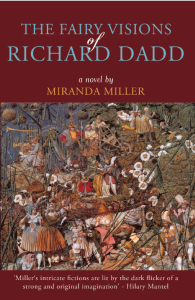 How would you describe The Fairy Visions of Richard Dadd and its themes?
In this novel, I have attempted to explore the artist Richard Dadd’s inner life and his relationship with the Victorian reformer, Dr Hood. Dadd is haunted by the voices of vicious fairies, his dead father and the Egyptian god Osiris.
Dadd suffered from what today would probably be diagnosed as schizophrenia. He murdered his father and spent most of his life, from the age of 26, in Bethlem and then Broadmoor hospitals. What attracted you to writing about Dadd?
When I was writing my sixth novel, Nina in Utopia (Peter Owen, 2010), I felt a shock of recognition when I discovered that Richard Dadd would have been in Bedlam at the same time as Nina, my fictional heroine. Up to that point I thought I was writing a gothic novel and assumed that a lunatic asylum in the 1850s would have been a horrific place, like the Bedlam represented in Hogarth’s The Rake’s Progress.
However, when I visited the archives of the Royal Bethlem Hospital in Kent, near Beckenham, I discovered to my surprise that Dr Hood had carried out the reforms I’ve already mentioned. In Swiss Cottage Library I discovered Patricia Allderidge’s fascinating book, The Late Richard Dadd, which vividly describes Dadd’s isolation and stoical determination to go on working. His long years of incarceration were not lost because, heroically, he continued to produce mysterious and beautiful work.
I felt that twitching of my inner antennae that was the sign I wanted to write about him. Yet it seemed presumptuous to write about a real person—I’d never done that before. In fact, a friend, also a writer, accused me of cheating. According to her argument, a novelist’s job is to invent characters and plots, not to take them ready made from the peg of history. My own point of view is that a novel can contain absolutely anything, and there are no rules about what you can or can’t wite about.
Dadd appeared as a minor character in Nina in Utopia and, after I finished writing that novel, he was still so alive for me that I felt I had to give him a novel of his own. It was difficult and painful to write about madness from his point of view. In my novel he is haunted by the voice of his dead father, by his increasingly vicious fairies and by the Egyptian god Osiris.
The novel uses two voices: Richard Dadd and Dr Hood. Can you tell us something about the challenge of creating a first-person narration from the perspective of a person with a serious mental illness?
I’ve tried to dramatize his hallucinations without being able to use any psychological jargon which, of course, didn’t exist at the time. I was deeply moved by the life of this sensitive, gifted man who managed to carry on drawing and painting despite his tragic destiny. I decided his story had to be told in the first person and struggled to find a voice. Strangeness and obscurity are attractive qualities in art, but I didn’t think my novel would be readable unless the narrative voice was lucid.
What resources did you draw on to create the character of Dr Hood?
I had expected to find that, at this time, mental patients were treated abominably. But when I visited the Bedlam archives, I discovered that in 1853 a new young resident physician, Dr Charles Hood, was appointed and carried out a number of liberal reforms. He and the other doctors encouraged Dadd to paint and even collected his work. I was inspired by Hood’s idealism, and in the British Library and the Wellcome Library, I read everything I could lay my hands on about his life and about attitudes to mental illness in the 1850s. Unlike earlier doctors, Dr Hood lived in the hospital with his wife and children. Mental illness was then considered a very unimportant branch of medicine and, of course, psychiatry had not yet been invented; Dr Hood was known as an alienist.
Was it significant for you to be able to draw on Dadd’s visions of twenty-first-century London?
Although each of the three novels in my Bedlam Trilogy is self-contained, they are linked by the themes of art, madness and time travel. While the nineteenth century has always felt quite familiar to me, perhaps because I’ve read so many Victorian novels, I found myself incapable of staying there. Most historical novels ask: What do we think of them, those long dead people? I kept wondering what they would think of us, and so in each novel the main character visits or dreams of twenty-first-century London.
These modern sections were the hardest to write. I went for long walks around London, trying to imagine how someone from the nineteenth century would view today’s city and its people, while still allowing for the protagonists’ individual perspectives.
To some extent, of course, we always see what we already know. Nina notices how relations between men and women have changed, perceiving “a wonderful city where men and women live quite freely and without lies and hypocrisy.” Dadd, who is bisexual in my novel, notices that same-sex love is now permitted. Sitting on the steps of St Paul’s, he watches two young men kissing, noting how “they are beautiful, shameless, and nobody except me is staring at them”, before they “walk off hand in hand. My heart soars as I watch them and will them to be happy together.”
The subjects of Dadd’s paintings include the fairy worlds of his visions, scenes from his Eastern Mediterranean travels, and portraits of his doctors. Did you draw on knowledge about art therapy and art history in writing the novel?
Although art therapy didn’t exist in the 1850s, Richard Dadd was encouraged to carry on drawing and painting and in 1857, the year when my novel is set, he was given a spacious room in which to paint where he began to produce his best work. You could say that this was art therapy avant la lettre. I am not an art historian. My response to art is personal rather than analytical.
Was highlighting the contemporary treatment of mental illness an important factor for you in writing the novel?
Recently, after I gave a talk about this novel, a young woman came up to me and told me that her stepbrother, who had been diagnosed with schizophrenia, murdered her father. He was sent to Broadmoor for two years and then freed on condition that he took his medication. This was a sharp reminder that such tragedies can and do occur in every century. I hope our treatment of mental illness is becoming more compassionate, but I don’t really know because I don’t work in that field.
 Can you tell us about your publishing process?
My seventh novel, The Fairy Visions of Richard Dadd, was first published by Peter Owen in 2013. Sadly, Peter Owen died in 2016, his company no longer exists, and I now own the rights of the four books of mine he published. This one is now out of print and my husband Gordon and I decided to reprint it to coincide with the exhibition of Richard Dadd’s work at the Royal Academy this summer. After conventionally publishing eleven books, this is my first venture into self-publishing, and it’s too soon to say whether this will work for me.
What is the best writing advice you have to share?
Iris Murdoch advised me to include “something for everyone” in a novel. I think she meant that a novel should work at many different levels.
What is the last great book you read?
The Silence of the Girls by Pat Barker

HNS Sponsored Author Interviews are paid for by authors or their publishers. Interviews are commissioned by HNS.