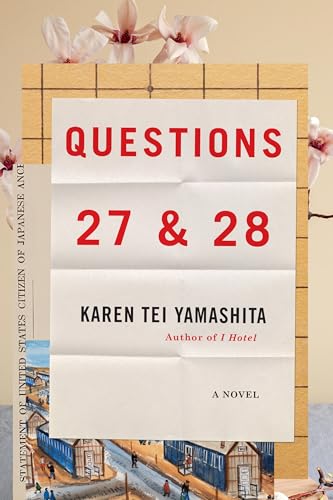
Questions 27 & 28
In response to the December 1941 Japanese bombing of Pearl Harbor, in 1942 President Franklin D. Roosevelt issued an executive order authorizing the detention of Japanese Americans on the west coast of the United States in the name of national security. This incarceration was indiscriminate, and many of those forced into inland internment camps were American citizens who spoke no Japanese and had never set foot in Japan. Inmates were given a loyalty questionnaire to prove their allegiance to the United States, but this was less straightforward than assumed. Questions 27 (whether they would enlist in the U.S. military) and 28 (whether they would renounce allegiance to the Japanese emperor) proved contentious. The answers sowed division between friends and families, and their repercussions impacted later generations.
Karen Tei Yamashita’s lyrical and inventive novel explores generations of Japanese Americans and the trauma wrought by internment and by these loyalty questions. Her book is told through twenty-three vignettes of real Japanese Americans, mostly artists, writers, and scholars. Some of the stories are told through narrative prose; the rest are told through documents like letters, telegrams, oral histories, memoirs, haikus, news articles, and testimonies. One is partially narrated by a collection of cameras. This style gives the feeling of being plunged into an archive to sift the human stories from the typewritten records. Yamashita’s work is literary fiction, but so tightly woven with the historical record that she blurs fact and fiction. She liberally and extensively quotes from primary sources, sometimes creating narrative just in the juxtaposition between excerpted material. And she is successful.
Questions 27 & 28 is emotional, vital, and effective at showing the impact of internment on a population of Americans. Do look up each of these characters after reading to learn more about their remarkable lives beyond the tantalizing sliver in Yamashita’s novel. Superb!