Resources on historical manners and etiquette

Children in Montreal learning to bow and curtsey, 1943
BY B.J. SEDLOCK
Do the characters in your novel conform to (or rebel against) expected “proper” behavior? You might want to research the etiquette/manners in your novel’s time period so you get the facts right.
Etiquette and manners are closely related, but are not quite the same thing. I had a lot of trouble figuring out how to state the difference in one sentence. Here’s what I came up with: Etiquette is a set of rules governing society’s expectations of behavior, whereas manners are how you apply those rules to make others around you feel comfortable.
Example: etiquette might dictate how a table setting is arranged at a formal dinner and the order in which utensils are used, but manners would influence how you treat your table neighbor’s action if they picked up the wrong spoon for the soup course. Make fun of them, or help them by quietly signaling that they should use a different one?
Consult these sources to research how your character might behave either correctly or incorrectly according to the etiquette of the time. Unless otherwise stated, illustrations are from Wikimedia Commons and in the public domain.
Print books, secondary sources
BOWING TO NECESSITIES: A HISTORY OF MANNERS IN AMERICA, 1620-1860, by C. Dallett Hemphill. Oxford University Press, 1999. 0135125576
“An examination of the changing rules of class, age, and gender relations in early America”—p.5. Chapters include the middle class, youth vs. adults, and sex differences. It has a very impressive bibliography of primary source etiquette books from the period.
FROM COURTESY TO CIVILITY: CHANGING CODES OF CONDUCT IN EARLY MODERN ENGLAND, by Anna Bryson. Clarendon Press, 1998. 019821765x
Examines the advice literature of early modern England, rather academic in tone.
GROWING UP JIM CROW: HOW BLACK AND WHITE SOUTHERN CHILDREN LEARNED ABOUT RACE, by Jennifer Ritterhouse. University of North Carolina, 2006. 9780807856840
The author consulted autobiographies and oral histories from the deep South to find out how Southern children, both Black and White, learned the code of “racial etiquette” in the Jim Crow era.
HOW TO BEHAVE BADLY IN ELIZABETHAN ENGLAND: A GUIDE FOR KNAVES, FOOLS, HARLOTS, CUCKOLDS, DRUNKARDS, LIARS, THIEVES, AND BRAGGARTS, by Ruth Goodman. Liveright Publishing/Norton, 2018. 9781631495113
“An exploration of the written and unwritten rules of Tudor and Stuart England, and how people went about breaking them…a study of all the niggling, antisocial, irritating ways that people used to kick against prevailing social mores”—p.3. Includes rude hand gestures, fencing rules, and bad table manners.
MOURNING DRESS: A COSTUME AND SOCIAL HISTORY, by Lou Taylor. George Allen and Unwin, 1983. 0047460164

Queen Victoria’s daughters in mourning clothes for their father, 1862. Mourning dress had complicated rules in that era
If your novel has a plot element involving a death and period of mourning, this book could be helpful. Chapters cover mourning dress and etiquette between 1600 and 1910, children’s dress, jewelry, and how mourning traditions changed after 1910.
THE POLITE WORLD: A GUIDE TO THE DEPORTMENT OF THE ENGLISH IN FORMER TIMES, by Joan Wildeblood. Davis-Poynter, 1973. 0706701097
Covers medieval times to 1929. One section covers manners for portrayal on stage. Appendices give details on the history of bowing and curtseying, and meaning of fan gestures.
RITUALS OF DINNER: THE ORIGINS, EVOLUTION, ECCENTRICITIES, AND MEANING OF TABLE MANNERS, by Margaret Visser. Penguin, 1992. 0140170790
This might be a bit difficult to use if you are researching one particular era, as the author deliberately does not organize her material in chronological order or by location. Consult the index to find the relevant passages on forks, ancient cultures, British vs. American manners, use of wine, etc.
SAVAGE OR CIVILIZED? MANNERS IN COLONIAL AUSTRALIA, by Penny Russell. New South, 2010. 9780868408606
“Tell people you are writing a book about Australian manners and they tend to laugh, and ask whether you have found any yet”—p.1. About the conflicting savage vs. refined manners in early Australia. I found the chapter on the experiences of a frontier governess particularly interesting and a good source of story material.
UNCOMMON HISTORY OF COMMON COURTESY: HOW MANNERS SHAPED THE WORLD, by Bethanne Patrick. National Geographic, 2011. 9781426208133
“It’s about different ways common courtesy is practiced and demonstrated around the world, including different cultures, regions, and even time periods”—p.9. This would be a good introduction to manners in general, a lot of the material covers present-day, but it does contain some historical information, such as early alcohol practices, and the influence of the Duchess of Orleans on pre-French Revolution manners.
UNMENTIONABLE: THE VICTORIAN LADY’S GUIDE TO SEX, MARRIAGE, AND MANNERS, by Therese Oneill. Little, Brown, 2016. 9780316357913
Humorously educates readers who don’t realize that beloved books/films/TV shows set in the 19th century skip over the nitty gritty details of life, like toilet habits, how women coped with periods, and the absurd rules of courtship.
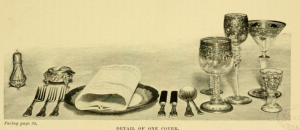
Place setting in 1902 for a formal or semi-formal dinner of 6 courses from Mrs. Seely’s Cook Book
WHAT WOULD MRS. ASTOR DO: THE ESSENTIAL GUIDE TO THE MANNERS AND MORES OF THE GILDED AGE, by Cecelia Tichi. Washington Mews Books/New York University Press, 2018. 9781479826858
Covers customs among the wealthy New Yorkers during the last quarter of the 19th century. Chapters cover fashion, dining etiquette, funeral practices, and correspondence. It also has a list of Mrs. Astor’s “Four Hundred” society leaders, if you want to incorporate a real-life family into your novel which moved in the highest circles.
Print books, primary sources
ETIQUETTE IN SOCIETY, IN BUSINESS, IN POLITICS AND AT HOME, by Emily Post. Funk & Wagnalls, 1922.
THE etiquette authority for Americans in the 20th century, still being published long after her death. This is her earliest edition, in which she notes “Etiquette must, if it is to be of more than trifling use, includes ethics as well as manners.” It’s interesting to compare Post’s advice on the same topic in different editions, such as smoking etiquette or playing sports and games. The Emily Post Institute continues her work since her death in 1960.
THE LADY’S STRATAGEM: A REPOSITORY OF 1820S DIRECTIONS FOR THE TOILET, MANTUA-MAKING, STAY-MAKING, MILLINERY & ETIQUETTE, edited by Frances Grimble. Lavolta Press, 2009. 9780963651778
While published in 2009, the book is a translation of several French works from the 1820s and 30s. Much of the work is instructions on dressmaking, cleanliness, advice for maids, etc., but the section on etiquette will be useful. The original works were “written for a solidly Bourgeois audience…,” so if your novel is set in late Regency/early Victorian times in western Europe and the characters are middle class, this would be very helpful, such as advice on a widow’s conduct, propriety at home and on the street, etc.
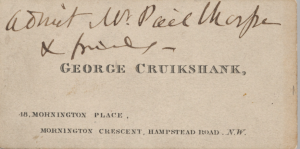
Caricaturist George Cruickshank’s calling card, between 1830-1878. Leaving calling cards had complex etiquette rules in his era
LETTERS TO HIS SON, by Philip Stanhope, fourth Earl of Chesterfield. Folio Society, 1973.
An important milestone in the field, published in 1774, offering advice on etiquette and good manners to 18th century audiences, such as how often to clean one’s teeth, why loud laughter is poor manners, and the art of pleasing others. Also available online in Project Gutenberg, see below.
NEVER GIVE A LADY A RESTIVE HORSE: A 19TH CENTURY HANDBOOK OF ETIQUETTE, by Thomas E. Hill. World Publishing, 1969.
While this was published in the 20th century, it is a selection of reprinted pages from Hill’s Manual of Social and Business Forms from 1873. Has sections on the language of flowers, recommended speaking gestures, how to raise good children, and proper modes of dress. There’s a passage in one of Georgette Heyer’s novels where the male half of the couple tries to restrain the female’s fractious riding horse, and she is infuriated that he assumes she isn’t competent to handle the horse—an example of a character rebelling against the prevailing etiquette.
POLITE SOCIETY AT HOME AND ABROAD: A COMPLETE COMPENDIUM OF INFORMATION UPON ALL TOPICS CLASSIFIED UNDER THE HEAD OF ETIQUETTE, by Annie R. White. J.H. Moore, 1891.
A period resource aimed at an American audience, which covers how to greet the President, wedding customs (bridesmaids wore white, not the bride), funerals, table manners, etc. If you have an American character who wants to rebel against society, this would give you a lot of story ideas of rules they could break.
REGENCY ETIQUETTE: THE MIRROR OF GRACES (1811), by a Lady of Distinction, enlarged ed. R.L. Shep, 1997. 0914046241
A 20th century reprint of the 1811 Mirror of [the] Graces. Covers deportment, manners, including examples from outside England, gives advice on dress. An appendix has period beauty product recipes. Original 1811 edition is also available online at Hathi Trust, see below.

Doffing one’s hat to a social superior (1896 illustration from an edition of Robinson Crusoe)
ONLINE RESOURCES
As usual I avoided listing .com commercial websites.
ETIQUETTE IN EARLY MODERN ENGLAND (2 PARTS)
First of a two-part article by Karen Lyon in 2017 from the Folger Shakespeare Library site about 16th-17th century English manners and etiquette. This link will take you to part 2.
MINDING YOUR MANNERS IN THE MIDDLE AGES
Article by Kathryn Walton about manners taught to children in the Middle Ages.
RENAISSANCE TABLE ETIQUETTE AND THE ORIGINS OF MANNERS
Article by Jesse Rhodes from 2011 from Smithsonian Magazine with quotations from period books on manners in the Renaissance era.
A TED talk video, “The School of Life teaches us some fun facts about the history of politeness.”
Good information for an overview of the topic.
A database of over 79,000 e-books. It’s more difficult to search this database by date than the two listed below. You can search on “etiquette” in the quick search box, and then sort by “release date,” but if the book is a reprint from the 21st century of a 19th century title, then it’s going to be listed by the reprint date, not the original pub date. You may just have to do a lot of paging forward. The “search options” bar doesn’t have a date search filter either.
Offers many etiquette e-books both current and from centuries past. To the left of the search box, use the arrow to select “books/documents” and then put “etiquette” in the search box. Then use the year filter on the left to select a book from the era you are researching. There are thousands, all freely available.
A collaborative of research libraries that provides access to digitized print collections. If you only type “etiquette” in the search box, you’ll retrieve a lot of extraneous material. It might be better to change the “full text and all fields” drop-down choice to “subject” and then search on “etiquette,” to get 1000+ books rather than 700,000+. The “date of publication” filter box will let you narrow the results by date.
About the contributor: B.J. Sedlock is a semi-retired archivist at Defiance College in Defiance, Ohio. She writes book reviews and articles for The Historical Novels Review, judges the First Chapters contest, and has contributed articles to The Sondheim Review and Northwest Ohio History.