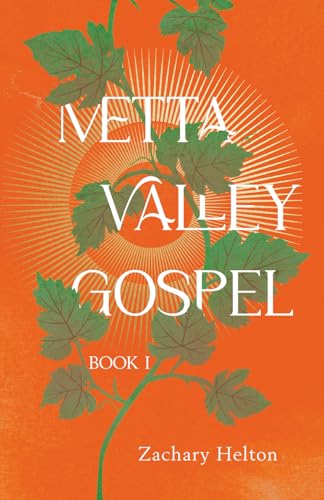
Metta Valley Gospel: Book 1 (The Metta Valley Gospel Series)
“Any religion can be co-opted by narcissists, fearful people, and power-grabbers,” Zachary Helton says in his author’s note. ‘They [religions] can be vehicles for abuse and harm, just as they can be vessels for justice and love. I hope this novel embodies both.’ It does. Powerfully and entertainingly.
Fleeing his home in Judea after a vitriolic encounter with his rabbi, Jesus becomes a homeless exile in Kashi, on the Ganges River. Weak and hungry, he is offered employment by the luminous character of Abraham, a vineyard owner and fellow Judean exile, whose history echoes Jesus’ own clash with the hierarchy of their religion. Years before, trained as a Pharisee but banished for rebellion, Abraham had been cared for by a Buddhist community in Metta Valley. There he regained his faith in the essential humanity that lies beneath scripture, and made it his mission to share that humanity. Jesus’ disenchantment with his faith is soothed by Abraham’s wisdom, but when he too travels to Metta Valley, he faces an uphill battle to reconcile himself with his damaged history, the shame of his birth, and the flaws of his volatile nature.
Arrogant and impulsive, Jesus makes an effective Everyman – which is infinitely arguably what he should be – both experiencing and exhibiting the prejudice, self-doubt and anger that all of humanity knows. And then there is the devastating, crushing, terrifying, scene of the Temptation, where the voice in the wilderness debases Jesus and inflames his grievances, alternately urging him to submit to religious and temporal authority, or to take up a sword against it.
Metta Valley Gospel can and should be read by everyone – especially by those who shy away from religion – if only to remind us of the power that can be wielded by those who are inclined to wield it.