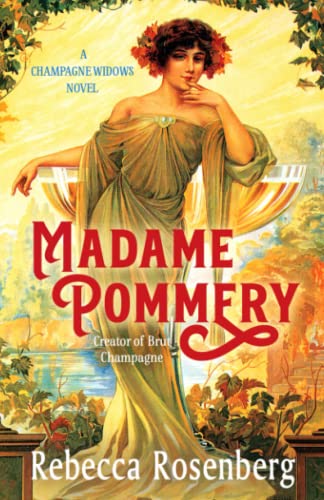
Madame Pommery (Champagne Widows Novels)
In spite of opening on a dark note, here we move crisply into more vivacious territory, passing through a multiplicity of contrasts to a nice finish that embodies lightness and joy. Effervescence and sweetness, however, are always tempered by a strong mineral edge. Rebecca Rosenberg’s Madame Pommery is the fictionalized biography of an extraordinary Frenchwoman. Widowed in 1860—under 19th-century Napoleonic law, widowhood was the only time women could own property and run businesses—Louise Pommery, following in the footsteps of her predecessor, the Widow Clicquot, took over the small family winery and transformed it into an international success.
The history of Champagne (the region) and champagne (the beverage) is long and occasionally mythological. Madame Pommery did not, in fact, invent brut champagne. (For millennia, champagne was a still, often sweet wine.) But she cleverly commercialized it, especially in the English market, where the term “brut” was actually coined. Champagne, she said, should be “joyful” and exhibit “lightness.” She also built extensive cellars in Reims’ chalky bedrock and a Victorian Tudor-style chateau above ground, married her daughter into French nobility, and was, as a business genius, the first Frenchwoman to receive a state funeral.
Rosenberg’s novel is strongest when depicting the processes of winemaking and marketing, and her main character’s personality, convincingly portrayed as both steely and sensitive. Most outstanding are the chapters where Louise Pommery’s wily courage carries her through the Franco-Prussian War. Less successful are the scenes set in high society (ducks aren’t hunted with rifles!). Overall, however, this is a zesty, bubbly novel to be savored with pleasure. A final caveat: after finishing it, one reader shopping for champagne found herself involuntarily, inexorably, joyfully reaching for a bottle labeled “Pommery.”