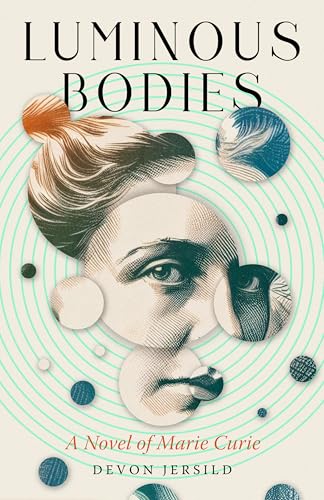
Luminous Bodies: A Novel of Marie Curie
Devon Jersild is a writer and practicing clinical psychologist who wanted to write a fuller picture of Marie Curie not just as the renowned scientist we know of today: the first woman to win a Nobel Prize, the first to win with her husband, and the first to win two Nobel Prizes (in chemistry and physics). Jersild also wanted to show her as a girl, a woman, daughter, wife, mother, lover and friend. It is told convincingly and movingly and imagines the inner life and challenges Marie Curie faced, based on known facts.
The book covers most of her life from childhood to WWI, but the focus of the story occurs from 1894-1912. Marie excelled in mathematics and physics and found getting the education she wanted challenging. She eventually moved from her home in Poland to Paris and studied at the University of Paris. This was when she met, became scientific partners with, and married Pierre Curie. They isolated radium and polonium and received the Nobel Prize for their work in radioactivity. The book describes in detail the Curies’ persistence in conducting their painstaking work in their underfunded and rudimentary laboratory. After 11 years of marriage, Pierre Curie died in a street accident at age 46. Marie’s sudden widowhood and subsequent affair with fellow scientist and friend, Paul Langevin, is a major focus of this story.
The book repeatedly demonstrates how women were not accepted as scientists in academia and had constricted societal roles. Marie’s friendship with Hertha Ayrton, a fellow scientist and suffragette, gives a glimpse of early suffragette efforts in England and the many challenges women faced as scientists. The book also reflects on the impact of her life on her two daughters, Irene and Eve. Highly recommended.