Launch: Mary Smathers’ Unfamiliar Territory
INTERVIEWED BY J. K. KNAUSS
Mary Smathers writes historical fiction, short stories, and bilingual children’s books. Her award-winning family saga through California history begins with In This Land of Plenty and continues in Unfamiliar Territory, tracing one woman’s journey through the Gold Rush and Civil War years. Her short story collection, Fertile Soil: Stories of the California Dream tells more contemporary stories. Tropical Tales is a picture book series in English and Spanish.
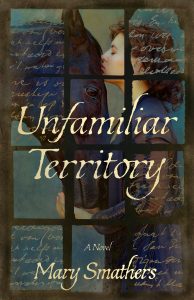 How would you describe Unfamiliar Territory and its themes in a couple of sentences?
As gold fever takes hold of California in 1850, Juanita Castro de la Cruz has lost everything—her family’s fourth-generation Mexican land grant, her livelihood, most family members, and her son. Her home, now a US state, has changed dramatically with an unfamiliar language, economy, religion, and culture.
With no resources, she is forced to be inventive to survive and find her son in the chaos of the Gold Rush. How will Juanita move through such a dangerous, male-dominated time to re-create a life and even find a way to thrive? You’ll have to read the book to find out!
What attracted you to writing historical fiction?
I’ve always loved both history and writing. In college, I obtained a degree in Latin American Studies partly because it allowed me to bridge both worlds. I could read great literature while also delving into the historical background of the Americas that influenced those writers.
I then taught high school Social Studies and English, so, again, I could enjoy both and find the crossover themes between the disciplines. During my long career in public education, I was a teacher, administrator, grant-writer, and educational entrepreneur, helping to found three education companies and a public charter school.
But I always secretly wanted to write fiction. So when I was able to make that life change and begin a second gig, merging history and writing was natural for me. And as a lifelong Californian, I felt I had a fascinating, and somewhat untapped, history to pursue.
Why this period or setting?
I grew up in Silicon Valley during its infancy, when it was famous for fruit trees rather than technology. I went to school, worked, and raised my children in Northern California. I have seen enormous changes in my home and find its history and recent incarnations fascinating.
Why is Silicon Valley and California such a hotbed of innovation? Why has the place been a beacon of hope for generations? What strengths and problems have persisted since its early days? Those are the questions that fascinate me.
I love delving into its history to find the root causes, and possibly even solutions, for many current issues. I believe that understanding our history helps us build a supportive foundation, opens us to seek common ground, and provides the motivation to move forward with longer-term thinking. I hope my historical fiction offers Californians and others a greater understanding of our shared history while taking readers on an adventurous journey via compelling characters and great storytelling.
Did you need to do much research to breathe life into your story?
Since I’ve lived in California for decades and worked in public education in low-income communities all over the state, my fiction is often inspired by the resilience of working people tackling adversity. And when I do intensive research into the past, I continue to find that the state is far from perfect, but its diverse, hard-working population is not new and is heavily influenced by its historical roots.
Gold Rush pioneers who survived the journey across the plains or months at sea around the Horn had to be hardy risk-takers, determined to succeed, often reinventing themselves to make it. Native Americans who lived here in relative peace for at least 10,000 years and then were colonized by the Spanish, and eventually the United States, had to adapt and fight as their numbers dwindled.
I scour local museums to examine artifacts. I visit archives and libraries to review primary source materials to understand what living in California’s rich past was like for our ancestors. Though I created a 250-year fictional family tree whose story unravels through my novels, I develop characters realistic in their time periods based on extensive research.
How do you get to know your characters?
Some fiction authors write detailed character profiles to flesh out a character. While I often start with a profile sheet, I quickly get to a point where I prefer to spend time in the story with the character. I want to see her in action, have her face tough decisions or extreme adversity to help me explore the complexity of her personality.
I work hard to create multidimensional characters. Fiction is only enjoyable when it is believable. An all-good or all-evil character is just not real. Even villains in this world can have positive qualities. And certainly, your protagonist needs some flaws, some weaknesses. She must make some terrible decisions, or your story will just not ring true for the reader.
Actually, I find writing those dastardly characters can be quite fun—a charming liar who pulls people in with charisma and fantastical tales but is stealing behind their backs is quite enticing and challenging to write. But such a character can be compelling for the reader because, in reality, haven’t we all met someone like that?
 What is the best writing advice you have to share?
Writing a book is incredibly hard work. It takes enormous discipline and determination. It takes research and planning. And it requires lots of patience—with yourself, with the process, with the story to form and grow. It involves revision, revision, revision. It is a ton of work so you must be disciplined to sit down and produce. Therefore, you must be inspired.
The cliché of “write what you know” to me is a bit simplistic. A writer must create from a place of deep emotion. I think it is more like “write what you are curious about and want to delve into because you care about it.”
If you don’t feel anger, passion, urgency, awe, compassion, grief, jealousy, desire, love or admiration, or some such gripping emotion, then it is going to be difficult to dredge up the will, the guts, the stamina to write a full novel. You will be with that story, that one set of characters, for years so you must care deeply or you will never get to type, “The End.”
What is the last great book you read?
The Island of Missing Trees by Elif Shafak.
Thank you, Jessica, and the Historical Novel Society for this opportunity to discuss my historical fiction.

HNS Sponsored Author Interviews are paid for by authors or their publishers. Interviews are commissioned by HNS.