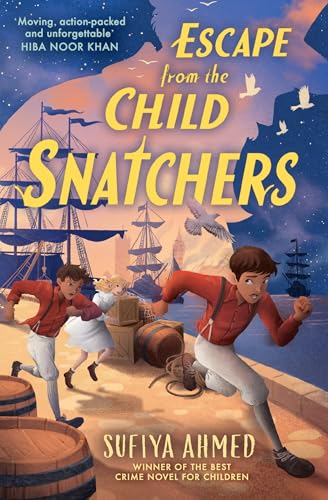
Escape from the Child Snatchers
The year is 1865. Humza and his little brother Usman are living in Bombay’s (Mumbai’s) poorest area. Their mother works as a servant for a white Englishman and his family in the local mansion. Both boys and their mother are deeply saddened because their older brother, Dani, left on a ship as a lascar or seaman to travel to England. He promised he would come back but has not returned.
Humza is called “useless” by the English wife. Incensed by this, he decides to stow away on a ship to find Dani in England and bring him home. His best friend, Ranj, who is a budding entrepreneur, hears of this plan and won’t let Humza undertake this mission alone. The rest of the narrative follows their perilous journey to England and their attempts both to find Dani and to evade the child snatcher, an evil man called Basil Brookes, who preys on unaccompanied children of colour and enslaves them in his child circus.
This is an information-packed book about a little-known facet of history. The representation of child circuses in Ahmed’s novel is dehumanising, with the children locked in cages despite being visibly ill and their faces painted as clowns. If they did not satisfy Brookes, they could be starved for several days. There is also a hint that young girls in this position could be sexually exploited.
The narrative voice is a little too contemporary at times, very much reinforcing modern thought patterns. While valid, this does interrupt the narrative flow. Visually, the book could be read by upper primary school children, which is deceptive because the contents are suited to middle secondary level. There is discussion of race, class and child slavery.