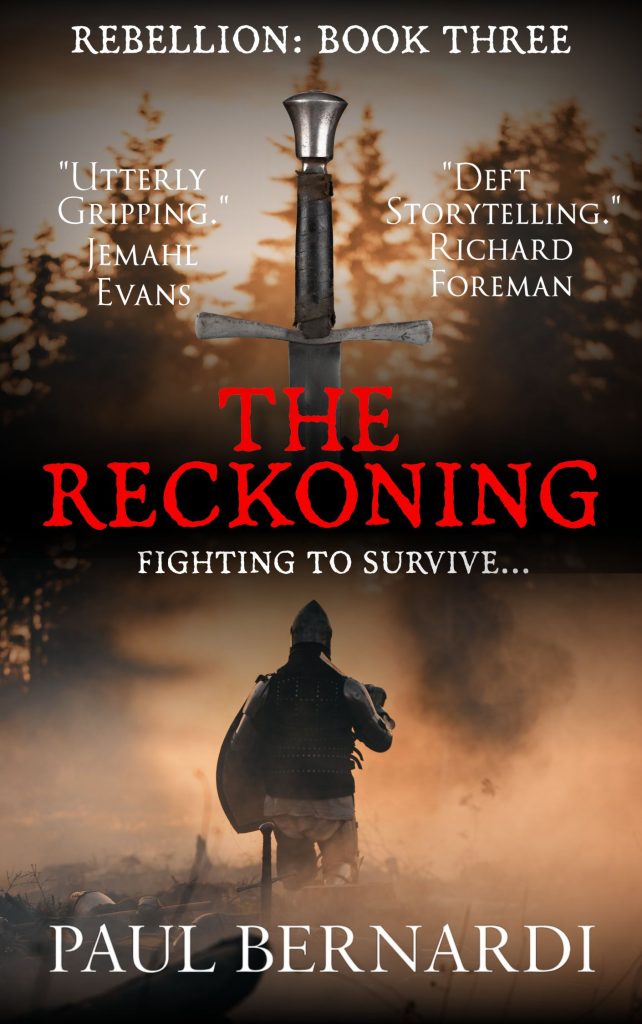
Launch: Paul Bernardi’s The Reckoning
INTERVIEW BY ELLEN IRWIN
Paul Bernardi has always loved all things historical, from childhood right through university, where he studied Anglo-Saxon history. He realised his dream of becoming a historical novelist in 2014 when he self-published To the Devil His Due, and he is now the author of seven historical novels.
 How might you summarize The Reckoning—the third and final installment in your Rebellion Trilogy—in a few sentences?
The Reckoning is about the culmination of two to three years’ worth of insurgency against the rule of King William’s Normans in the north of England. Time and again have the Saxons revolted against their oppressors only to fail for want of a strong and charismatic leader behind whom they can all unite. Whatever happens now, in 1069, it’s going to be the final throw of the dice: either they will succeed in smashing the Norman yoke or they will face truly horrific consequences.
What inspired you to write about the Norman Invasion of England through the eyes of Oslac, a defender of English independence from the new Norman threat?
I felt that it presented an interesting angle, one that takes us away from the traditional heartlands of the south of England. Since the eighth century, Northumbria – with a few notable exceptions – had kept to itself. At the same time, the kings to the south of the Humber were pretty much content to leave them to it. To my knowledge, England’s first king, Aethelstan, only went north of York once, and I’m not sure that King Harold or Edward the Confessor ever did.
Hence you have the starting point where those north of the Tyne care very little about what is happening in London and the south. In Book One (Blood Feud), Oslac is far more concerned with the ancient and deadly feud with the Danish lord in the nearby town of Hexham than with the arrival of foreigners down south. It is only as time progresses, during which he comes to realise that this new king is intent on encroaching on all parts of England, that he begins to get drawn into the desperate struggle for survival.
What intrapersonal and interpersonal journeys did Oslac have to navigate throughout this story? How do you think readers might resonate with him?
In all my writing, I try to make the characters as real and relatable as possible. Rather than Anglo-Saxon James Bonds, Batmans or Jason Bournes, I think readers identify more with people in whom they can recognise a bit of themselves. So whilst the characters may live in a period that is far removed from ours in time, they have the same hopes, fears and ambitions as you or me. And they have the same problems to deal with as well: Oslac will be lambasted by his wife for allowing the dog to walk his muddy paws through the newly swept hall, or for not holding the ladder steady when she’s trying to decorate the hall for Christmas.
At the same time, as Lord of Acum, Oslac must cope with unimaginable stress. Not only is he sworn to protect his people from harm, but he also knows that his decisions can and will lead to the death of men sworn to him. Men he will have known all his life. As Michael Caine (playing Lieutenant Gonville Bromhead in Zulu) remarked, ‘Sometimes, I wish I was a damned ranker’. That is very much a thought with which Oslac would identify.
Reviewers have mentioned that you write breathtaking battle scenes. Help us see through your lens here. How do you approach writing a gripping historical battle scene, and how do you know when you’ve made it work?
It’s in part down to research, understanding the nature of Saxon versus Norman battle tactics. The things that stuck most clearly in my mind were that the shield wall was, mostly, a defensive formation, and that most of the killing in battle happened only once a shield wall broke (i.e., when one side turned their backs and fled, they were incredibly vulnerable).
It’s also a case of reading up on accounts of major battles. Hastings is a key example. The whole arrow in the eye schtick is rubbish, if you ask me. It’s not even what the Bayeux Tapestry shows (the arrow is the result of an error in a much more recent restoration). The most contemporary written source states that William sent knights to seek out and butcher Harold. Not only is this what the Tapestry does show, it also makes sense strategically in that it was essential that Harold be killed if the conquest were to be a success.
In short, realism. Both in terms of battle tactics and actual history.
What are your plans for future writing projects, now that you are bringing Oslac’s journey to a close with this final book in the Rebellion Trilogy?
I’m hoping to move back in time to the tenth century next, specifically to the time of King Aethelstan, the first (and arguably best) king of what we would recognise as England.
 When was your dream of publishing historical novels born? Can you talk about the steps involved in realising this dream?
I think it had long been something burning in the back of my mind; I recall a desperately poor attempt as a teenager which was quickly binned. The real beginning, however, came around the turn of the century with an article I read about some newly released files from the archives concerning the existence of a British plan to assassinate Hitler during the war. Though it was never enacted (spoiler!), I thought it would make a fantastic premise for a novel in terms of imagining what might have happened if it had been.
It took many years to realise the dream; the kids were young and the day job demanding. It was only when I woke up to the need to prioritise time for myself (and once the kids needed less hands-on care), that I really began to make progress.
What advice or encouragement would you give aspiring authors in our historical fiction genre?
I always fall back on three core themes:
- Write, write, write. Create that first draft – don’t stop to edit. For me, the most important thing is that sense of achievement in terms of reaching that initial goal. It doesn’t matter if it’s rubbish – you’ll have plenty of time to edit later.
- Make time for yourself. Try to set aside thirty minutes per day to focus on writing. Not only does it help get the job done, but it also boosts one’s mental health.
- Keep it real but also relatable. It has been humbling to receive reviews that both say how readers felt they were transported to the eleventh century, and also that the characters came across as normal people with the same hopes, fears and goals as you or me.
What are the last great books you read?
Murder in Anglo-Saxon England: Justice, Wergild, Revenge by Annie Whitehead.
How England Began: From Roman Britain to the Anglo-Saxons by Professor Nicholas Higham.

HNS Sponsored Author Interviews are paid for by authors or their publishers. Interviews are commissioned by HNS.