Launch: Catherine McCullagh’s Murder and Masquerade
INTERVIEWED BY LESLIE S. LOWE
Catherine McCullagh lives and writes in the serenity of the Australian bush. While her first published works were non-fiction, having discovered the thrill of historical fiction, there was no turning back! She has now penned six historical novels, of which Murder and Masquerade is the most recent.
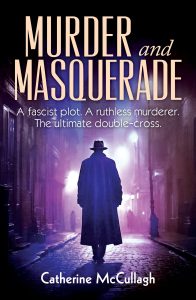 How would you describe Murder and Masquerade and its themes?
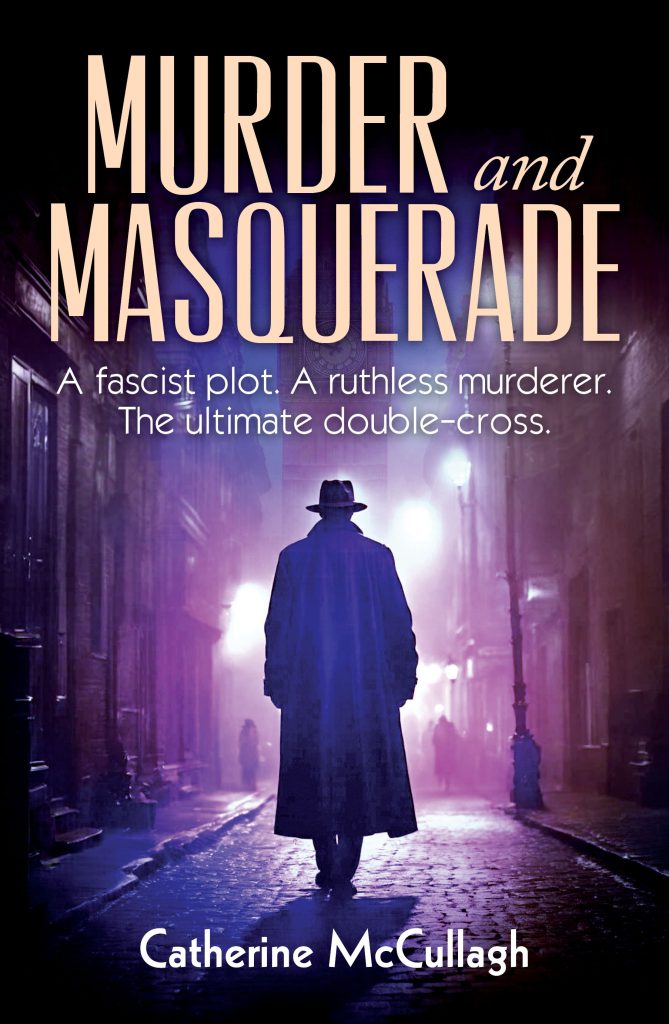
In London, 1946, an Irish policeman and ex-resistance leader joins forces with the man he hates obsessively, a former SS general, to thwart a fascist plot to overthrow the government and return Britain to a Nazi dictatorship. But a spectacular double-cross forces him into an agonising decision.
What inspired and attracted you to writing historical fiction after a lengthy career in the Army?
My Army career was a precursor to a second career as a military history editor. It was this later career that brought me face to face with veterans and others who had lived through periods of conflict, people with extraordinary, almost unbelievable stories. These were the stories that inspired me to write historical fiction.
Murder and Masquerade is your tenth book. How is it different from your other works?
Murder and Masquerade is my sixth novel and my third alternate history, but my first sequel. It represents the first time that I have become so obsessed with the conflict between characters that I could not leave it unresolved. It is also my first book in which the primary protagonists are male.
What are you working on now?
My next book is completely different and tells the story of a Red Cross tracer in post-war Europe.
Does any part of your own life experiences connect with any character or events in the story? What difficulty did you have in writing?
Interestingly, none of my novels connect with my own life, but spring from my research into the footnotes of history. In Murder and Masquerade, I wanted to explore the schisms in an occupied society post-liberation. I wanted to dispel the illusion that any society could return to its previous form following an occupation by a foreign power. My only difficulty in writing this story was what to leave out. This is an enormous topic, and I had to adopt a very disciplined approach.
Is there a key historical event you found in researching that inspired you to write this story to portray a key message relevant now?
Given that this story is set in a post-liberation society, I researched the post-war history of Europe to understand the way the various nations reshaped themselves. My description of the resurgence of fascism was guided by the history of 1930s Britain, when such ideologies had yet to acquire the notoriety of their wartime iterations. I had little idea at the time that this story would serve as an allegory for the emergence of far-right groups today, but once the story was completed, I realised how clearly it paralleled certain political trends.
What key message do you want to share to the world through this story?
The dominant message of this novel is the fragility of democracy and the threat to personal freedom represented by the rise of far-right ideologies. I wanted to demonstrate that no groups are immune to the lure of such ideologies, even some of the conservative religious elements, as the story suggests.
How do you think the reader will connect with Brendan O’Connor or his SS general partner? Is there one that you feel connected to?
Both Brendan O’Connor and Oskar Voigt are complex men who will appeal to a broad variety of readers for a host of different reasons. O’Connor is an egalitarian Irishman who will attract those who enjoy cheering on the underdog. He has a raw honesty, a grittiness that, combined with his physical attractiveness, will see him appeal to female readers and to male readers who admire a fighter. O’Connor is not a man who gives up easily and has a highly developed sense of justice.
Oskar Voigt, on the other hand, is smooth and sophisticated, urbane and assured. His preferred haunt is the upper echelons of society, alongside men of privilege and power. He brooks no opposition and has no use for those he regards as the detritus of society. Like O’Connor, he is physically attractive, but in a more refined, polished way. He will also appeal to readers of both sexes, particularly those who are drawn to a clever, manipulative personality. I find both characters irresistible, although Oskar Voigt’s duplicitous justification of the previous regime and his ruthless drive for power at any price will always see him cast as the villain. But his is a seductive, enticing villainy.
Tell me about your publishing journey.
By happy accident, I found my publisher through my work as a military history editor. He wasn’t planning to move from non-fiction to fiction, but his manuscript reader liked my work and pitched my historical novels as ‘faction’ — a combination of factual backdrop and fictitious plot. Fortunately, he liked my stories, too, and I have been published by Big Sky Publishing ever since.
 What advice would you give to other aspiring historical fiction writers?
Good historical fiction is set against a backdrop that the author knows well. That means a steady diet of research in the chosen era and the society of the time until the intimate details of life, including the spoken idiom, fashion styles, décor, cultural customs and the habits of its people become second nature. Writers must read, research, read, then research some more.
What is the last great book you read?
The Great Swindle by Pierre Lemaitre is the best book I have read recently. It is carefully engineered social satire, with vividly drawn characters, both grotesque and whimsical, and a plot characterised by the unexpected. The ending pivoted on a series of extraordinary twists that were clever and creative.

HNS Sponsored Author Interviews are paid for by authors or their publishers. Interviews are commissioned by HNS.