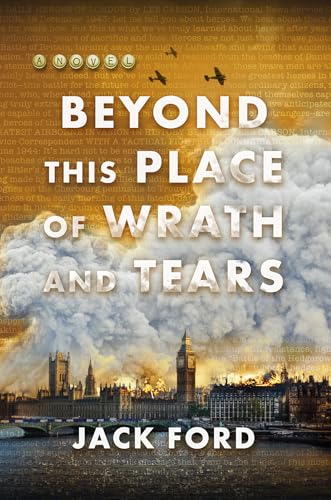
Beyond This Place of Wrath and Tears
This novel is based on the awe-inspiring life of Lee Carson, who smashed the barriers that blocked female reporters’ access to the battlefield in wartime. The novel features two timelines, World War II and the 1950s. The Carson story in World War II is factual, the latter Carson is fictional.
In World War II, Carson wins over the sexist, male-dominated power structures of the military and the press, initially by artful rule breaking and persuasion, and ultimately by her unbelievable bravery in harm’s way. World War II has been covered exhaustively in novels and documentaries, and Jack Ford has stuck doggedly to including only actual events. However, because of this, it inevitably reads more like a biography than historical fiction. Also, Carson works hard to remain detached because of her dangerous work as a professional, so she shies away from truly intimate relationships. As a result, Ford has his work cut out to show readers a glimpse of her vulnerable, human side.
In the 1950s, Carson is a fictional character along the lines of Woodward and Bernstein in Watergate. She uncovers a Russian spy ring orchestrated by the highest level of American government. A reader may find that the fictional 1950s part of the story is more of a gripping page turner. Reading this part of the novel is an experience which might leave a reader breathless right up to the final twists and turns.
Lee Carson was a true pioneer whose life was cut tragically short and not on a battlefield. This extraordinary woman, who is now truly in a world ‘beyond this place of wrath and tears,’ surely deserved to have her life shown to us by Jack Ford in his heartfelt novel.