Launch: Pamela Belle’s The Boy With Five Names
INTERVIEWED BY LESLIE S. LOWE
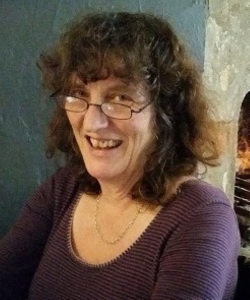
Pamela Belle was telling stories before she could read or write, and began her first book, The Moon in the Water, at the age of thirteen. She studied history at Sussex University and amongst many other jobs, she’s been a primary school teacher, a charity shop manager, and a library assistant. She lives in Wiltshire, UK, with her Burmese cat, Phoebe, and has two adult sons and a toddler granddaughter.
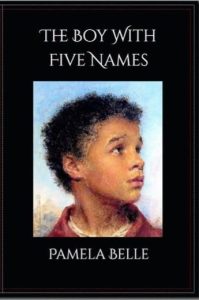 How would you describe The Boy With Five Names and its themes in a couple of sentences?
Hannah Evans’s son, Kojo, was torn away from her and sold to strangers when he was five years old, and only now does she feel safe enough to search for him. Can she and her friends Polly, Dark, and Gin find and free him at last, or will their hunt lead them into terrible danger?
What inspired and attracted you to writing historical fiction after a lifetime of teaching?
I always wanted to be an author, and wrote my first ‘book’ at the age of eight. History fascinated me, and I was inspired by the novels of Rosemary Sutcliff, Elizabeth Goudge, and Dorothy Dunnett. Being a teacher gave me time to write in the holidays, but eventually I found that I was teaching all day and typing all night, and left the classroom to concentrate on my writing. I’ve never regretted it!
This is the fourth book of The Paradice & Dark Series. What are you working on now?
I’m working on the fifth in the series. It features many of the regular characters, including Kojo, but I’ve taken them well outside their London comfort zone and transported them to Newmarket in Suffolk. What’s Newmarket famous for? That could give you a clue about the subject!
How is this book different than the other books in your series?
I had a strong storyline from the start, and that made it very much quicker and easier to write. At ninety thousand words, it’s easily the shortest of all my books, but a reviewer on Amazon said they thought it was also my best, so I’m not complaining.
Does any part of your own life experience connect with any character or events in the story? What difficulty did you have in writing this novel?
This is the story of the search for an enslaved child, and many of the characters have African heritage, so as a privileged white English woman, I was very conscious of my responsibility to ‘get it right’ and to recognise the many pitfalls I faced in writing about the subject. I found a sensitivity reader, an academic steeped in the subject, and she made several helpful comments, as did my beta readers. The last thing I want to do is to offend or upset anyone, and I hope I’ve managed to avoid it.
Is there a key historical event you found in researching that inspired you to write this story to portray a key message prevalent now?
There’s a common misconception in the UK that there were no Black people here before the 20th century. In fact, many of them, free and unfree, lived in Georgian London, which was very diverse, especially in the East End communities. There was racism, of course, founded in slavery, but there was also acceptance and integration.
Another point I wished to make, which I also made in the previous novel, Foul Players, was that Georgian London was not only ethnically diverse, but diverse in other ways. In my research, I found a wonderful person calling herself Princess Seraphina, born John Cooper, who flourished in London some years later than events in the book, dressing as a woman and accepted and even admired by her community, and couldn’t resist putting her in the novel as Lady Lucinda.
What kind of research did you have to do for this story? How did your teaching and library skills assist you in your research?
The story involves not only enslavement, but the details of textile production, specifically printed cottons, in the early 18th century around London. I needed a lot of what my son calls ‘niche’ books, and I usually find them in the London Library – I’ve been a member for many years – but I had to buy quite a few, including the very ‘niche’ Study of the Textile and Bleaching Industry in Merton and Mitcham from 1590-1870! My research into the Black presence in London was made much easier by the online database of runaway slaves, which documents all the advertisements for them throughout the late 17th and the 18th centuries, and gave me a lot of very useful insight into their lives and the attitudes of those who had enslaved them.
How do you think the reader will connect with your main characters? Is there one that you feel connected to and why?
I love Gin, the homeless urchin who becomes Polly’s maid. She is tough, opinionated, and as a reader once pointed out, the moral arbiter of all the other characters. If she says it’s wrong, she’s usually right, and she isn’t afraid to speak her mind or to act, whether it’s shouting in street slang at obnoxious men or leaping in to help someone in trouble.
Every author has a publishing journey. Tell me about yours.
I was lucky enough to find an agent and a publisher for my first novel, The Moon in the Water. Over the next twenty years, I produced eight historical novels, a fantasy trilogy, and two modern novels, but my next two books, A Parcel of Rogues, the first in the Paradice & Dark series, and a book set in Anglo-Saxon England were rejected. I then tried a novel about the making of an Elizabethan garden; however, by then I’d lost my mojo, there were major difficulties in my personal life, and it remains unfinished. The fun of writing a dual-time blog novel in instalments restored my belief in myself, and so did the shortlisting of A Parcel of Rogues in the 2018 HNS Unpublished Novel competition. Submitting it to agents, though, only resulted in many more rejections, so I decided to self-publish. I had a core of loyal, long-term fans of my earlier books, so I knew it might do well, and the reissue of my backlist as e-books also helped. Now, in retirement, I can devote much more of my time to writing, and I have lots of ideas for future books.
 What advice would you give to other aspiring historical writers?
Don’t give up, is the lesson I’ve learned from my rather chequered publishing history. Keep going, finish it, and make it the best it can possibly be. And that means research – you’re re-creating a world that once existed, and if you want to make your characters, settings and events as real to the reader as they should be to you, you’ll need to put in some work. Do your best to avoid errors, make your plot fit the history and not vice versa, and above all, have fun – if you enjoy writing it, then people will enjoy reading it. Good luck!
What is the last great book you read?
The Cromarty Library Circle by Shona Maclean. Highly recommended.

HNS Sponsored Author Interviews are paid for by authors or their publishers. Interviews are commissioned by HNS.