Launch: Elisabeth Storrs’ Fables & Lies: A World War II Novel
INTERVIEWED BY LESLIE S. LOWE
Elisabeth Storrs is the award-winning author of A Tale of Ancient Rome trilogy, which was endorsed by Ursula Le Guin, Kate Quinn, and Ben Kane. Now her obsession lies with Trojan treasure and twisted Germanic history in her new release, Fables & Lies. Elisabeth is also the founder of the Historical Novel Society Australasia and the $150,000 ARA Historical Novel Prize.
 How would you describe this book and its themes in a couple of sentences?
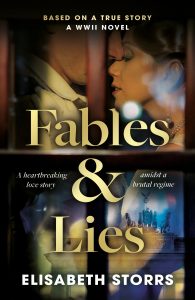
Set in WWII Berlin, Fables & Lies charts the journey of museum assistant, Freyja Bremer, who marries SS scholar, Kaspar Voigt, to protect her father, unaware of her husband’s role in Himmler’s scheme to achieve Aryan dominance. After falling for archaeologist Darien Lessing, she’s drawn to aid a Jewish doctor, confronting moral corruption as she risks everything to safeguard both truth and her nation’s treasures amid chaos.
What inspired you to start writing historical fiction, and what has been the most rewarding about it?
I was inspired after reading Mary Renault’s The Persian Boy at school. Renault’s lyrical prose and skill at world building enthralled me. The challenge of entwining historical research within a fictional narrative gives me great pleasure.
How is this latest novel different than your Roman history series? What inspired you to switch to World War II history?
I actually started with World War II because the genesis for Fables & Lies was a bottom-drawer novel with a narrative switching between the ’90s (then contemporary) and the war. I was fascinated with Priam’s Treasure from Troy, which was held in a Berlin museum and disappeared mysteriously for 50 years after the Soviets plundered the city. My plot became redundant when the Russians admitted in 1994 they’d hidden it!
The A Tale of Ancient Rome trilogy dealt with my next obsession – the Etruscans, whose sophisticated civilization amazingly offered independence and education to women in contrast to the militaristic Rome.
Fables & Lies is based on a true story. Is there a historical event you found in researching that inspired you to write this story to portray a key message relevant now?
When researching the true story of Priam’s Treasure, I discovered Wilhelm Unverzagt, the curator who braved air raids to protect the gold. However, when I learned he was a member of Himmler’s SS Ahnenerbe research institute, I sought to tell a more complex story exploring Himmler’s weaponization of prehistory.
Himmler believed in occult fancies such as Atlantis and the Holy Grail. Steven Spielberg’s Indiana Jones franchise was inspired by the Ahnenerbe’s expeditions to find them. Himmler also tasked prehistorians to brainwash German soldiers to believe they were reincarnations of ancient Aryan peoples, thereby entitling them to reclaim “ancestral lands” by dispossessing and massacring 20 million Slavs. SS ethnologists also espoused negative eugenics, which led to dehumanization and genocide.
I wanted to sound a warning about the corruption of academics who warped history to serve power, especially as our world is turning to more authoritarian leaders, with democracy undermined by similar strategies from the Nazi playbook.
What did your characters’ journeys mean to you as you wrote it?
My protagonist is Freyja Bremer, Unverzagt’s young assistant. To reveal the evil of the SS scholars, I was faced with the ethical challenge of marrying Freyja to the ethnologist, Kaspar Voigt. I saw it as the only credible plot device to reveal the Ahnenerbe’s despicable actions. Her eyes are soon opened to the rot beneath the regime’s myths when she falls for archaeologist Darien Lessing, who exposes her to the truth. I found it very difficult to write Freyja’s earlier scenes as I knew I was spouting dangerous rhetoric, but in doing so, also revealing bizarre, esoteric Nazi beliefs.
Do you think the reader will connect Freyja or Darien within this story? Which character do you connect with as an author?
I hope so, as their love is true and deep, and both display courage. I related more to Darien, as he presents a sane external viewpoint. However, he is also a prickly character who is reckless, impatient and, at times, arrogant.
Freyja is a child of the Reich, indoctrinated throughout her schooling when only Nazi teachers were employed. However, she’s dissatisfied with the strictures placed on girls, which confine them to home duties. Darien sees no such limitations, encouraging her to see beyond Fascist dogma, which enables her to grow into a more sympathetic character.
How did you balance the research with writing the story? Did you find any interesting historical facts while researching?
I do get lost down research rabbit holes! It took me considerable time to understand the broader events of World War II before zooming in on specific elements. I also overwrite, then whittle down the history to ‘embroider’ details into the narrative.
An interesting fact: One gem was the Berlin Jewish Hospital. Perversely, the Nazis expected doctors to heal Jews before sending the patients to the camps.
What are you working on now? Is it connected to this one or your other works in any way?
I am currently writing the ‘companion’ novel to Fables & Lies. Spanning 4,000 years, I tell the journey of Priam’s Treasure through the eyes of four women with their own secrets: Annitti, a Trojan goldsmith; Sophia, the wife of archaeologist Heinrich Schliemann; Safinova, a Soviet Major; and Freyja’s granddaughter, Mia, who seeks to solve the mystery of the gold’s disappearance.
How have your life and work experience been incorporated into your writing?
I was a lawyer for over thirty years as well as a writer. As such, I use both left and right sides of my brain. I think my legal training serves me in good stead when analyzing research. But I love to escape into my imagination, which frees me from everyday worries.
Every author has a publishing journey. Tell me about yours.
It took me ten years to research, write, and publish The Wedding Shroud, the first book in the Roman trilogy, when I was squeezed between raising children and caring for ailing parents while working. The book was published in 2010 by an Australian publisher, but unfortunately, the imprint closed down before the sequel, The Golden Dice, was published.
I decided to self-publish both novels at a time when Amazon supported Indie authors. After noticing my sales record, Lake Union Publishing bought the books and commissioned Call to Juno. Since then, an Italian publisher, Altre Voci Edizioni, has translated the trilogy into Italian.
Throughout this time, I researched and wrote Fables & Lies, which took far too long to finish due to a series of family tragedies. After receiving countless rejections, I’m thrilled The Book Guild and Bolinda Audio saw value in my story.
 What advice would you give to other aspiring historical writers?
My motto is ‘never give up’. Keep submitting to agents and publishers, as their opinions are very subjective. But if you do finally hit a dead-end, consider self-publishing. More importantly – keep writing!
What is the last great book you read? Why?
The Granddaughter by Bernard Schlink, author of The Reader, which reveals the impact on Germans after the fall of the Berlin Wall together with the dark underbelly of Neo-Nazism decades later. I found the book riveting in depicting a man trying to connect with a long-lost granddaughter who’s been raised in a rural village where people still glorify Hitler.

HNS Sponsored Author Interviews are paid for by authors or their publishers. Interviews are commissioned by HNS.