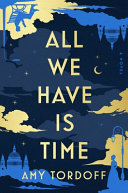
All We Have Is Time
Set across centuries, All We Have Is Time opens in fragments—brief glimpses of moments and places that may initially feel disorienting. But once the novel finds its rhythm, those temporal snippets become part of its design, drawing the reader steadily into Beatrix’s long, lonely existence.
In 1605 London, Beatrix lives on the margins, marked as “other” by her mismatched eyes and shunned by a society quick to fear what it does not understand. Her isolation deepens when it is finally revealed that she is immortal, the result of a faerie bargain made after her death in childbirth. What begins as a wish simply to live becomes a centuries-long endurance marked by loss, suspicion, and grief. Tordoff captures this loneliness with quiet persistence, allowing it to accumulate rather than relying on melodrama.
The novel gains emotional momentum with the arrival of Oliver, a man out of time whose own borrowed life mirrors Beatrix’s in unexpected ways. Their connection—tentative, urgent, deeply human—forms the heart of the story. While the mechanics of time travel and its governing rules are sometimes left impressionistic rather than fully defined, the emotional logic remains clear. This is a novel more concerned with emotional resonance than with rigid rule-setting, and it largely succeeds on those terms. History appears in vivid but fleeting impressions, offering a sense of movement through time rather than prolonged immersion in any single era. That choice reinforces the novel’s central themes: impermanence, memory, and the way love can anchor even the longest life.
For readers willing to settle into its rhythm, All We Have Is Time delivers a moving, satisfying conclusion. Tordoff’s debut is an ambitious, emotionally driven historical romance that privileges connection and sacrifice over certainty and leaves a lasting impression long after the final page. Highly recommended.