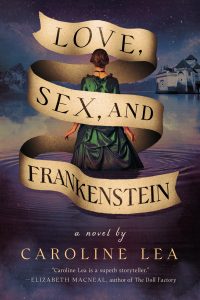
The Monsters We Create: Love, Sex, and Frankenstein by Caroline Lea
 BY ELISABETH LENCKOS
A certain cold and stormy night in the summer of 1816, which Mary Shelley, later Godwin, Percy Bysshe Shelley, Lord Byron, Claire Claremont, and John Polidori spent at the Villa Diodati on the shores of Lake Geneva, has long been the stuff of legend. The quintet famously read gothic fiction and dared each other as to who could write the most terrifying ghost story. In the final instance, the wager begot two Romantic classics that endure to this day—John Polidori’s The Vampyre and Mary Shelley’s masterpiece, Frankenstein, or the Modern Prometheus.
Mary Shelley was only eighteen years old at the time of composition, a fact that has always intrigued author Caroline Lea. She considers Mary Shelley a genius, whose invention, Frankenstein, “shows every facet of the trauma and fierce intelligence that formed such an incredible imagination at such a young age.” Much of Lea’s fascination with Mary Shelley has to do with the idea of monstrosity, “the monsters we create, the monsters we hide, the monsters we make of others within relationships when they go wrong.” The original working title of her novel Love, Sex and Frankenstein (Pegasus, October 2025) was, not surprisingly, ‘The Summer of Monsters.’
When asked what compelled her to take on a chapter in Mary Shelley’s life that has since assumed mythological proportions, Caroline Lea suggests that she felt the origin story of Mary Shelley’s Frankenstein has long been ripe for exploration and reframing. “I wanted to explore the raw, ugly emotions and hidden feelings [these geniuses experienced] within that period of creative intensity… and the emotional reality that must have underpinned many of those confined days, and what the reality of that claustrophobia must have meant for Mary, a young writer and a young mother, who had been rejected by her family and depended on Shelley entirely.”
Mary Shelley’s natural mother, Mary Wollstonecraft, died ten days after Mary’s birth. While Mary loathed her stepmother, she idealized her father, who raised his daughter in keeping with the freethinking ideals of her feminist mother, but broke with Mary when she fell in love with then married Percy Bysshe Shelley in 1814. At age sixteen, pregnant Mary eloped with Shelley and spent most of the ensuing years with him in exile, dreading that he might be unfaithful to her.

author Caroline Lea
In 1815, she gave birth to a premature daughter who soon died, a devastating loss Mary recorded in her journals, which is assumed to have haunted her creation of Frankenstein. As Lea elucidates, “Mary and her creation of the monster are equally as interesting as the monster itself, because the creature she created raises so many questions about the darkness we hide within us, and the way creativity can give us an outlet for that… Don’t we read history and historical fiction to understand more about what motivated people in the past, and then look at our own values? There are certainly questions raised in the novel about the role of women and creativity, and it’s possible that some of my rage about how difficult it is for women to find creative space comes through here.”
Part of Love, Sex, and Frankenstein centers on the relationship between Mary Shelley and her stepsister Claire Claremont. According to some biographers, Claire embarked on an affair with Percy Bysshe Shelley and might even have become pregnant with his child. With the two young women forced to compete for Shelley’s attention, Love, Sex, and Frankenstein portrays the connection between Mary and Claire as far from harmonious. Commenting on female relationships within her novel, Lea reveals that she loved examining the bonds between women. “Female relationships are central to my life,” she admits. “I come from a family of many sisters…but I am acutely aware of the power politics between women… Mary and Claire are, in many ways, foils of each other – both reflections and opposites, exposing their respective weaknesses and fears… Mary’s absent mother and fraught relationship with her stepmother was central to the girl she was and the writer she became. I realise that this psychoanalytical perspective might be anachronistic, but great characterization comes from deep exploration.”
In contrast to Shelley, who called Mary ‘Pecksie,’ and regarded her as sweet and biddable, Love, Sex, and Frankenstein shows Lord Byron, who was well known as ‘mad, bad, and dangerous to know,’ as an admirer of Mary and, being ‘wild’ himself, appreciating her wilder side. As Lea elucidates, she intended Mary’s interactions with Byron as a contrast to the way Shelley regarded his mistress. “Byron’s own wildness gave me a chance to explore… the creative rage of Mary, the novelist.”
Love, Sex, and Frankenstein concludes with a heartbreakingly beautiful scene, where Mary’s love for Shelley, the attraction to Byron, her writerly creativity, the monstrous object her imagination birthed, as well as its significance for her psyche, come together during an epochal journey into the Alps. The mountain scene is deeply atmospheric, as is the entire novel. Its language aptly evokes the sublime Romantic poetry and literature created by her key protagonists, who took freedoms contemporary society wasn’t ready to grant them and paid dearly for their daring.
Historically, Mary and Percy Bysshe Shelley would only have six more years together before he was killed in a boating accident near Viareggio in Italy in 1822. Mary would lose two further children before giving birth to a son, Percy Florence, with whom she returned to England a year after her husband’s death. Back home, Mary embarked on a prodigious writing career, which resulted in novels, travelogues, biographies, and short stories. When Mary died at the age of fifty-three, she was respected as a pioneering thinker and author. However, her fame faded during the ensuing century, and she became known merely as Percy Bysshe Shelley’s wife and the creator of Frankenstein.
Nowadays, Mary’s ‘creation’ is better known among the general reading and viewing public than any of her husband’s epic poems, an irony which would not be lost on Mary herself. Modern researchers assume that Percy Bysshe worked on later editions of Frankenstein with his wife to an extent that qualifies him as a co-author of the novel, but the fact remains that the moving entries in Mary’s journals, which describe her deep anguish after realizing that her firstborn had died in the night, as well as her subsequent desperate efforts to revive her daughter, gave rise to the wishful fantasy of raising a deceased creature from the dead. Perused by millions of readers from around the globe, Frankenstein constitutes the reason why that mythical holiday at the Villa Donati, on the Shores of Lake Geneva in June 1816, remains so intriguing to us. That time period in Mary Shelley’s life is movingly rendered in Love, Sex, and Frankenstein, both paying tribute to her immense talent, as well as providing us with a fascinating re-interpretation of the creative processes of her mind and heart.
About the contributor: Elisabeth Lenckos reviews and writes for the Historical Novel Society. A member of its Social Media Team, she posts and tweets to its members on Wednesdays. She is at work on a novel about a 20th-century German Jewish family.