Stranger Than We Think?: Francis Spufford on Turning Fantasy into a Story that Resonates
WRITTEN BY LUCINDA BYATT
 Francis Spufford is the author of the historical novels Golden Hill (his 2016 award-winning debut), Light Perpetual (2021, nominated for the Booker Prize) and Cahokia Jazz (2023), as well as non-fiction works of great originality (from I May be Some Time; Ice and the English Imagination to Unapologetic, a personal and passionately argued defence of Christianity).
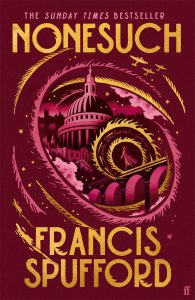
Spufford has now drawn on a “long history of pleasure reading fantasy” to write Nonesuch (Faber/Scribner, 2026), in which he blends a fascination with the early days of television and radio in London, the horrors of the Blitz, and a beautifully crafted speculative history rich in arcane detail. As for inspiration, he says: “The way it seems to work for me, with every book, is that a set of ideas turn up at different places round the horizon of my imagination, and then gradually converge, and reveal that they’re really parts of the same project. So I knew I wanted to write about the unexpected world of pre-WW2 television; I knew I wanted to write about the temporary freedom for women the war brought; and I knew I wanted to write something that brought out the fantastic qualities, the unearthly qualities, of blacked-out wartime London. And then I remembered the momentary glimpse of her rackety early life that my grandmother had given me, when she was in her nineties. (‘I always preferred going out with married men,’ she said to me suddenly when we were sitting in a restaurant. ‘Because they always spent so much more money on you.’ And then she clammed up again.) The figure of Iris, Nonesuch’s protagonist came to me – clever, brave, greedy, self-reliant, not very scrupulous – and the other things I’d wanted to do slotted into place around her, and I realised that it was one story I was planning. One story with room in it for bombs, bonds, bad behaviour, the television studio at Alexandra Palace, and literal angels among the ruins.”
The appearance of angels is only the start of the strange events in which Iris and Geoff become involved. There is also the mysterious Order, now largely defunct, but the knowledge of how to “bind” and master otherworldly spirits is extremely dangerous in the wrong hands. To me the process of binding, as well as the eventual release, was reminiscent of the movement of minuscule atoms in particle physics, but Spufford corrected me: “Maybe not particle physics, but definitely electromagnetism. I wanted to line up the angels in Nonesuch with the frontier technologies of 1940, which people then were still finding magical or enchanting, as you do with technologies when they’re new: with radio, which had filled the skies of Europe with frightening or desperate voices, and most of all with television, only just invented, which could pluck pictures out of the thin air. The spirits of the air in the book inhabit an atmosphere crowded with jabbering signals, so it seemed right to make them a kind of signal themselves, riding on the radio waves, beings of energy rather than matter.”
Iris works in the City. How the world of finance continued, how the intricate cogs of banking and stockbroking kept turning, even after the onset of the Blitz, is described in vivid detail: “Blitz London is a place we have repeatedly imagined, in a thousand books and films, so the challenge there was to try to find the details that would get past the thick layer of images for it that we all already have in our heads, and make us feel it afresh, and make it come to life newly. […] In my experience it’s pretty much the same kind of detail you want to find for every project. The kind that go straight to the reader’s senses. The ones that tell you what it was like being a body in a particular time and a place. The colour of bomb flashes, the burnt smell of a Blitzed building, the feel of broken glass under your office shoes during your morning commute to work.”
The parallels between the stock market and the magical realm are brilliantly drawn. In particular, the appearance of John Maynard Keynes was unexpected, and I asked Spufford why he chose Keynes in particular, and whether other historical figures had cameo roles in his books. “Well, money is the other great enchanted thing in Iris’s world, and certainly in Iris’s own imagination, flowing from person to person in the form of stock certificates or coins or messages on office teletype machines, but not really made out of paper or gold or electricity, but of something more mysterious and impalpable, behind those things. Iris wants money to transform her, like a wish-granting genie. She wants it to turn her from a clever girl from the suburbs, in a world where women can’t be anything in the City of London but clerks and secretaries, into a tycoon with a fur coat and a yellow Rolls-Royce. Against her are ranged all the crusted rules of patriarchy and the British class system. Now, Keynes, as well as being the great mid-20th-century theorist of money, was also one of the great intellectual modernisers of Britain. He was a mind that helped us see through what was redundant in the older order of things. I don’t know if the real Keynes would have been able to recognise a ruthless twenty-two-year-old secretary as a kindred spirit. But in Nonesuch, at a dinner party by candlelight as the bombs fall, he absolutely can. Also, I just like bringing real famous people on stage in minor roles. There aren’t any others in Nonesuch, but I had Vladimir Nabokov as a guest star in my previous book Cahokia Jazz, and the sequel to Nonesuch, Arcady, due out next year, has at least two more celebrity walk-ons. Who? Not telling.”
Iris and Geoff pit their wits – and their lives – against a group of fascist occultists in London who are determined to use the Order’s fusty secrets to rewrite the historical events of the present. “Tell me where all past years are?” is the question that opens the otherwise invisible walkway to Nonesuch, a place of all times and none, where the sequence of history can be deviated. The passage of time, its loops and jumps, is a topic that Spufford has written about before.“One of the things I liked about bringing the angels into Nonesuch was the contrast it gave me between human beings in one of history’s tightest tight spots, living through months that really did decide whether the world was going to tilt down into a terrible darkness, and all the while not knowing the outcome – and the view you’d have of time if you were outside it, only really visiting 1940, and seeing it as just one place on the great map of the ages. The angels are benign, but very remote from the urgencies of human life and human history. The ‘time machine’ in the book that the 17th-century alchemists made, and the fascist occultists are trying to use now for nefarious purposes, is really a way of shackling and exploiting the angels’ freedom in time. Fantasy lets you take an idea like that literally and work it out as a story instead of a metaphor. I have been very interested in time in my other books, and in all the different ways that human beings experience living in time, from the time of a song up to the time of a lifetime – but Nonesuch let me throw off the limits of realism, and do something wilder with time. All the same, I hope it still resonates with what we genuinely know and feel. We’re stranger than we think, I think.”
The “time machine” in the novel (Spufford describes it as “a network of enslaved angels”) was documented by the alchemists who created it in the 17th century, and the cryptic notes have survived among the Order’s crumbling papers. Spufford’s invented alchemist is Hieronymus Dawe – “I love 17th-century English names,” he notes, “with their combination of very high-flown and very down to earth. Sir Kenelm Digby! Shackerley Marmion! Arise Evans!” To make the plot work, Spufford had to go back in history and “find a juncture when there’d been a problem they thought they desperately had to fix, and where the outcome – an awful warning that using the machine was not a good idea – ended up being worse than the original problem. I won’t say what it is, to avoid spoilers, but I’m quite pleased with how it worked out.” The sequel to Nonesuch, Arcady doesn’t appear until 2027, so this reader will not be alone in waiting to see how and if things ultimately work out for Iris, Geoff and the others.
Looking forward to his next project, and more generally at the appeal of historical fiction, Spufford writes: “I’m thinking about how, to me now at the age of sixty-two, the world seems to be slipping out of a state I found reasonably comprehensible and into one that’s much stranger and more threatening. And it occurs to me that the way to write about that might be to imagine what the world would be like for a myopic Romano-British bookseller in the year 410, also in his early sixties, who finds that the state of things he’s known his whole life is slipping away as the empire crumbles and the towns empty. That’s the appeal of historical fiction to me, in fact: that there’s always something in the past to illuminate the present, something there to help us recognise our own times better.” That sums up the appeal for a lot of us, I think.
About the contributor: Lucinda Byatt is HNR‘s Features Editor and an honorary lecturer at the University of Edinburgh.
Published in Historical Novels Review | Issue 117 (August 2026)