Launch: Jane Lancaster’s Liberty is Sweet
Jane Lancaster(opens in new tab) lives in Providence, RI, walks more than she drives, moved from the UK, and earned a PhD at Brown while teaching high school history. She likes to play Scrabble, take photos on her phone, read historical fiction, and travel the world. As a historical detective, she likes to investigate alternative stories.
 How would you describe this book and its themes?
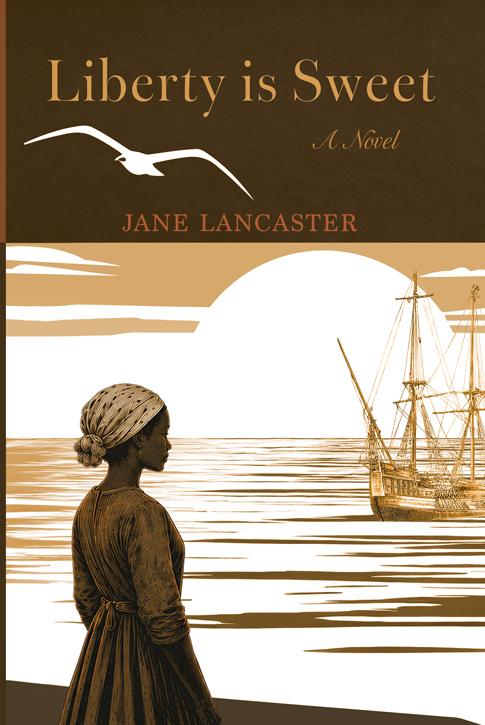
Liberty is Sweet(opens in new tab) is about the search for freedom. It is the true story of Phebe, an indigenous servant, and Arthur, an enslaved African, who navigate the American War for Independence and journey for thousands of miles. They seek freedom, even if it means leaving the new United States, which is not the “land of the free” for them.
What inspired you to start writing historical fiction, and what has been the most rewarding about it?
I’ve been researching the role of the Black Loyalists in the American Revolution for some time and discovered Phebe’s story: her birth as a free person of color, which means her mother was most likely a free indigenous woman, her marriage (formal or informal) to an enslaved man, their journeys from Rhode Island to New York City to Nova Scotia and finally to the appropriately named Freetown, Sierra Leone.
I found numerous clues in the archives, and Arthur appears by name at least eight times. Phebe appears only once by name, though she’s there by implication several times.
There are, of course, gaps in the documentary evidence, which is not surprising, as poor, possibly illiterate eighteenth-century people of color do not leave many paper traces. I decided, therefore, to use my knowledge of the period to fill in the gaps and turn Phebe’s odyssey into a novel. I wanted to consider how she may have felt on leaving her home, and understand her hopes and fears as the world changed around her.
How is this latest novel different from your other works?
It’s my first novel, though I’ve published four nonfiction books and many articles in both scholarly and popular sites.
Why the focus on this topic now? Is there a key historical event you found in researching that inspired you to write this story to portray a key message prevalent now?
The United States is currently celebrating 250 years of independence. I wanted to explore a different aspect of independence, freedom from slavery.
How do the Phebe and Arthur transform within the story over the series? What did that journey mean to you as you wrote it?
Phebe and Arthur learn to take chances as they move from place to place in search of freedom. They show resilience in difficult situations, such as when they first arrive in New York with nowhere to live, and endure even more difficult years in Nova Scotia before they decide to go to Africa. They use hard-earned knowledge and skills to make better lives for themselves as independent people.
In some ways, their journey reflects my own, as I had to start my life again when my family and I moved to the United States. Although the terrible physical hardships Phebe and Arthur faced were absent in my transition, psychological adjustments were equally necessary.
How do you think the reader will connect with Phebe in this book?
They’ll meet a young woman who’s not particularly heroic or brave (few of us are) prepared to take chances to improve her life and help her husband find his freedom, even though, in so doing, she sacrifices her closeness to her mother and all that is familiar.
How did you balance the research with writing the story?
I’d already done the research before I started writing the novel, and had published several short (nonfiction) pieces in historical journals. I’d visited archives in the USA—in Newport, Providence, New York, and Washington DC; in Halifax and Birchtown, Nova Scotia, and both the National Archives and the London Library in the UK, as well as Wilberforce Research Centre in Hull, UK. The Sierra Leonean archives were online at the London Library.
I also visited the house where some of the action happened in Newport, Rhode Island; they allowed me to visit the attic and the cellar (not open to the public), places where the slaves and servants would have lived. I visited the site, now abandoned, in Birchtown, Nova Scotia, where Phebe and Arthur lived for eight years.
A sense of place is vital for the novelist, I believe, and standing where they may have stood some 250 years earlier made it easier for me to picture their lives.
As a history teacher and lecturer in the US and the UK, how have your life experiences been incorporated with or assisted you in your writing? Do you plan to write any books on UK history?
I still have many American stories to tell, and I have an almost finished dual timeline historical detective novel sitting in a drawer. It is about the wealthy New Yorker, Madame Eliza Jumel, who appears briefly as an impoverished child living in a brothel in Liberty is Sweet.
Some years ago I won a major national award (I was one of fifty Christa McAuliffe fellows) to create curriculum materials about Rhode Island women, many of whom were obscure or forgotten. Eliza Jumel was one of them. I hadn’t come across Phebe yet: if I had, I’d have included her.
I never want to write about famous people. I prefer to be a historical detective and discover ordinary people who are affected by and react to major historical events. I like to read about ordinary people facing extraordinary times.
Tell me about your publishing journey.
My four earlier books run the gamut: a prize-winning biography via an academic press; a commissioned history of a library; and two books via a mid-sized trade publisher, one on Emily Post’s 1916 car journey across America (this would make a good novel!), and one on a local militia founded in 1800.
The novel Liberty is Sweet was self-published via an independent press, Stillwater River Publications.
 What advice would you give to other aspiring historical writers?
Have fun doing the research and persevere.
What is the last great book you read? Why?
I read Josephine Tey’s The Daughter of Time when I was an adolescent; it made me want to be a historian and to question the evidence. More recently I’ve reread George Eliot’s Middlemarch. As annoying as the self-denying Dorothea Brooke is, it is immensely revealing about class and gender and the effects of industrialization, as well as a pleasure to read.

HNS Sponsored Author Interviews are paid for by authors or their publishers. Interviews are commissioned by HNS.