Secrets and Solidarity: Susan Meissner’s A Map to Paradise
WRITTEN BY SARAH JOHNSON
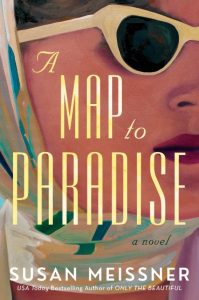 In her new novel A Map to Paradise (Berkley, 2025), Susan Meissner’s three protagonists each have reasons for avoiding unwanted attention. It’s late 1956 in Malibu, California. Melanie Cole, a 25-year-old film starlet, has isolated herself in a house rented by her lover and former co-star, an actor who landed on the Hollywood blacklist. Her presence in his life has deemed her guilty by association, and she despairs about her future career. One of the few people she sees is Eva Kruse, her housekeeper, who’s keeping her own secrets: she isn’t the displaced war refugee from Poland she claimed on her immigration papers.
Melanie had used to enjoy chatting with her agoraphobic next-door neighbor, Elwood Blankenship, a talented screenwriter who was in a terrible car accident years earlier. When Melanie and Eva glimpse his sister-in-law, June, digging up his rose garden, with Elwood nowhere to be found, they know something’s wrong.
Meissner is known for her skilled depictions of women’s connections across age and class barriers, and June, Eva, and Melanie discover surprising commonalities. With strong undercurrents of suspense, the novel shows how the three unite to protect themselves and each other as truths emerge. “I do love a good mystery,” Meissner says, “and while I don’t always come up with a storyline to support one, when I was plotting this one, some mystery threads suggested themselves to me from the get-go. From the beginning I didn’t necessarily want readers to be completely surprised by June’s secret regarding Elwood as much as I wanted them to wonder: why on earth did she do what she did? It’s not so much a whodunit as it is a whydunit, and that’s a more unique angle and completely intentional.”
Incorporating a firm sense of place in her historical novels, Meissner, who grew up in Southern California and calls it “part of the fabric of my life,” is clearly at home there writing-wise. Her latest subject reflects her fascination with the setting at a volatile time.
“The fact that the Red Scare was particularly intense in Hollywood, of all places, was extremely interesting to me. One of the most impactful situations that came about after the end of World War II was the era of McCarthyism and the accompanying nationwide dread of a nuclear war. Even though the US was technically at peace after almost four years of horrific fighting, the fear of Soviet aggression was very real and very powerful. There was peace, but the atmosphere was not peaceful; it was fearful. This seemed a perfect backdrop for a story about ordinary people living in extraordinary times, my favorite kind of book to write.
“There were a number of women like my fictional Melanie who ended up on the real studio blacklist during the long years of the Hollywood Red Scare; one of them being actress Lee Grant. Some people might know her from the 1975 film Shampoo, also starring Warren Beatty, as she won an Academy Award for her role. But fewer may know that prior to making that movie she’d been blacklisted for more than a decade,” Meissner continues, describing how Lee refused to name names and lost career opportunities as a result.
While slowly uncovering her protagonists’ motivations, Meissner focuses closely on them and their backstories, successfully illustrating the impact of larger events on a very personal, intimate level. “That aspect of the book was the hardest to pull off,” she reveals. “There were a number of chapters about these three women’s individual stories—well before they knew each other—that ended up on the cutting room floor because I actually only needed a certain amount of their earlier histories to show up on the pages. That’s because the true heart and soul of the story is just those weeks leading up to Christmas night 1956.”
Structuring a novel with multiple viewpoints and flashbacks that readers can smoothly follow wasn’t easy, she admits. “I ended up writing it three times. Not from scratch, but it was like significantly remodeling the same house three times, and in huge, sweeping ways,” says Meissner. “There are probably better ways of keeping track of timelines, historical data, and character backstories but for me it’s notes and notes and more notes, both typed and handwritten. I’m an outliner and plotter, which helps to keep me focused on a destination, but I also write by discovery, so I am always making more notes as I progress.”
With her guarded demeanor and hard-to-place accent, Eva Kruse is a multilayered character with good reasons for disguising her past. “Eva’s backstory was the hardest to write because hers was the hardest life experience to have survived,” Meissner explains. “You can read multiple eyewitness accounts of what it was like to live through the hell of war, but to write as if you were there, too, when you actually weren’t is always a challenge.”
Creating a realistic background for Eva provoked some of Meissner’s most interesting research discoveries.
“I was amazed at the sheer number of Displaced Persons (DPs) at the end of World War II… I hadn’t read any novels or nonfiction books about DPs and what it was like for them when the war ended,” she says. “There were an astonishing 700 camps (most in Germany in the Western occupied zones) that temporarily housed the millions displaced by war, which included concentration camp survivors, forced laborers, political refugees, released prisoners of war, and those whose homes or entire villages were bombed to bits… it was an unprecedented humanitarian crisis. The US Congress would end up passing the Displaced Persons Act to bring in 415,000 DPs to America as immigrants, starting in 1948.”
Above all, A Map to Paradise tells a riveting, timely tale of solidarity and survival while illuminating the past. “What I love about historical fiction is that I can take readers back in time, safely and easily, and let them experience the past almost as if they are actually there,” Meissner says. “The vehicle of story does that. Historical fiction also brings back to the forefront events that had a significant impact on humanity and therefore should not be forgotten. In a sentence, my goal in writing historical fiction is to keep the past alive so that we can keep the lessons of the past alive.”
About the contributor: Sarah Johnson is the HNR’s Book Review Editor.
Published in Historical Novels Review | Issue 112 (May 2025)