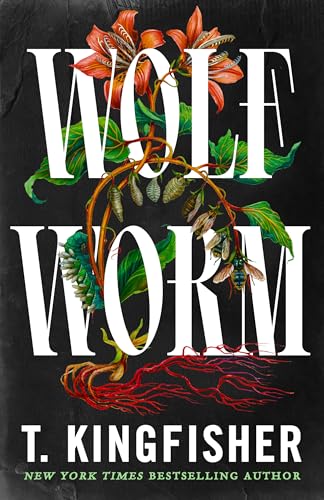
Wolf Worm
It is the end of the 19th century, and Sonia Wilson arrives in Siler City, North Carolina, to start a new job as a scientific illustrator, working for entomologist Dr Matthias Halder.
The scene is quickly set for creepy goings on as locals avoid going out after dark and Sonia is warned not to go the local woods. We learn that the previous illustrator has left in mysterious circumstances while strange lights can be seen glimmering outside at night and local wildlife seems eerily knowing. Sonia’s work involves assisting the brusque and unsympathetic Dr Halder in his work on flesh-eating insects – including botflies and their parasitic larvae, wolf worms. Sonia works hard to take a scientific approach, repressing her natural revulsion.
The narrative is very skilfully handled with just the right amount of tension coupled with a deliciously slow reveal. The North Carolina setting is evocatively described and Kingfisher also captures the social milieu of that time and place. The story is told from Sonia’s perspective and Kingfisher has created an immensely likeable character, a young woman impelled to call upon hidden reserves of strength that even she is unaware exist.
As an artist, Sonia often sees the world in terms of colour; art for her is both a living and an emotional solace. But the insects she is drawing are little short of disgusting. There are scenes of graphic body horror not for the faint-hearted. They bring to the fore the repugnance of the natural world, a world of which humans are an intrinsic part. With Sonia, we are led to question how far we are animals of instinct and how far we can overcome our natures.
Highly recommended for a well-written slice of Southern Gothic. But be warned: you will learn more about parasitic flies than you bargained for!