Launch: Bryony Bedggood’s The Luthier
INTERVIEW BY ELLEN IRWIN
Bryony has loved history all her life. Whether fiction or non-fiction, the era of World War II has held her attention—enquiring, investigating, and thinking of the lives of that time.
To begin writing about some of what she has read was a natural evolution, and after raising two children, three dogs, and a husband, the time felt right to share the stories that have been swimming in her head. She hopes you enjoy what she has to offer.
 How would you summarize your novel in a few sentences?
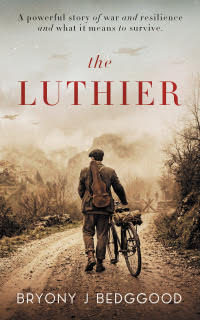
The Luthier is a stand-alone novel set largely in WWII Italy that explores resistance against oppressive regimes. At its core, the story considers what it means to survive: love and life beyond adversity.
What inspired you to tell a tale through the lens of a luthier?
Listening to the musical narrative, A Soldier’s Tale by Stravinsky. I had heard it before, but for some reason that day it set off an incredibly clear desire to explore that relationship between the soldier returning home from war and his instrument. What had he gone through? Why did he make a deal with the devil? I also wanted to have Nico’s experiences translate through the building of his own violin. I thought it would be unique and powerful if making the instrument reflected a part of his conscience.
What drew you to make the lesser-known ancient Italian region of Bagni di Lucca the setting of this novel?
I knew I wanted to set The Luthier in the era of World War II. But I also wanted to explore some lesser-known aspects, and so I began researching more out of the way places. I came upon some local history that I really wanted to delve into further. The pockets of partisan resistance were very active in this region and were met with extreme retaliation from the Germans in the form of reprisals. Many villages have monuments in recognition of these events.
Were there any unsung WWII facts, artifacts, or survivor accounts you came across in your research that gripped you and influenced your story-crafting?
Oh, definitely. I read and listened to many interviews and testimonies of survivors, including resistance fighters. I also love researching what life was like for people, what they had to live through, and their day-to-day survival. It wasn’t just the war; it was also the paranoia and brutality experienced during the longer period of Mussolini’s Fascist regime. Ordinary people chose to do extraordinary things—hiding food under their floors to avoid starvation, ferrying supplies to partisan cells hiding in the mountains, and running messages and false papers right under the noses of the Germans and the Blackshirts. Then there were the more extreme acts, like stealing weapons and sabotaging vehicles. Any act of defiance could bring about disastrous consequences.
What made you decide a dual timeline was the most compelling way to tell this story? What were the messages you hoped to highlight through the intersecting storylines of your luthier, Nico, and your Hungarian refugee, Sandor?
It was something I wanted to do from the start: have two juxtaposing experiences that were similar, but where the characters responded differently. Where Nico’s life has been eclipsed by what he’s been through, Sandor has been able to rebuild and embrace his new life. I wanted to have a connection build between these two people, a bond where Sandor’s personal history ultimately helps Nico make peace with his own.
What psychological complexities did you hope to explore as you took your characters on their journeys through adversity? How do you think readers might resonate?
Experiencing adversity isn’t owned by any one generation. We as humans go through a lot in our lifetime, but we all respond so differently to it. I feel sharing past experiences is so important to staying connected in a human way. We can help each other and the wider community by being aware of what others have been or are going through.
The Luthier is being released alongside two companion books. Can you share a bit more about these?
Yes, they’ll be available November 15. Claudia is a companion novella to The Luthier that delves into Claudia’s untold story. She’s a bit of a complex character, so I really wanted to give her more of a voice and provide more context for her narrative within The Luthier. Since it is a follow-on novella, I would recommend reading the main novel first! Food From The Luthier explores the dishes that feature in the main book and has historical and cultural articles about food in Italy during the war years. It also has original art and colour plates throughout, so I’ve been busy!
As a celebration of the companion books’ release, The Luthier eBook will be on sale for $1.99 on Amazon until November 19.
 What is the best writing advice you have to share with other writers of our genre?
I’m new, so I’m at the beginning of collecting experience to be able to impart advice! But for me, I know I am extremely passionate about history, stories from people’s pasts, and creating gripping narratives that share those with others. I think the WWII era is a powerful vehicle to explore this.
What is the last great book you read?
Oh boy, this one is hard. For non-fiction, Fey’s War by Catherine Bailey. For fiction, I just re-read All the Light We Cannot See, by Anthony Doerr, because I am in awe of his use of words.
 HNS Sponsored Author Interviews are paid for by authors or their publishers. Interviews are commissioned by HNS.